Heading to SupplySide Global? FrieslandCampina Ingredients is at Booth #3753 in Las Vegas from October 28 to 30, where it's showing its new clear whey (NutriWhey Isolate Clear PA) and a GLP-1 nutrition platform. Stop by to see what their applications team has been building, and catch us recording a podcast at the booth.
In June 2026, the Associated Press reported that whey protein isolate was about 150% more expensive than a year earlier,[1] as food and beverage brands piled into high-protein launches and fought over the same supply. PricePlow's own data verified this, digging even deeper.[2]

Casein is due for a comeback, and not for nostalgia reasons. Whey prices are at record highs. Casein is 80% of milk's protein, comes from skim milk instead of the cheese vat, and the research kept supporting it the whole time it was out of fashion.
There's no shortage of milk, though. FrieslandCampina's 2026 half-year report describes a market where global milk supply was high while demand for commodity dairy lagged. The pinch is in whey, which makes up only about 20% of milk's protein, and in the processing capacity needed to turn it into concentrate and isolate.
The other 80% is casein.
Is It Time for a Casein Comeback? It Is.
If you trained in the 2000s or early 2010s, you remember it: whey after the workout, casein before bed, and a tub of each in the cabinet. Then casein faded from supplement marketing, even though much of its best research was published after the hype died down.
So what happened? We went through the studies, the market history, and our own archives to find out. For this article, we've partnered with FrieslandCampina Ingredients, a major caseinate producer, to show where casein fits in 2026. Its Excellion® caseinate line covers everything from heat-stable ready-to-drink (RTD) shakes to soft-textured protein bars.
Here's the short version:
- Casein's decline came from marketing. Yet the research kept supporting it, especially for long gaps between meals.
- Most pre-sleep protein research used casein, and those studies keep holding up.
- Caseinates solve formula problems: heat stability in RTDs, softer bars over shelf life, and a supply chain that doesn't depend on cheese whey.
- How a caseinate is made changes how fast it digests.
Want to know when our FrieslandCampina podcast and future casein coverage go live? Sign up for news alerts below, then let's get into the full story:
Subscribe to PricePlow's Newsletter and Alerts on These Topics
What Happened to Casein?
-
The Slow-Protein Era
Casein's sports nutrition identity traces back to a 1997 study by Yves Boirie and colleagues. They fed volunteers milk proteins tagged with a stable isotope, which let them follow the amino acids from the drink into the body.[3]
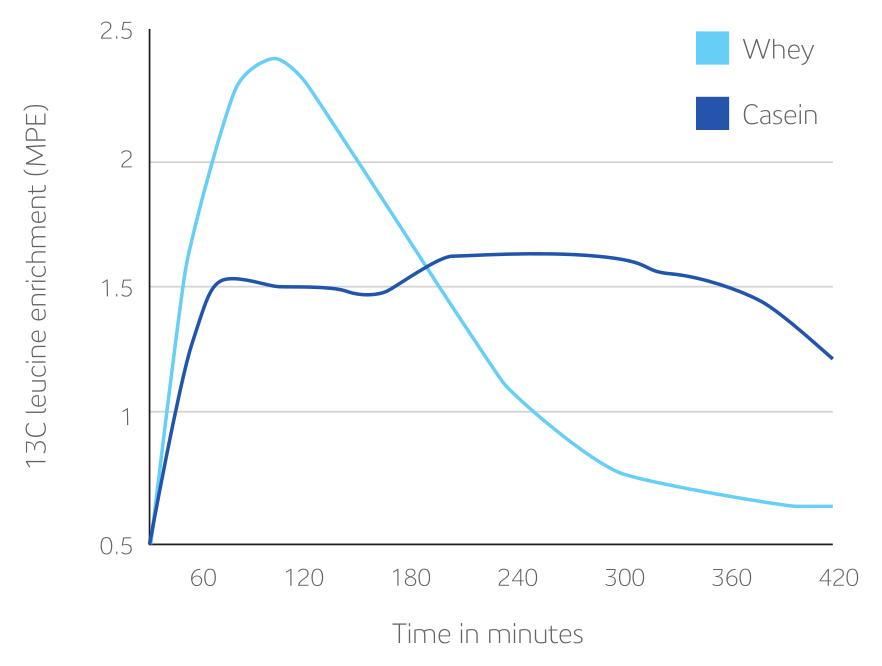
Whey produced a fast, tall spike in blood amino acids that faded quickly. Micellar casein produced a lower plateau that lasted for hours, probably because it takes longer to pass through the stomach. Casein also cut whole-body protein breakdown by 34%, which whey didn't, and left a more positive leucine balance over seven hours.[3]

Whey spikes near the 100 minute mark then falls off, while casein holds a flat plateau out past seven hours.
Note that a lot of the research above and below was on micellar casein. This will become a point later on, as we discuss other forms of caseinate.
A follow-up from the same group matched the amino acid content of fast and slow meals and changed only how quickly the protein arrived. The slow meals led to more protein retention, showing that digestion speed itself matters.[4]
That gave marketers an easy story: whey is the fast protein for after training, and casein is the slow one that keeps you "anabolic" overnight. Most major brands sold a nighttime casein, and we covered plenty of them throughout the 2010s. Only, this decade, things went a bit quiet. Why?
-
Then Came Leucine
In 2009, a study by Jason Tang and colleagues compared whey hydrolysate, soy, and micellar casein at matched essential amino acid doses. Whey produced the biggest rise in blood leucine, and muscle protein synthesis after whey was about 93% higher than after micellar casein at rest and about 122% higher after resistance exercise.[5]
A 2011 study in older men pointed the same way, with 20g of whey producing nearly double the muscle protein synthesis rate of 20g of casein.[6]
A study by Daniel West and colleagues then gave men 25g of whey either all at once or as ten small drinks spaced 20 minutes apart, mimicking a slow protein. Total amino acid exposure was identical, but the single dose produced more muscle protein synthesis both early and later in recovery.[7] The takeaway that spread through the industry was simple: "faster and spikier is better."
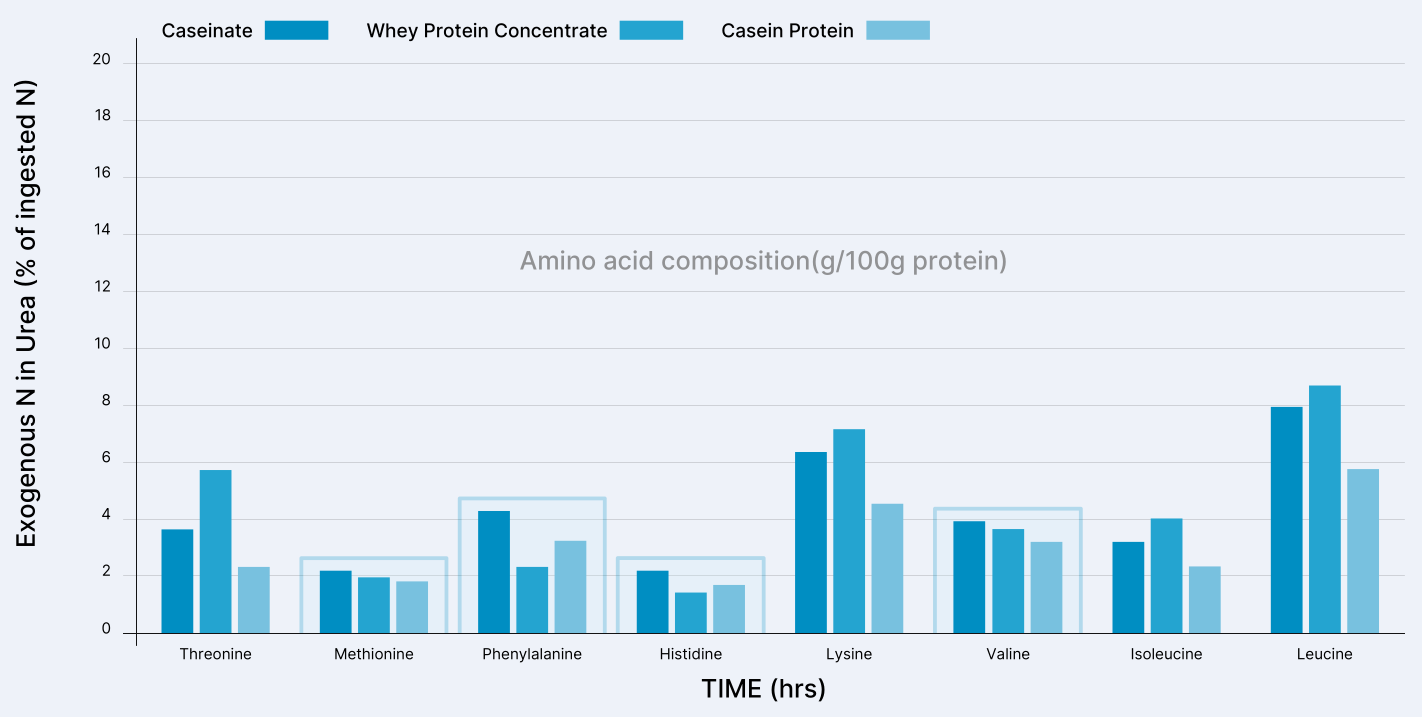
Leucine made that case stronger. Leucine is the amino acid best known for switching on muscle protein synthesis through the mTOR pathway, and casein has less of it than whey. In the labeled proteins used in one 2011 study, whey contained 11.8g of leucine per 100g of protein versus 8.8g for calcium caseinate.[8]

Caseinate tops both comparators in methionine, phenylalanine, histidine, and valine, while whey keeps its lead in leucine and lysine.
Then came a 10-week training study in recreational bodybuilders, where hydrolyzed whey isolate produced 5.0kg of lean mass gain versus 0.8kg for casein, along with bigger strength gains.[9] It was a small study (13 people), but it fit the story perfectly.
-
The Market Moved On
That research showed whey was faster and higher in leucine, which nobody disputes. But it didn't show casein was ineffective. Unfortunately, marketing follows the simplest story, and two product trends did the rest:
- RTD shakes moved toward milk protein concentrates and isolates. Those keep milk's natural ratio of roughly 80% casein, so casein never left many of these shakes. It just stopped getting top billing.
- Clear protein took off, and casein can't be clear (at least not easily). Casein precipitates in acidic conditions (that's one of the ways it's separated from whey), so acidic, see-through drinks belong to whey isolate and collagen.
We see the same drop-off in our own archives. PricePlow's casein coverage runs heavy from 2014 through 2022, mostly nighttime proteins and flavor launches. Since 2023, casein has mostly appeared as a supporting ingredient in mass gainers and multi-source blends, and we've never published a deep dive on casein itself. This article fills that gap.
Casein still has a loyal base, though. One top-selling protein brand's purchase data, shared with us privately, showed that about 80% of its collagen buyers also bought its whey, while only about 30% of its casein buyers did. Casein customers tend to stick with casein. Those who love this texture seem to have a tough time going back to thin whey drinks.
So while casein lost a marketing war it never provoked, researchers kept studying it, and most of what they've found since then is good news for casein.
Casein 101: Micelles and Caseinates

Casein makes up about 80% of the protein in cow's milk, while whey makes up the other 20%. In milk, casein exists as micelles, which are clusters of protein held together partly by calcium phosphate. Whey proteins are compact, globular proteins that stay dissolved, which makes them easy to filter into an isolate. But whey clumps and gels when heated, which limits how much of it can go into a shelf-stable, heat-treated drink.
According to FrieslandCampina, casein's looser, non-globular structure gives it much better heat stability.
There are three main ways to separate casein from whey:[10]
- Renneting, the cheese-making process, which keeps casein micelles intact and leaves whey behind
- Filtration, which also keeps micelles intact and produces micellar casein isolate
- Acidification, which lowers the pH until casein precipitates out of skim milk. Neutralizing that acid casein with sodium, potassium, or calcium hydroxide produces sodium, potassium, or calcium caseinate.
That last route is important to us in the 2026 landscape. Most whey comes out of cheese production and then needs extra plant capacity to become concentrate or isolate. Caseinates come from skim milk. FrieslandCampina's Excellion EM 9 calcium caseinate, for example, is made from fresh skimmed milk, so its supply doesn't run through the cheese vat.
The GLP-1 Market Has Flipped Whey Upside Down
Yet with whey prices at record highs, and less cheese (and pizza!) being consumed due to the GLP-1 boom, caseinate is becoming the cheaper protein to formulate with lately! Whey is experiencing a double-ended squeeze on both supply and demand, the former of which affects casein much less.
Why Casein Digests Slowly
As many of us learned during the 2000s, casein gels in the stomach. Micellar casein coagulates in response to both stomach acid and the digestive enzyme pepsin, forming a curd that empties slowly and releases amino acids over hours.[10] Interestingly, heat processing changes that curd. In rat and lab gastric-model experiments, UHT-treated milk formed fragmented, crumbly curds that broke down faster than the more cohesive curds from pasteurized milk.[11]
The difference shows up in human tracer data. A pooled analysis of 18 trials and 602 people found that over five hours, 45% of the amino acids from casein had reached the bloodstream, compared with 57% for whey and 65% for milk protein.[12] Casein simply takes longer to finish!
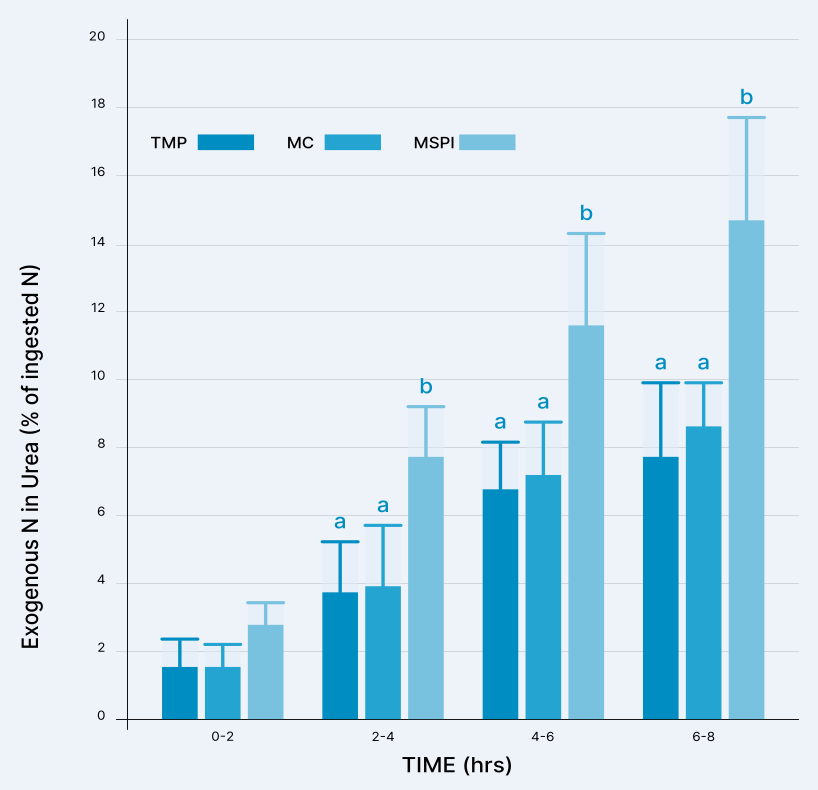
Micellar casein tracks total milk protein for eight hours while the soluble isolate burns off roughly twice as much nitrogen.
However, processing can speed casein up. Pre-digesting casein into peptides (hydrolysis) raised the rate its amino acids appeared in the blood by 27% in older men.[13]
The Science Never Left
Head to Head With Whey
As mentioned above, the leucine-era studies pitted whey against micellar casein. But calcium caseinate produced different results.
In 2011, Danish researchers gave young men whey or calcium caseinate (0.3g per kilogram of lean mass) right after heavy resistance training. Whey produced bigger spikes in insulin and branched-chain amino acids, and its effect came early: myofibrillar protein synthesis reached 0.123%/hour in the first 3.5 hours, then dropped to 0.071%/hour. Calcium caseinate held steady at about 0.10%/hour through both periods. Over the full six hours, muscle protein synthesis was equal between the two proteins.[8] The authors even noted that the type of casein may explain why their results differed from the 2009 micellar casein data.
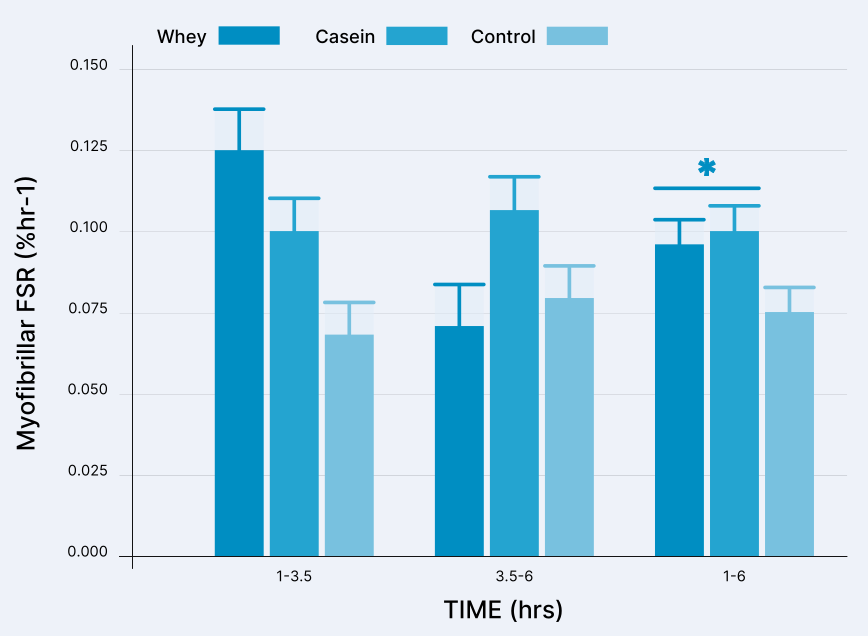
Whey leads in the first 3.5 hours, casein takes over from 3.5 to 6, and the two tie across the full window.
The same group found the same result in older adults. Caseinate and whey produced identical muscle protein synthesis (0.09%/hour) after resistance exercise, and taking caseinate before training worked as well as taking it after.[14]
Training studies also agree:
- In NCAA Division III women's basketball players, 24g of whey or casein before and after training for eight weeks produced no differences in body composition or performance.[15]
- In overweight police officers on a reduced-calorie diet with resistance training, a casein hydrolysate group lost 7.0kg of fat versus 4.2kg with whey hydrolysate, gained twice the lean mass, and increased strength 59% versus 29%.[16]
- Smaller head-to-head training trials mostly land in the same place, with one caveat: protein of either type doesn't always beat training alone.
In older men doing 12 weeks of power training, 30g/day of whey or casein produced similar results, and neither added a measurable benefit over placebo in men who already ate enough protein.[17] Two four-week studies from Florida State University in obese women doing exercise training found similar strength gains with whey, casein, or a carbohydrate control.[18][19]
Whey still wins some matchups, especially on the ones requiring speed. In a 135-day resistance training trial in older adults, a cysteine-rich whey isolate produced about 10% greater relative strength gains than casein, though lean mass didn't change in either group.[20] The fair summary is that whey is of course an excellent protein, but casein holds its own in most head-to-head training studies.
The Overnight Window
Casein's bedtime reputation started as marketing, but the research actually caught up to this, much of it from research conducted at Maastricht University in the Netherlands (notably with grant money from several food and dairy companies, including FrieslandCampina).
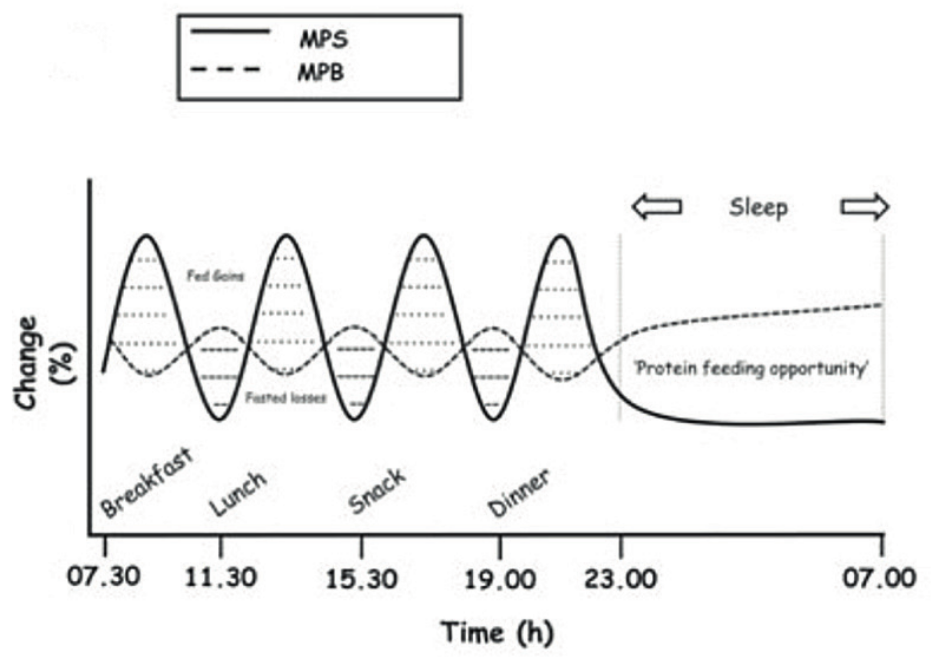
Four meals drive synthesis peaks, then breakdown climbs through the overnight gap that pre sleep protein is meant to fill.
- Delivered by feeding tube during sleep, casein was digested normally in older men and raised overnight muscle protein synthesis versus placebo (0.045% vs 0.029%/hour).[21]
- Young men who trained in the evening and drank 40g of casein 30 minutes before bed had higher whole-body protein synthesis and a positive overnight protein balance compared with placebo. Mixed muscle protein synthesis was about 22% higher, a borderline result (P=0.05).[22]
- Over 12 weeks of training, young men who drank a nightly shake with 27.5g of protein (half casein, half casein hydrolysate in the form of PeptoPro) gained more total strength than placebo (+164kg vs +130kg) and more quadriceps size (+8.4cm² vs +4.8cm²).[23]
- In older men, 40g of casein before bed raised overnight myofibrillar protein synthesis, but 20g (with or without added leucine) didn't produce a statistically significant increase.[24]
- Exercising in the evening boosted that overnight response by 31% in older men taking the same 40g dose.[25]
The group's review concluded that about 40g of protein before sleep is needed for a strong overnight response, and that prior exercise lets more of it reach muscle.[26]
Unexpected Result: Improved VO2max!
The research isn't limited to lifters. In a 10-week endurance training study, young men who drank 29g of calcium caseinate after each session and every night before bed improved VO2max more than a carbohydrate control group (from 49.9 to 55.4 vs 50.8 to 53.9mL/kg/min) and gained 1.5kg of lean mass versus 0.4kg.[27] While the lean mass gains aren't surprising, seeing VO2max improve over 10% is impressive and something most people wouldn't have considered.
You Can Use More Than 25g Protein at a Time... and Casein Helps
Then there's the 2023 Maastricht study that challenged the idea that your body can only use about 25g of protein at a time. Young adults recovering from resistance exercise who ate 100g of milk protein (about 80% casein) had a larger anabolic response lasting more than 12 hours compared with 25g, with a negligible effect on amino acid oxidation.[28] While the effect probably isn't necessarily unique to slow proteins, slow digestion certainly isn't a drawback, especially for a long gap between meals.
A Pre-Fast Protein Source
Long fasting windows keep showing up in the casein research. Among combat sport athletes fasting during Ramadan, micellar casein taken at the pre-dawn meal (sahur) limited the fasting-related drop in anaerobic power better than whey isolate or placebo.[29]
What About Satiety?
Casein's slow digestion has long been linked to staying full, and the answer depends on the time window. In a 2003 study, a 48g whey drink reduced how much people ate at a buffet 90 minutes later compared with casein, and whey raised the gut hormones CCK and GLP-1 by 60% and 65% more.[30] In the short term, whey wins.
Over longer windows, however, casein pulls ahead. In a 5.5-hour crossover study of high-protein meals built on whey, casein, or soy, participants rated casein and soy as more filling than whey (whey had a slightly higher thermic effect).[31] In a four-week trial in obese women doing exercise training, a nightly casein drink raised next-morning satiety more than whey or a carbohydrate drink.[19] A review of controlled trials summed it up: whey tends to be more satiating in the short term, and casein in the long term.[32]
For a nighttime shake, pre-fasting situation, or a meal replacement that has to carry you to the next meal, that long tail is exactly the point.
Caseinates: Processing Changes Digestion
Researchers long assumed caseinates digest faster than micellar casein, since they're more soluble and don't clot in response to pepsin the way micelles do.[10]
In 2020, the Maastricht group put that to the test. Fifteen young men drank 40g of protein as micellar casein, calcium caseinate, or a cross-linked sodium caseinate (treated with an enzyme that bonds the proteins together), and the researchers tracked blood amino acids for six hours. They expected the caseinate to digest faster than micellar casein and the cross-linking to slow it down. Interestingly, both predictions missed:
- Cross-linked sodium caseinate was the fastest, with higher blood amino acids from 15 to 90 minutes and about 13% more total amino acid exposure over six hours than calcium caseinate.
- Calcium caseinate was the slowest, with a smaller early rise than even micellar casein.
- From about three hours on, calcium caseinate produced slightly higher branched-chain amino acid levels than the cross-linked sodium caseinate.[10]
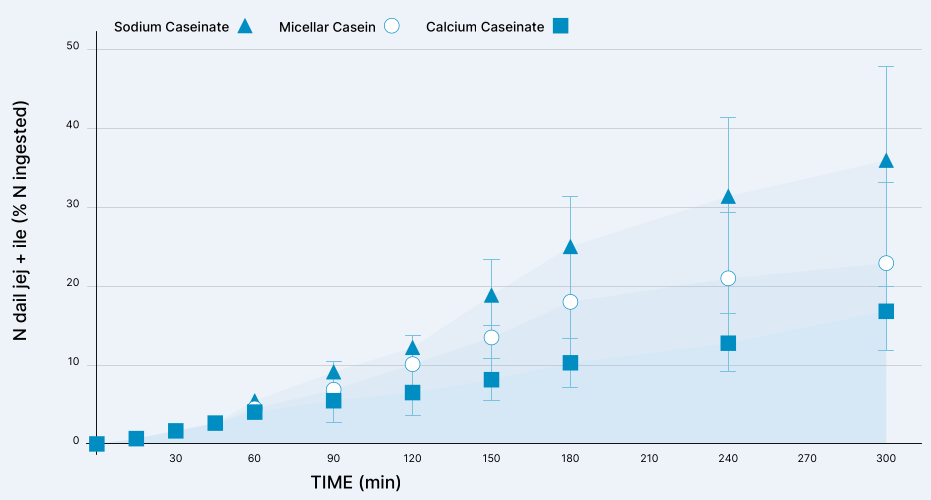
Sodium caseinate clears fastest over five hours, micellar casein sits in the middle, and calcium caseinate trails as the slowest of the three.
The Calcium Question
The researchers pointed to calcium.
Casein tends to precipitate in the presence of calcium, so calcium caseinate likely clots more in the stomach and empties more slowly. Solubility also varied widely (99% for the cross-linked sodium caseinate, 53% for calcium caseinate, and 5% for micellar casein), and the authors say more work is needed to sort out how solubility affects digestion.[10]
Casein ingredients behave differently depending on how they're made. In this study, calcium caseinate acted like a slow protein and the sodium caseinate acted like a faster one, which matches how FrieslandCampina positions them: sodium caseinate for quicker amino acid delivery, and calcium caseinate or micellar casein for extended release.
The caveat is that the sodium caseinate here was cross-linked, and the authors call for more head-to-head testing of standard caseinates. For transparency, FrieslandCampina's Innovation Centre produced the calcium caseinate and cross-linked sodium caseinate for this study.
Additional Variables: Drying and Storage
Drying is another processing variable. The Maastricht team lists drying alongside heating, added salts, cross-linking, and glycation as steps that can change how a protein behaves,[10] and FrieslandCampina makes both spray-dried caseinates (like Excellion Calcium Caseinate S) and roller-dried ones (like Excellion EM 7, a sodium caseinate).
Storage matters too. Over time, proteins can react with sugars like lactose in the first step of the Maillard reaction (glycation), which ties up the essential amino acid lysine. FrieslandCampina says the low lactose content of its Excellion caseinates keeps glycation risk low. Excellion EM 9, for example, is specified at just 0.25% lactose.
Excellion Caseinates for Formulators
FrieslandCampina is a Dutch dairy cooperative owned by its member farmers, with roots going back to 1871. Its ingredients division sells proteins and prebiotics to food, beverage, and supplement brands around the world. Because the cooperative controls its supply chain "from grass to glass", it can turn its members' milk into caseinates directly.
The Excellion caseinate line includes:
- Excellion Calcium Caseinate S: a very heat-stable, low-viscosity, neutral-tasting grade with a milky look, made for UHT RTD shakes. FrieslandCampina says it doesn't denature, aggregate, or flocculate during heat treatment and holds more than 12 months without gelling or thickening.
- Excellion Calcium Caseinate I: an easy-dispersing grade for powdered shakes, with fine foam and a milky appearance.
- Excellion Calcium Caseinate A: a free-flowing grade for fortifying foods.
- Excellion EM 9: a calcium caseinate (92% casein protein, 1.2% calcium, 0.25% lactose) used in high-protein bars to reduce stickiness and keep bars soft through shelf life.
- Excellion Textpro: a patented bar ingredient designed for bars above 35% protein that reduces hardening over shelf life.
- Excellion Sodium Caseinate S and Excellion Potassium Caseinate S: very heat-stable emulsifiers with high solubility. The potassium version suits low-sodium products (about 0.04% sodium).
- Excellion EM 7: a roller-dried sodium caseinate made from fresh skimmed milk.
In Drinks
Heat is whey's weak spot. Its globular proteins unfold and clump under the heat treatment that shelf-stable RTDs need. Calcium caseinate holds up to UHT processing while staying smooth, with low sediment and a milky appearance. Caseinates also add body and creaminess, which can reduce a formula's reliance on gums.
FrieslandCampina's concept breakfast protein drink, a sweet cinnamon RTD built on Excellion Calcium Caseinate S, shows the idea in practice.
In Bars
Protein bars also have a well-known problem: they harden as they age on the shelf. "Bricking", as we say. FrieslandCampina's applications team builds concept bars to show how its ingredients handle that. Two recent concepts:
- A Key Lime Pie bar with 20g of protein from Excellion Textpro and Nutri Whey 800F. FrieslandCampina says Excellion Textpro reduces hardening for up to 12 months and allows bars with up to 40% protein.
- A Dubai Chocolate Crispy bar at 40% protein (25g per bar) built on Excellion Textpro and NutriWhey Isolate, designed for a soft, smooth, candy-bar texture without the usual chalkiness.
Per FrieslandCampina, tender and soft textures grew from 3% to 14% of new U.S. sports bar launches.

Bars and shakes also deliver protein at the same pace. In a 2023 study supported by FrieslandCampina, 12 young women ate 20g of protein as either a bar or a drink, both made by FrieslandCampina Ingredients from Nutri Whey Isolate and Excellion Calcium Caseinate with matched ingredients. Their blood amino acid responses were identical.[33]
Better Together: Whey Plus Casein
It's not always black and white though -- it doesn't have to be one or the other! Most protein products are blends, and the research supports pairing the two.
When young men drank 25g of whey, micellar casein, or a 50/50 blend, the blend's peak and total essential amino acid response matched whey's and beat casein's.[34] Over 10 weeks of training, men taking 40g of whey plus 8g of casein daily gained about 1.9kg of lean mass, while placebo and whey-plus-amino-acid groups didn't.[35] Several popular proteins use this method, bringing the "best of both worlds".
Who Should Skip Casein?
Casein is one of the major milk proteins and can trigger reactions in people with a milk protein allergy. Milk protein allergy and lactose intolerance are different conditions. Caseinates are very low in lactose (Excellion EM 9 is specified at 0.25% lactose), which may make them suitable for many lactose-sensitive people. However, they aren't suitable for anyone with a milk protein allergy, since they still contain casein proteins.
Some people also report digestive discomfort from A1 beta-casein, one of two common beta-casein variants in cow's milk. A systematic review rated the evidence for worse digestive symptoms with A1 versus A2 beta-casein as moderate certainty, while the evidence for other health effects was low or very low.[36] Unless a product is made from A2 milk, assume its casein contains both variants.
For healthy people, high protein intakes look safe. Resistance-trained men eating about 2.5 to 3.3g of protein per kilogram of body weight per day for a year showed no harmful effects on blood lipids or on liver and kidney function.[37]
Casein Never Left the Lab
Micellar casein lost the marketing fight of the late 2000s to a simple story about speed and leucine. Those are important, of course, but they're not the entire story.
And now we know much better: The research kept going, and it keeps supporting casein's role. Calcium caseinate matched whey for muscle protein synthesis over six hours after training, casein before bed supports overnight muscle protein synthesis, and processing gives formulators control over how fast a caseinate digests.
For brands, the case is practical as well. Caseinates hold up in heat-treated drinks, help keep high-protein bars soft, and come from a supply chain that doesn't run through the cheese vat while whey prices sit at record highs. When everyone's looking for whey, but we're making less of it because fewer people are eating cheese and cheese pizza, it's time to look at the "other half" -- and by "half", we mean 80%!
FrieslandCampina's Excellion line covers both sides, from Excellion Calcium Caseinate S for RTDs to Excellion Textpro for bars. We'll dig into all of this with the FrieslandCampina team on the PricePlow Podcast, so sign up below to get the alert when it goes live:


Comments and Discussion (Powered by the PricePlow Forum)