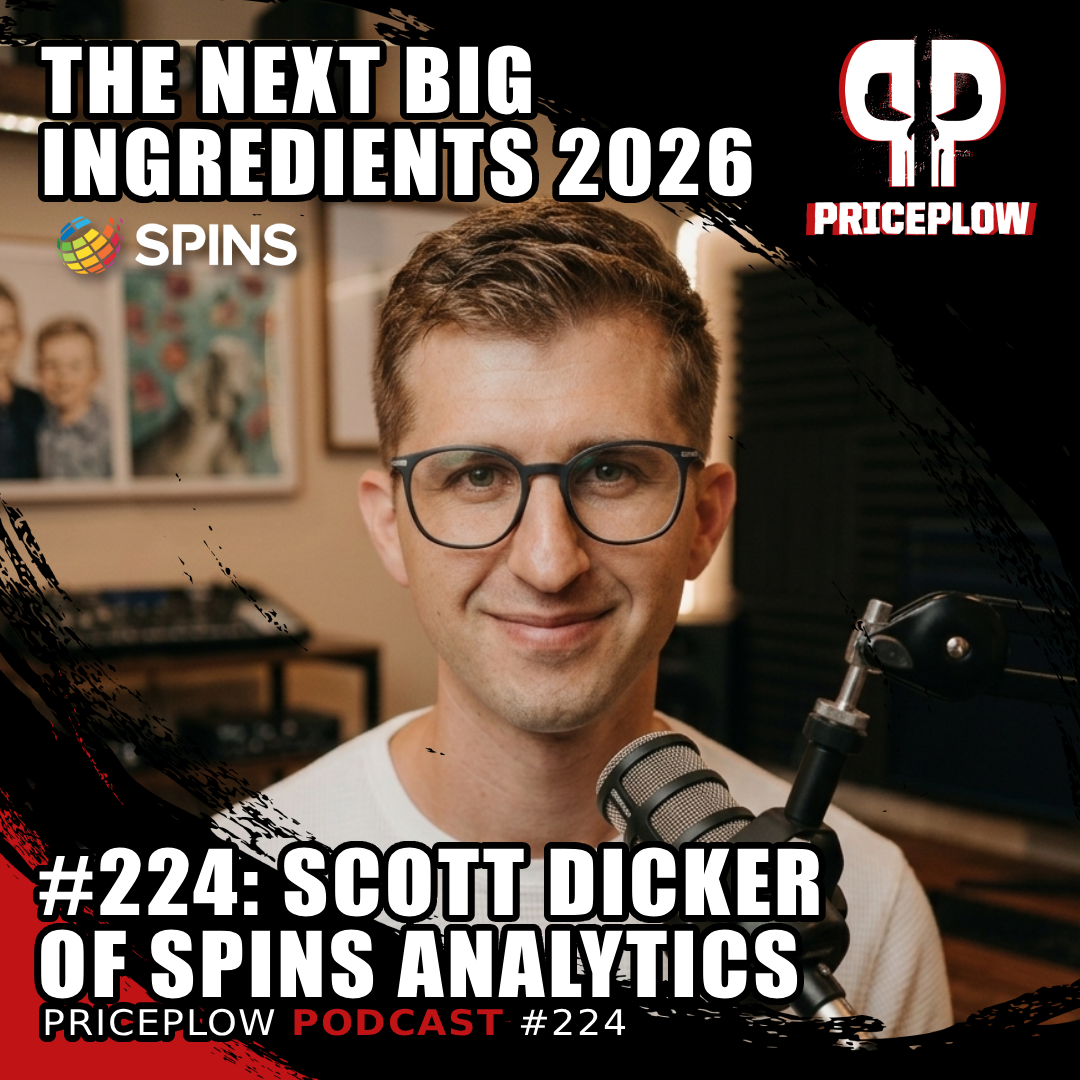
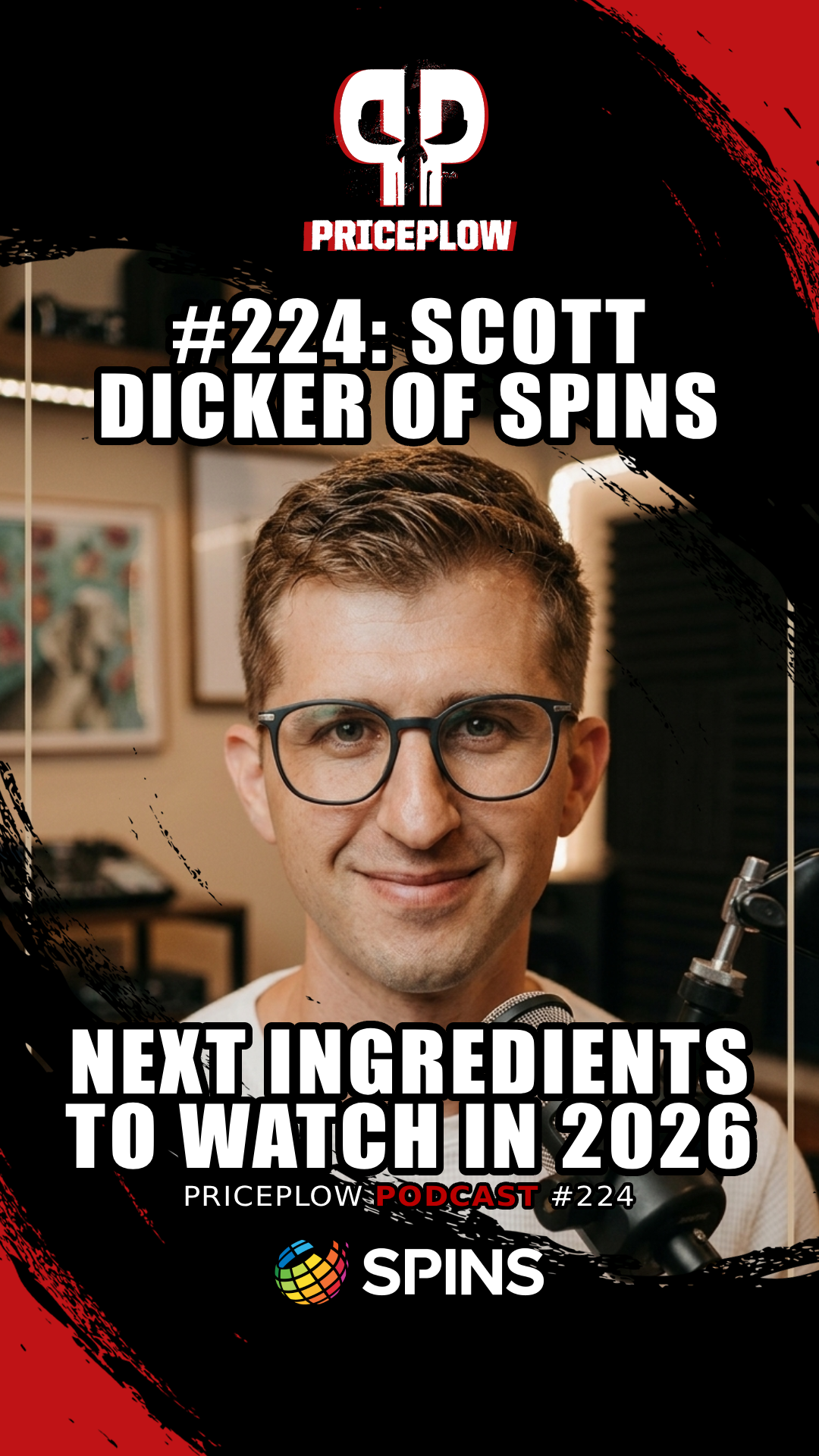
Scott Dicker, Senior Director of Market Insights at SPINS, returns to grade his 2023 supplement trend predictions and share fresh data on creatine, hydration, and GLP-1s on Episode #224 of the PricePlow Podcast.
Three years ago, Scott Dicker of SPINS joined us on Episode #082 of the PricePlow Podcast to talk creatine, collagen, and where sports nutrition was heading next. On Episode #224, Scott returns to grade his own predictions and dig into everything that's changed since February 2023.
The report card is mostly great news for Scott. Creatine's move into cognitive health and older demographics played out almost exactly as he called it, hydration supplements kept climbing even as ready-to-drink sports drinks flattened out, and Red Bull is still the top-selling energy drink despite years of Celsius, Alani, Ghost, and C4 taking share. Scott, Mike, and Ben also cover where his 2023 calls needed adjusting, from ashwagandha's staying power to pre-workout's real exposure to energy drinks.
From there, the conversation moves into new territory: the creatine gummy boom, GLP-1 ripple effects on weight management and protein, precision fermentation's push into alternative dairy proteins, and Scott's fresh picks for the next ingredients to watch.
Before diving in, subscribe to the PricePlow Podcast on your favorite platform and sign up for SPINS and supplement industry news alerts below:
Subscribe to the PricePlow Podcast on Your Favorite Service (RSS)

Apple Podcasts

Spotify

YouTube
https://blog.priceplow.com/podcast/kaitlyn-kenna-smith-223
Video: Scott Dicker of SPINS Grades His 2023 Supplement Trend Predictions

Podcast: Play in new window | Download (Duration: 1:30:50 — 83.7MB)
Detailed Show Notes: Scott Dicker Returns After 3 Years of SPINS Supplement Trend Predictions
-
0:00 - Introductions
Ben welcomes back Scott Dicker, Senior Director of Market Insights at SPINS, for his second appearance on the show following his Episode #082 visit in February 2023. Scott jokes that he can't believe three years have passed since the two last caught up on camera.
For newer listeners, Scott refreshes what SPINS does: a retail data and analytics platform covering everything from snacks and beverages to supplements and beauty. By layering product intelligence onto point-of-sale data, SPINS tracks who's winning, who's losing, and where pricing and demand are heading across the CPG landscape. Scott leads thought leadership at SPINS, and he's eager to see where his three-year-old predictions held up.
-
2:00 - Grading the Creatine Call Three Years Later
Ben gives Scott credit for something he's joked about for years: Scott's insistence that creatine was "the trend", long before it became the industry's biggest growth story. Scott admits it's the call he gets referenced for more than any other, and he's happy to take the flowers.
He also reflects on the personal side of it, joking about his 16-year-old self buying his first tub of creatine at a mall GNC, never expecting to still be talking about the same ingredient two decades later. Scott calls himself lucky that his core area of expertise turned into the ingredient driving the entire industry forward.
-
3:30 - Sports Nutrition as the Testing Ground for Mainstream Trends
Ben lays out a theory he's held for a while: sports and active nutrition function as the proving ground for ingredients that later go mainstream. Protein followed this path, and creatine is following it now.
Scott agrees, explaining that consumers assume what works for elite athletes will work for them too. He traces the same pattern across several ingredients: creatine's newer use case is cognitive health rather than muscle building, protein has shifted from bulking to muscle preservation during weight loss, hydration moved from endurance athletes to hangover relief to everyday use, and beetroot went from a vasodilator for athletes to a mainstream cardiovascular health ingredient.
-
8:00 - Hydration Shifts From Ready-to-Drink to Ready-to-Mix
Scott notes that the 2023 conversation happened right around the rise of Prime, which temporarily supercharged the hydration category. Since then, ready-to-drink hydration beverages have mostly flattened into modest single-digit growth, while ready-to-mix hydration supplements kept accelerating. Scott cites 24% year-over-year growth in that category, with unit growth over 20%, meaning the gains aren't just coming from higher prices.
Formats are also getting more creative, with brands positioning hydration alongside immunity or protein rather than as a standalone use case. Scott points to an unusual ingredient shift within hydration too: zero sugar is driving all the growth, yet higher sodium content is also performing well, flipping salt from a vilified ingredient into a sought-after functional one.
-
11:15 - Energy Drinks Continue Eating Into Pre-Workout Occasions
Scott confirms one of his 2023 calls held up: energy drinks keep taking pre-workout occasions. Using combined Natural, MULO, convenience, and Amazon channel data, he reports pre-workout powders up 3.5% while energy drinks are up around 12%.
Ben shares an anecdote from Ghost's CEO about walking into elite gyms and seeing pro bodybuilders reach for a canned energy drink over a tub of pre-workout, even knowing it likely costs them some performance. The reasons: carbonation, convenience, and no shaker bottle to clean. Scott adds that C4's original ready-to-drink launched non-carbonated before the brand found a bigger audience by leaning into the traditional carbonated format, and he calls out L-theanine as one of the category's more unexpected winning ingredients.
-
16:30 - Red Bull Still Reigns, But the Perception Game Has Changed

Scott Dicker of SPINS joins the PricePlow Podcast to talk supplement industry trends!
The conversation shifts to what an energy drink choice signals about the person drinking it. Scott jokes that showing up with a Red Bull reads as "rough night," while a Ghost or Celsius reads as health-conscious, even though Red Bull remains the top-selling energy drink brand today, exactly as Scott predicted back in 2023 despite Celsius acquiring Alani in the years since.
Scott also flags a broader, somewhat counterintuitive trend: premium products are thriving across the grocery store despite economic pressure on consumers. He compares it to trading a $7 coffee shop latte for a $4 energy drink, framing premium purchases as a justified, smaller-scale indulgence rather than a splurge.
-
19:30 - Premium Pricing Reshapes the Creatine Category
Scott previews unreleased data from SPINS' upcoming Market Watch pricing series, noting that creatine SKUs priced at least 50% above the category average, which SPINS calls "ultra-premium," are driving a disproportionate share of category growth. That's notable because creatine, unlike collagen or ashwagandha, has never had one dominant brand credited with taking it mainstream.
Instead, brands are differentiating through combination products like creatine plus HMB or creatine plus collagen, along with premium sourcing claims such as German-made creatine on the label. Scott adds a number he wants to double check before publishing: roughly 25% of the entire creatine market now comes from products launched within the past year, a sign of just how much new entry and turnover the category is seeing.
-
22:45 - Creatine Gummies Go From Novelty to Mainstream
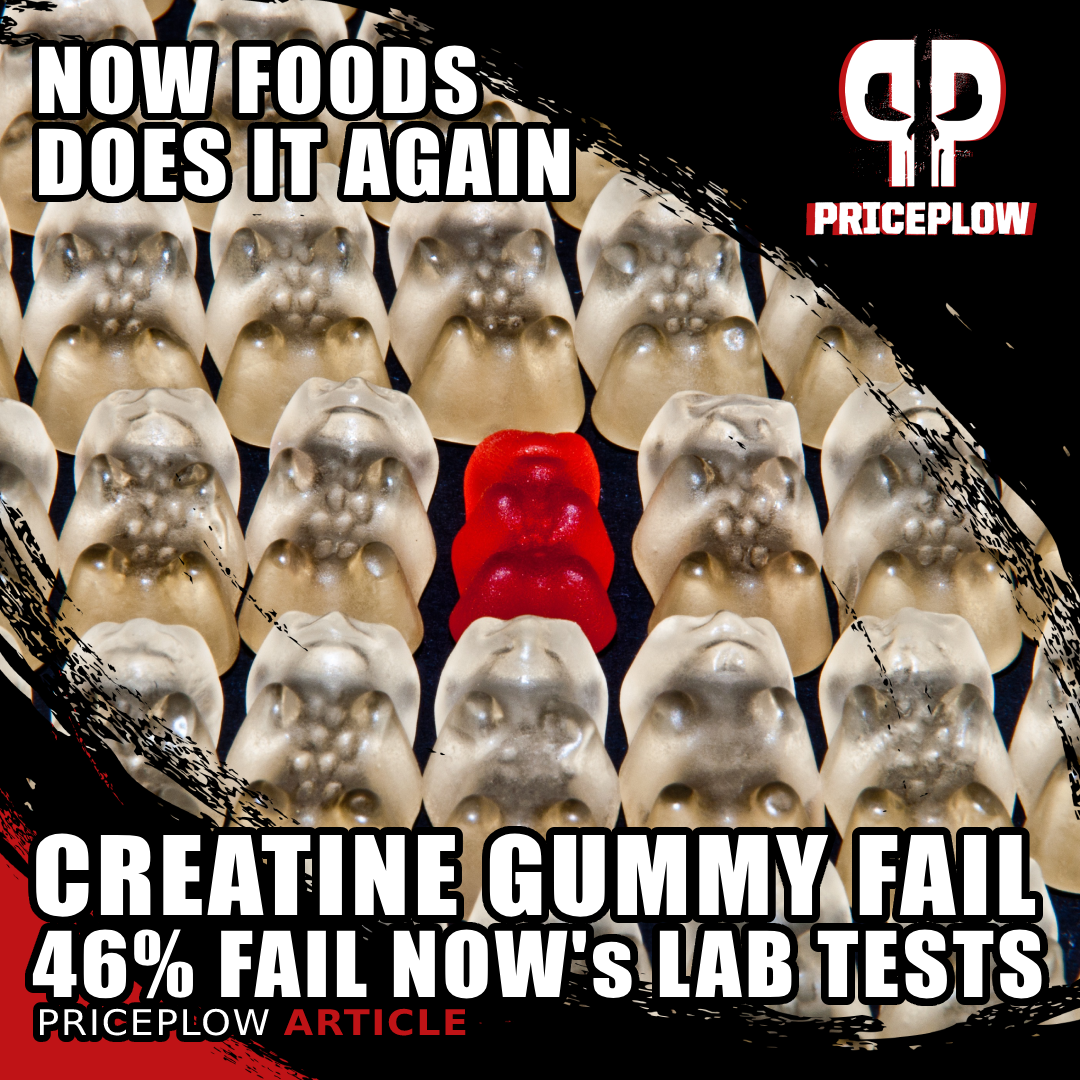
Scott says creatine gummies were nearly nonexistent in 2023, with maybe one or two brands experimenting. Three years later, they're everywhere at trade shows. Ben recounts PricePlow's own role in that shift: he and Mike helped push the original third-party testing that found many early gummies failed to deliver their labeled creatine dose, a story PricePlow first covered in Creatine Gummy FAIL: 46% of Brands Failed NOW Foods' Testing. That testing later fed into a class action lawsuit and pushed manufacturing forward industry-wide, with independent YouTubers and Instagram creators now running their own follow-up tests.
-
25:45 - Better Formats Win: Soft Chews and the Push for Stability
NOW Foods has published a new round of third-party lab testing, finding that only 46% of creatine gummies tested passed lab tests for creatine.
Ben shares a family proof point: as of a few days before recording, both of his parents started taking creatine for the first time, thanks to Vitamin Shoppe's soft chews. His parents wouldn't mix a gritty powder, but a tasty chewable they could leave on the counter finally stuck. Ben also recalls a past collaboration with Glanbia at Supply Side on a tea-based creatine drink, where the label claimed 1,500mg of creatine per serving, but the actual dose ran closer to 7,500mg to guarantee stability through the full shelf life. Mike adds that he and Ben nudged NOW Foods to publish its original test data, which he believes moved the entire gummy category forward by a year or two.
-
27:15 - Delivery Formats and the Rise of "Permissible Indulgence"
Scott frames most of this shift around one question brands need to answer: what's the delivery vehicle? Whether it's a beverage, a pill, a powder, or a cookie, consumers are increasingly choosing convenience-first formats, and Gen Z in particular has shown little patience for mixing powders at all.
That preference connects to what Scott calls "permissible indulgence," where a functional ingredient gives consumers a reason to feel good about a treat. A cookie becomes acceptable once it has added protein, and soda becomes more acceptable once it has prebiotic fiber. The indulgence itself doesn't change, but the framing does.
-
30:45 - L-Theanine and the Hunt for Stim-Free Alternatives
Mike asks Scott a pointed dosing question: should a tea-based beverage keep a modest, roughly 50mg dose of L-theanine even though most competitors already include it? Scott declines to give a one-size-fits-all recommendation, pointing to what he calls a graveyard of brands that assumed simply adding a trendy ingredient, like protein a few years back, would guarantee success on its own.
The conversation shifts to caffeine awareness. Ben suggests that typical consumers likely consume as much caffeine as industry insiders without realizing it, largely because coffee shop drinks don't disclose exact milligram counts. Scott says he tracks his own daily caffeine intake precisely because his sources, unlike coffee, list exact amounts.
-
37:30 - Kava, Caffeine Modulation, and the New Wave of Session Drinks
Scott sees early growth in non-stimulant pre-workouts and caffeine alternatives like paraxanthine, though he's clear that caffeine-free products will never fully match the real thing. The more interesting shift is younger consumers drinking less alcohol and gravitating toward other mood-altering categories, including THC beverages and calming, non-alcoholic drinks, following a pattern similar to non-alcoholic beer.

Mike recalls Bang's 2018 caffeine-free launch, which flopped despite tasting fine, simply because the market wasn't ready. Scott flags kava drinks making a comeback too, alongside a broader trend of brands modulating caffeine doses beyond the long-standing 200mg standard. Ben notes that Ghost Energy originally stood out with a lower 200mg dose, and newer entrants like BUM Energy have pushed even lower, landing at 112mg with 250mg of Cognizin citicoline.
-
42:45 - Why "Natural Flavors" on the Label Isn't Enough Anymore
Mike brings up a conversation from Episode #179 with Sensapure Flavors' Tyrus Sciarra, where Tyrus noted that some brands and consumers no longer want to see the generic term "natural flavors" at all, preferring the actual fruit or ingredient named on the label. Scott confirms the sentiment shows up in SPINS' own research.
He cites SPINS' Next Gen Consumer Study, which found that 90% of Gen Z and Millennial respondents said they actively avoid certain ingredients, with sweeteners as the top concern in candy and beverages. Scott notes a gap between stated preference and actual purchasing behavior, but says that gap still leaves an opening for brands that can close it with better-tasting, genuinely cleaner formulas.
-
48:15 - GLP-1s Reshape Weight Management and Create New Companion Categories
Weight management supplements were already declining 3% to 6% annually before GLP-1 drugs arrived, and the category has since settled into a lower base, still down around 5.5% in units. Scott points to berberine as the clearest beneficiary among natural competitor products, noting it keeps hitting new sales peaks, though he's careful not to call it "nature's Ozempic" without a caveat given how different the mechanisms are.
The bigger opportunity is in companion products supporting people already on GLP-1 medications, led by protein to help preserve muscle. SPINS' Next Gen Consumer Study found high protein is now the most common diet Gen Z and Millennials report following, and many call it medically necessary given GLP-1 use, making the habit far more likely to stick.
-
52:15 - Active Lifestyle Meets Natural and Organic: A Consumer Venn Diagram
Tyrus Sciarra, Sensapure Flavors' high-energy sales expert, breaks down flavor science, industry trends, and the natural vs. artificial debate on Episode #179 of the PricePlow Podcast, recorded at IFT First 2025.
Scott describes one of the industry's biggest shifts as "preference-based consumption," driven by consumers who track their own sleep, steps, and blood work through wearables and adjust their supplement stacks in near real time. He also cites survey data showing that shoppers at natural grocery stores are more likely to use GLP-1 medications than the general population, a counterintuitive finding given that audience's usual skepticism of pharmaceuticals.
That overlap reflects a wider convergence between active lifestyle consumers and natural and organic shoppers, two groups that once dismissed each other's approach to health. Scott adds that this holistic mindset has fueled the rise of med spas, which increasingly offer GLP-1s, other peptide therapies, and hormone support alongside more traditional wellness services.
-
59:15 - Cognizin, Health Span, and Winning the AI Search Era
Scott says health span, rather than just lifespan, now shapes how consumers approach nearly every category, and cognitive support is a clear example. He notes that interest in staying mentally sharp used to skew toward older consumers avoiding "senior moments," but has since expanded to younger consumers chasing everyday focus.
Scott closes the segment on a different kind of discovery problem: brands increasingly need to show up in AI chatbot answers, not just search engines, since more shoppers now ask AI directly for product recommendations before ever visiting a store. As Scott puts it, brands now have to sell the algorithms as well as the shoppers.
-
1:01:45 - Horseshoe Theory: How Niche Trends Find the Mainstream
Mike introduces horseshoe theory as it applies to nutrition: consumer groups that seem to sit at opposite ends of the spectrum, like strict natural-foods shoppers and more libertarian-leaning consumers, sometimes land on the exact same position, such as wanting fewer restrictions on raw milk access.
That convergence shows up on store shelves too. Mike points out that brands now sit comfortably inside Whole Foods and Sprouts that simply wouldn't have existed in those aisles a decade ago. Scott adds that The Vitamin Shoppe was ahead of this shift, having offered GLP-1 and TRT telehealth services years before mainstream retailers followed, and notes that even Lifetime Fitness now offers pharmaceutical services on-site.
-
1:04:45 - Precision Fermentation's Long Game for Alternative Proteins
Laura Katz and Pamela Besada-Lombana take us inside Helaina's Manhattan R&D facility to reveal the precision fermentation science, clinical breakthroughs, and empathy-driven culture behind effera® lactoferrin on Episode #197 of the PricePlow Podcast.
With whey protein prices climbing due to surging demand, Mike and Ben point to precision fermentation as a promising long-term pressure valve. Perfect Day gets an early mention alongside NNB Nutrition's work in the space (see Episode #192), and the conversation turns to Helaina, the company behind human-identical lactoferrin, whose growth story PricePlow covered in Episode #197.
Scott agrees precision fermentation likely arrived a few years too early, similar to early precision-fermented dairy ice cream that never took off. With whey costs rising and production scaling up, he sees a bigger opening now. Ben adds a wrinkle worth watching: as GLP-1 use reduces cheese consumption, the whey supply that comes as a cheese byproduct could tighten too, much like creatine's own origin as an industrial byproduct.
-
1:11:15 - Ice Cream and the Challenge of Refrigerated Snacking
Mike calls the ice cream aisle one of the toughest categories to compete in, with dozens of new entrants and little staying power beyond a handful of established names. Scott agrees, comparing it to the broader challenge facing fresh and refrigerated snacking, where brands have to convince retailers to dedicate scarce cold storage space to a new item. He points to Halo Top's earlier protein ice cream wave and a newer cottage cheese-based version as the latest attempt to make the format stick, though price still needs to come down.
-
1:13:30 - Are Functional Ingredients Welcome in Snacks?
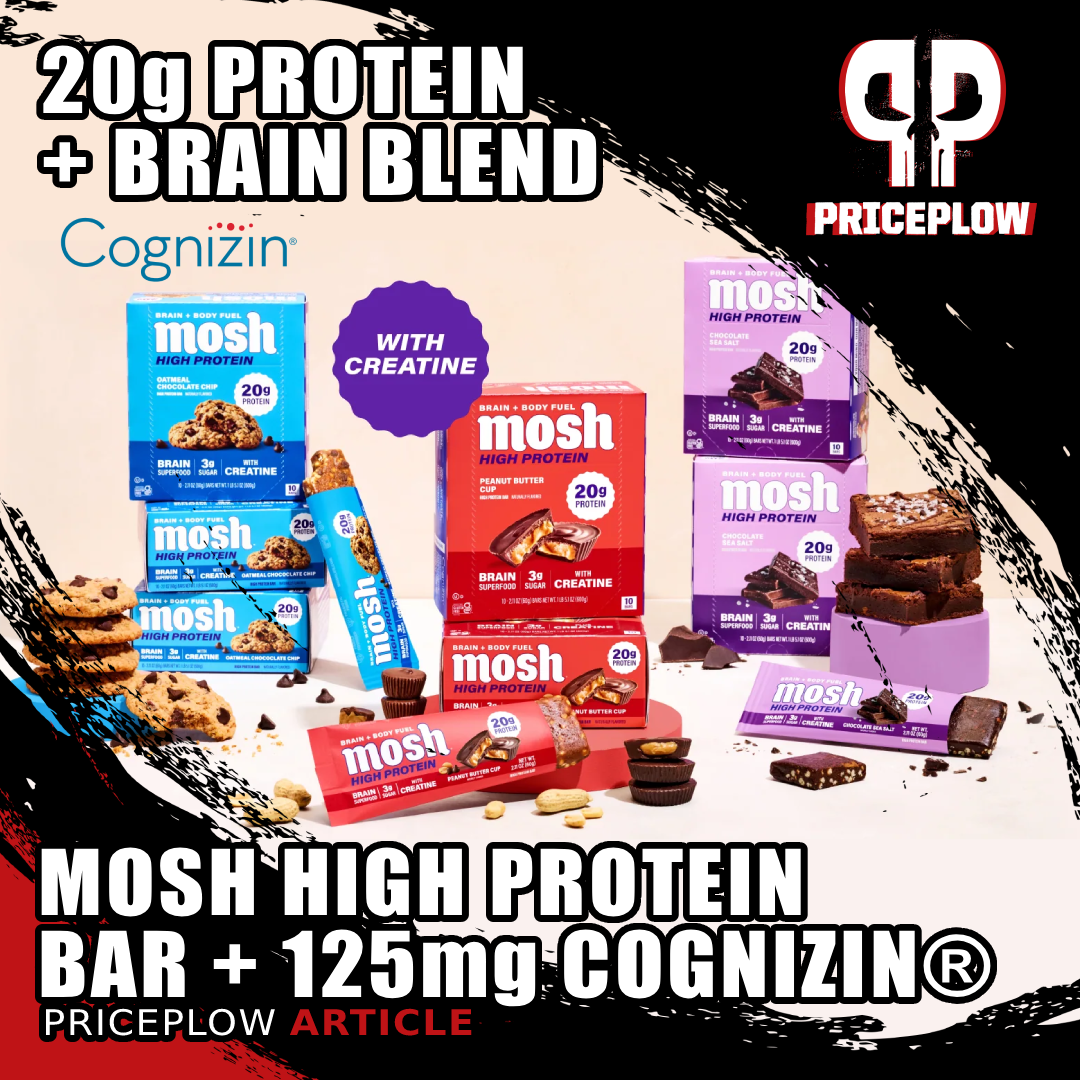
Mike mentions MOSH's new High Protein Bar launch at Target, which pairs creatine with Cognizin citicoline, then recalls a trade show conversation at a Kyowa Hakko booth (Episode #118) where Fit Butters' Ryan Bucki argued that consumers don't actually want functional ingredients in their snacks. Scott offers a nuanced take: protein and fiber already succeed as functional additions, but ingredients tied to a specific feeling, like a "relaxing" bar, need to deliver quickly. Consumers won't wait 90 days for a snack to work the way they might for a capsule.
-
1:16:00 - Is Fiber the New Protein?
Scott fields two of his most common questions back to back. First: have we hit peak protein? Not yet, he says, pointing to continued growth in protein powder alongside inherently high-protein foods like yogurt, eggs, and cottage cheese. Second: is fiber the new protein? Also no, since fiber has a practical ceiling that protein doesn't, but that doesn't mean the category has topped out.
A protein bar built for your brain as much as your muscles? MOSH High Protein is now at Target with creatine, Lion's Mane, KSM-66 ashwagandha, and 125mg Cognizin® citicoline alongside 20g protein.
Scott credits modern sodas with fiber's mainstream rebrand as prebiotics, which opened the door for fiber to become a viable beverage ingredient in categories where it rarely appeared before. The next challenge for brands, he says, is differentiating a specific fiber source the way protein brands differentiate between whey, plant, and collagen sources.
-
1:19:30 - Scott's Playbook for Spotting the Next Mainstream Ingredient
Scott's advice for spotting the next big ingredient is consistent: look for an established ingredient finding a new demographic or health focus rather than betting on something entirely novel, the same path ashwagandha, creatine, and magnesium each followed. On that basis, he points to magnesium for mood support as still having room to run, and zinc for hormone support, noting that AI tools asked about natural testosterone support tend to recommend zinc, magnesium, and vitamin D first.
He also calls out single-mushroom positioning, especially lion's mane, as more promising than generic mushroom blends, plus a "second wave" of alternative proteins and calming functional beverages as categories worth watching next.
-
1:25:15 - Why Cognizin Became the Model for Ingredient Partnerships
Ben nominates Cognizin citicoline as an ingredient that's already made the leap, crediting its success to more than good timing with the brain health trend. Kyowa Hakko backs the ingredient with enough acute and long-term data that brands can promise consumers they'll notice something, without leaning on disease-style claims to do it.
Ben also credits Kyowa Hakko's willingness to collaborate on flexible, lighter doses, pointing to BUM Energy's 250mg serving as an example of a brand using Cognizin without needing a heavy-handed dose. Scott agrees, adding that citicoline is a rare case of an ingredient already backed by a brand making real inroads with it.
-
1:27:30 - The ZMA Comeback and Mike's Mineral Preferences
Scott flags a modest but real comeback for ZMA blends, a pick he made for 2025 that's since had a solid year, driven by the same zinc and magnesium momentum discussed earlier, even if it's still a small slice of the overall mineral category. Mike shares his own team potassium and zinc picolinate preferences, along with a longstanding wariness of the high-dose vitamin B6 found in traditional ZMA formulas, joking that the mineral benefits are still worth it as long as it's not megadosed.
-
1:29:15 - Wrap-Up and Where to Find Scott and SPINS
Mike and Ben wrap up by thanking Scott for another wide-ranging conversation and pointing listeners toward SPINS for anyone in the industry who wants deeper data access. Scott says SPINS works with brands, retailers, and ingredient suppliers alike, and points listeners to his LinkedIn as the best way to connect.
Before signing off, Scott shares his upcoming trade show schedule, including IFT in Chicago, NBJ, Supply Side, and Newtopia. Mike and Ben both say they're looking forward to catching up with him at the shows, and hope it won't take another three years before Scott's back on the podcast.



Where to Follow and Learn More
Connect with Scott Dicker and SPINS
Resources Mentioned
- Episode #082: Scott Dicker - Analyzing Supplement Trends at SPINS
- Creatine Gummy FAIL: 46% of Brands Failed NOW Foods' Testing
- NOW Foods Tests and Fails 30 of 33 of Berberine Supplements from Amazon
- Episode #179: Sensapure's Tyrus Sciarra on Flavor Innovation, Sucralose vs. Natural Sweeteners, and Industry Trends
- Episode #197: Helaina's effera® Lactoferrin Growth Story with Laura Katz & Pamela Besada-Lombana
- Episode #192: NNB Nutrition's Pure, Potent, Precise Revolution with Shawn Wells & Dustin Elliott
- Episode #174: Glanbia's Strength Platform - CreaBev® and OptiATP™
Products Discussed
Huge thanks to Scott for another wide-ranging conversation, and to SPINS for continuing to share the data that keeps this industry honest. We'll be watching that Market Watch pricing series closely.
Thank you to Perfect Shaker for sponsoring this episode. Check out their incredible shaker cups at PricePlow.com/perfect-shaker, or hear the story behind them in Darren Thompson: Inside PerfectShaker in Episode #209.
Subscribe to the PricePlow Podcast on any platform, sign up for SPINS news on PricePlow, and leave us a great review on iTunes and Spotify!
Subscribe to the PricePlow Podcast on Your Favorite Service (RSS)
Apple Podcasts
Spotify
YouTube


Comments and Discussion (Powered by the PricePlow Forum)