Most avocado oil claims on packaged food don't survive lab testing. Most olive oil claims do. Guess which oil has decades of anti fraud standards behind it. New UC Davis study, 74 products, and a very ugly result for one side.
Who's ready for dozens of lawsuits?
If you've paid extra for chips, mayonnaise, or salad dressing labeled "made with avocado oil", new lab testing out of UC Davis suggests you probably didn't get what the label promised.
Researchers pulled 74 products off store shelves and online retailers, extracted the oil from each one, and checked whether its chemical fingerprint actually matched real avocado oil or olive oil. The results split sharply by oil type: avocado oil claims failed at a startling rate, while olive oil claims mostly held up.[1]
Below we discuss what the testing found, and what it means for industry insiders if your brand sources either oil. Before jumping in, subscribe for our avocado oil updates to be notified any time we cover the ingredient in the future:
Subscribe to PricePlow's Newsletter and Avocado Oil Alerts

Study Design & Methods
Researchers at UC Davis's Department of Food Science and Technology purchased 74 products across three categories:[1]
- Potato and tortilla chips
- Mayonnaise
- Salad dressings
Each of these declared a single edible oil (avocado or olive) on the ingredient label, so no blends should be expected if they're in compliance.
They extracted oil from each product (Soxhlet extraction for chips, centrifugation for mayo and dressings), then analyzed its fatty acid and sterol profile by gas chromatography. Those profiles were compared against Codex Alimentarius reference ranges, the same international compositional standards used to define authentic avocado and olive oil.
Two separate lots of each product were tested in duplicate to check for lot-to-lot consistency. A pretty good design here.
The 2026 Avocado Oil Shortfall Findings
Bad news first:
-
Avocado Oil Claims Fall Short
The numbers aren't even close. 93% of avocado-oil-labeled chips, 100% of avocado-oil-labeled salad dressings, and 71% of avocado-oil-labeled mayonnaise showed fatty acid and sterol profiles inconsistent with authentic avocado oil![1]
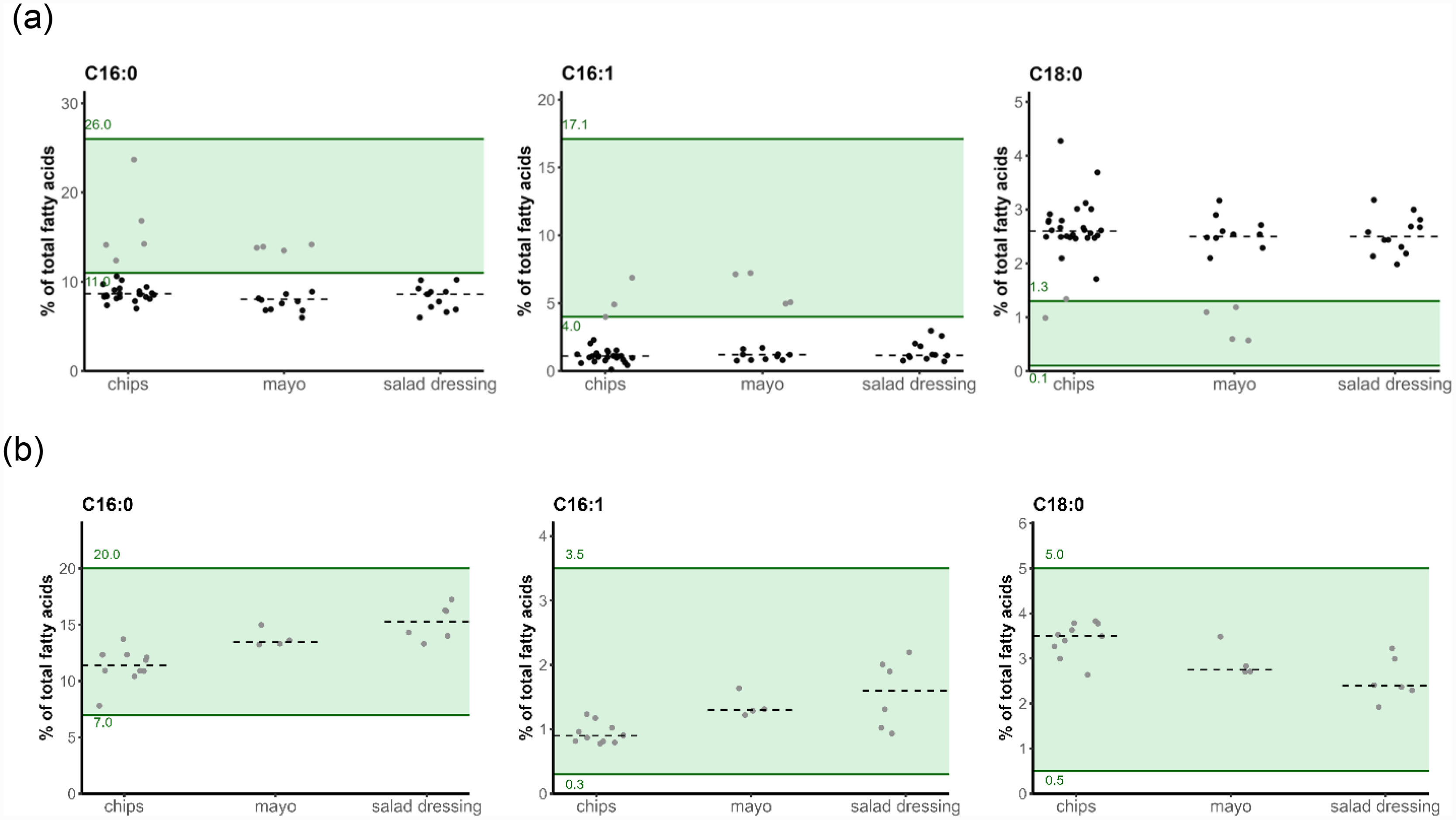
How did they know? It's the telltale pattern: low palmitic acid, palmitoleic acid, and cis-vaccenic acid, paired with elevated stearic acid, campesterol, and stigmasterol, the same chemical signature you'd expect from cheap seed oils standing in for avocado oil.

Green bands mark the Codex range for authentic oil. Nearly every avocado oil product in panel (a) lands outside it on palmitic, palmitoleic, and stearic acid, while the olive oil products in panel (b) sit comfortably inside.[1]
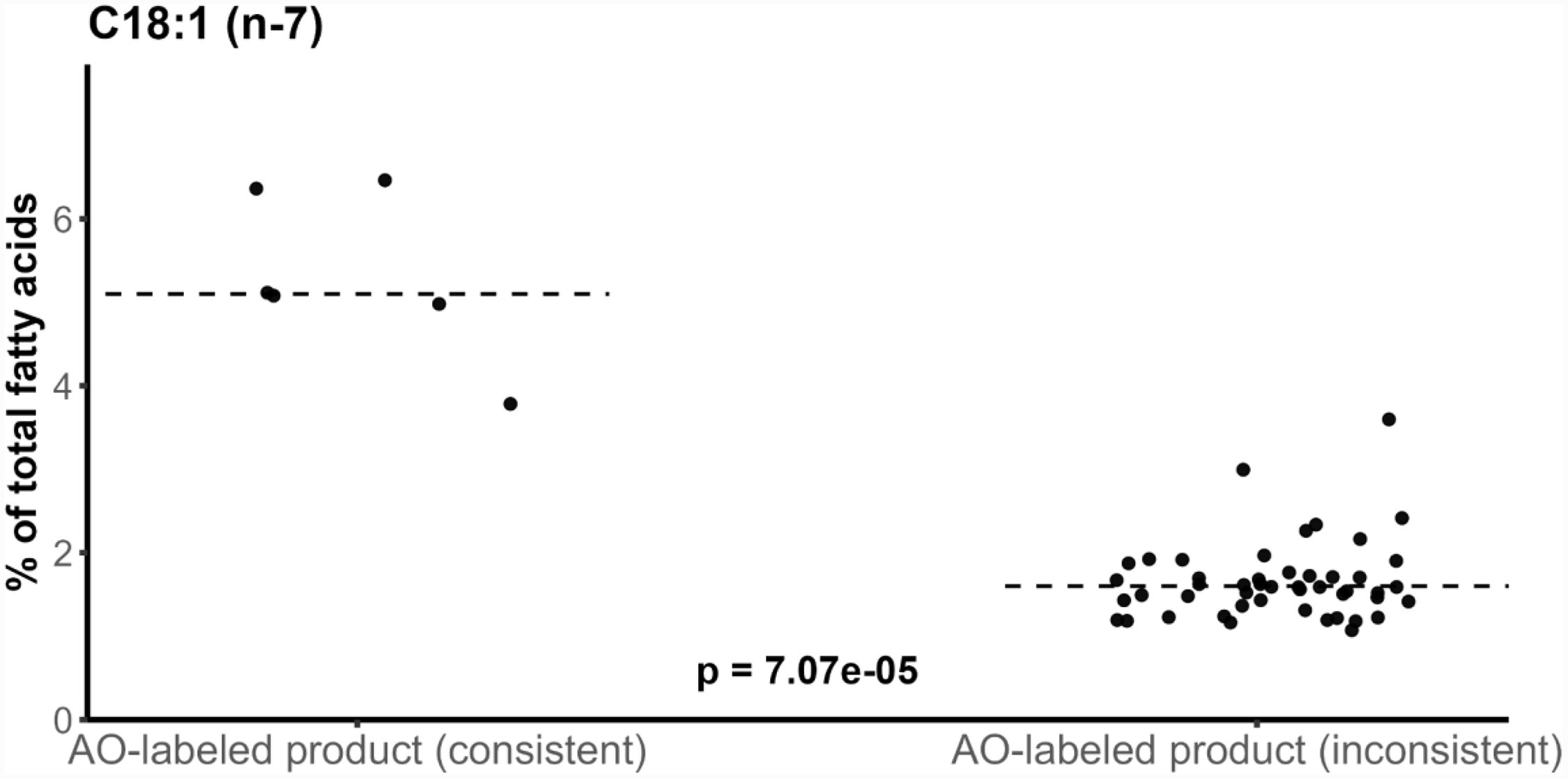
Cis-vaccenic acid turned out to be the cleanest single discriminator. Products that passed authenticity testing clustered around 4% to 6% cis-vaccenic acid, while products that failed sat at 1% to 2%, a difference the researchers found statistically significant (5.3% versus 1.7%, p < 0.001).

One marker did most of the sorting. Products that passed clustered near a 5% median for cis-vaccenic acid while the failures grouped down around 1.7%, with the gap holding at p = 7.07e-05.[1]
In fact, one sample's fatty acid profile didn't resemble avocado oil at all. It matched soybean oil almost exactly. Beyond being wholly fraudulent and completely illegal, this is a major allergen/safety risk, too.
-
Olive Oil Claims Hold Up
Olive oil told a different story.
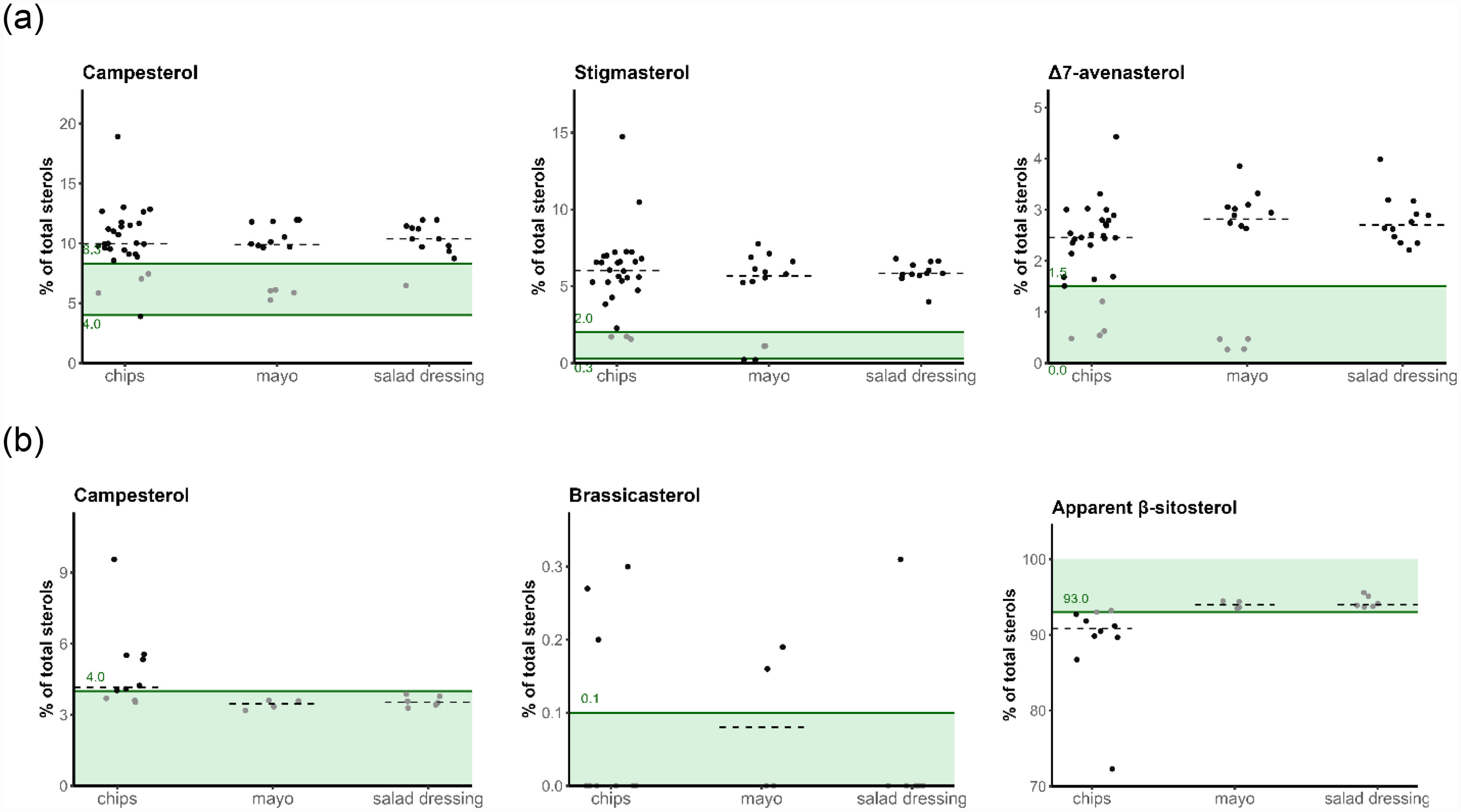
90% of olive-oil-labeled chips and 100% of olive-oil-labeled dressings and mayonnaise matched authentic olive oil's compositional profile. A few chip samples showed trace brassicasterol, a marker associated with canola oil, but not at levels consistent with meaningful substitution.[1]

The sterol data tells the same story. Avocado oil samples run high on campesterol and stigmasterol across chips, mayo, and dressings, a pattern that points toward cheaper seed oils in the mix.[1]
The researchers pointed to olive oil's decades of more mature regulatory standards and analytical scrutiny, infrastructure that avocado oil simply doesn't have yet.
-
Processing Isn't the Explanation
Before concluding these products were adulterated at the source, the researchers ruled out an obvious alternative: could frying or emulsification alone explain the deviations?
So they actually fried potato and tortilla chips in pure reference avocado and olive oil under controlled lab conditions, then made mayonnaise the same way, and re-measured the oil afterward. The changes were small, mostly under two percentage points across every fatty acid and sterol marker tested, and cis-vaccenic acid barely moved at all.[1] Whatever's causing the deviations in real products, it isn't happening in the fryer or the mixing bowl... it's happening before the oil ever reaches the production line.
What This Means for Consumers
-
Price Isn't a Reliable Signal
The two avocado oil chip products that passed authenticity testing were priced at or below the category average. Meanwhile, some of the pricier avocado oil products in the study still failed.
So if you're trying to shop your way around this problem by buying the more expensive option, this study suggests that strategy won't work. Third-party certification, like the Seed Oil Free Alliance's seal, existed but was rare, showing up on only two of the 74 products checked.
What This Means for Brands
-
The Legal Exposure Is Gonna Be Bad
This isn't the first time this exact lab has flagged this exact problem. The same senior author, food scientist Selina Wang, led a UC Davis study in 2020 that first documented widespread purity problems in bottled avocado oil sold at retail.[2] A 2023 follow-up found the same issues in private-label products.[3]
Those findings didn't just stay academic, either -- they became the evidentiary basis for class-action lawsuits filed against Target, Walmart, and Aldi over avocado oil purity in their store brands.[4] One of those cases, against Kroger, was dismissed on pleading-standard grounds rather than on the merits of the underlying testing, and several others remain pending.[5]
This new study extends the same testing approach into territory that hasn't faced this level of scrutiny before: avocado oil as a stated ingredient in packaged snacks, condiments, and dressings, rather than as the bottled product on its own.
Long story short? There's going to be a bloodbath here.
Brands making "made with avocado oil" claims on packaged foods without their own verified, lot-level testing are leaning on the same kind of supplier assurances that already failed to hold up in court for several major retailers. Wreckage is coming.

Not every brand is waiting to find out the hard way. PricePlow covered this firsthand in our conversation with Nate Frazier and Brooks Thomas of Gym Snack, whose seed-oil-free protein snack line uses olive oil as its base fat instead of avocado oil. Given what this study found about which oil claim is more likely to hold up, that sourcing decision looks like it's aged well.
-
A Sourcing and Oversight Gap
One brand in the study sold both avocado oil and olive oil potato chips. Every avocado oil chip product from that brand failed authenticity testing. Its olive oil chips did better, with one of two passing. So we can't even rely on one company with decent supply chain relationships to follow through 100%.
There's simply a massive sourcing issue with avocado oil, which doesn't yet have the depth of established standards or analytical convention that olive oil does. This puts more of the verification burden on the brand buying the oil rather than on the standards policing it.
Limitations
The study's authors note their own constraints: sampling came from California retail and online stores, which may not fully reflect national market variability, and each product was tested at a single point in time from two lots, not tracked across ongoing production. So maybe there's some conspiracy to fatten up Californians with spiked soybean oil, but we doubt it's any different anywhere else in America.
Also note that the origin and cultivar of the avocado oil used in these products also isn't disclosed on labels, so that source of natural compositional variation couldn't be factored into the authenticity criteria.
Using Avocado Oil? Get Testing and Pepper Your Angus
Olive oil earned its cleaner track record here the hard way, through decades of adulteration scandals, tightened standards, and analytical methods built specifically to catch fraud. It took time but it looks like we're mostly there with it.
Avocado oil, on the other hand, is still catching up, and this study suggests the industry hasn't caught up nearly fast enough. Until it does, "made with avocado oil" on a bag of chips or a bottle of dressing is a claim worth verifying, not assuming.
And you can definitely get ready for more lawsuits, as there's now blood in the water and the sharks have already been circling.
Subscribe below to see our future coverage as more avocado oil testing and industry response comes in.


Comments and Discussion (Powered by the PricePlow Forum)