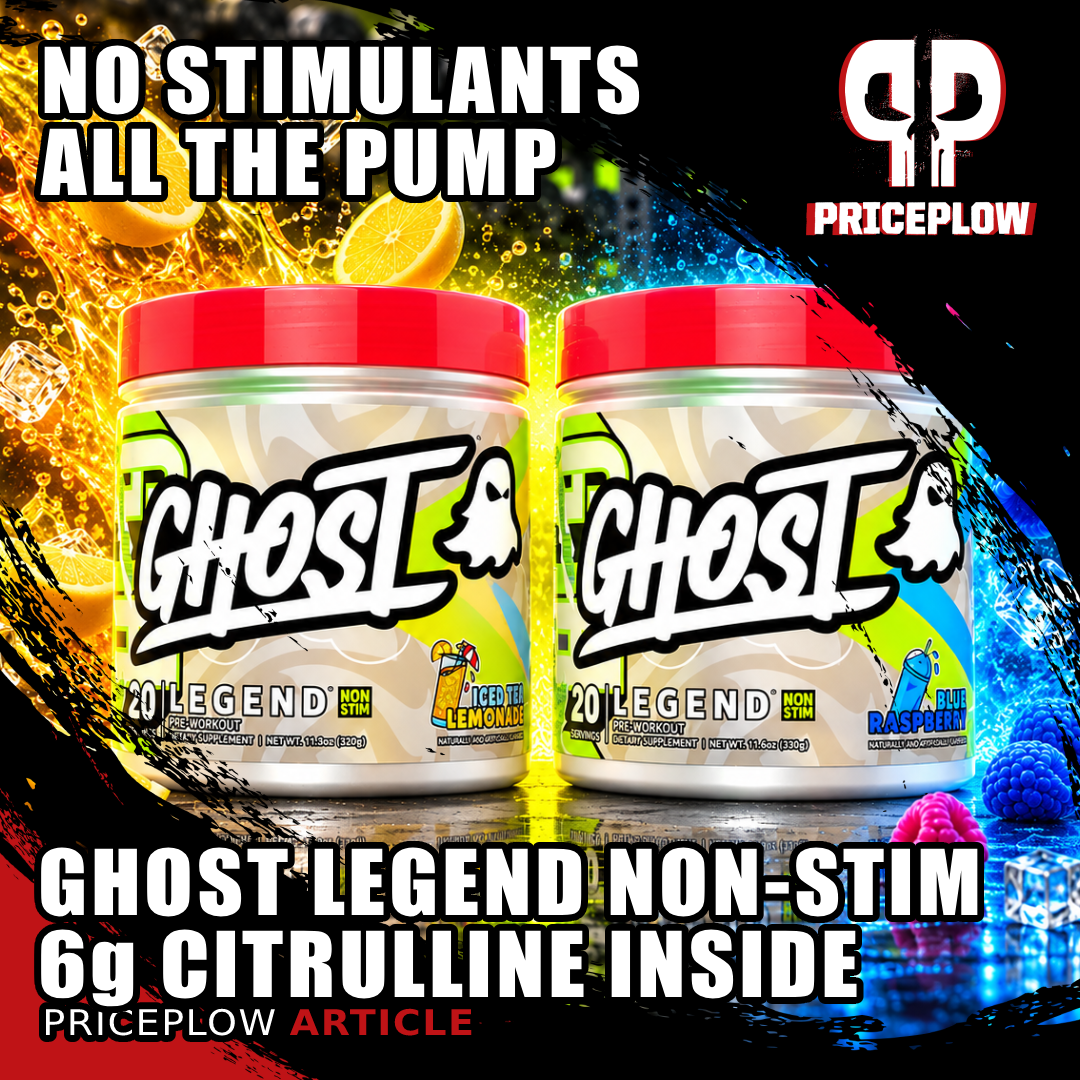
GHOST noticed half the gym already trains with a can of GHOST Energy, so they built the other half. GHOST Legend Non-Stim brings 6g L-citrulline, 3.2g beta-alanine, 2.5g betaine, and alpha-GPC with zero stims.
GHOST Legend® Non-Stim is the stimulant-free version of GHOST's flagship pre-workout, and the idea came straight from the gym floor. GHOST co-founder and CEO Dan Lourenço trains at Dragon's Lair, a hardcore gym full of advanced lifters, and as he told Mike and Ben on Episode #241 of the PricePlow Podcast, "it blows my mind how many people are walking around the gym with a can of GHOST [Energy Drink]".
He's proud of that, but he's also straight about what a can of GHOST Energy is built to do: "you're not really powering your workout, at least from a performance perspective, with an energy drink, whether it's ours or anybody else's". But rather than fight the trend, GHOST decided to make it better.
The plan is simple: take a scoop of Legend Non-Stim, then drink your GHOST Energy before or during your workout. Sip-scoop-sip.
GHOST Legend Non-Stim: The Pre-Workout to Pair With Your GHOST Energy
As Dan describes it, Legend Non-Stim carries the core ingredients of Legend, minus the stims, in a smaller scoop. Each serving delivers:
- 6g L-citrulline for blood flow and pumps
- 3.2g beta-alanine for muscular endurance
- 2.5g betaine anhydrous for strength and power
- 300mg alpha-GPC 50% (150mg alpha-GPC) for focus support
Dan even has his own gym-floor shortcut: a sip of GHOST Energy, a small dry scoop of Legend Non-Stim, then another sip to wash it down. As he put it, "Liquid, powder, liquid. That's the key." Just know that's his personal habit, not official instructions. Dan was clear that dry scooping is "not something that we recommend for people trying at home", and the label directions are to mix one scoop before training.
Sign up for alerts on our Ghost news page so you don't miss any news!
Legend Non-Stim drops on November 27, 2026 in Blue Raspberry and Iced Tea Lemonade, direct from GHOST and flowing into retail stores, in the US and Australia only. Looking for the stimulant-based original? Our main GHOST Legend article has the full breakdown, and it's getting an update soon, too.
Before diving into the ingredients, check prices and availability and sign up for PricePlow's GHOST news alerts:
GHOST Legend Non-Stim – Deals and Price Drop Alerts
Get Price Alerts
No spam, no scams.
Disclosure: PricePlow relies on pricing from stores with which we have a business relationship. We work hard to keep pricing current, but you may find a better offer.
Posts are sponsored in part by the retailers and/or brands listed on this page.
This area is reserved for Team PricePlow's upcoming videos.
Subscribe to our channel and sign up for notifications so you catch it when it goes live!

GHOST Legend Non-Stim Ingredients
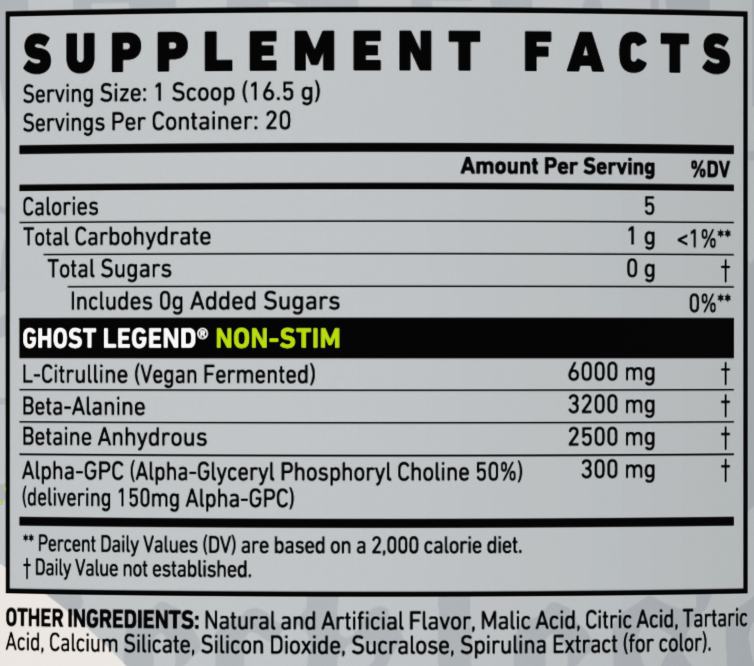
Each 16.5g (Blue Raspberry) or 16g (Iced Tea Lemonade) scoop provides the following:
-
L-Citrulline (Vegan Fermented) - 6000mg
Legend Non-Stim leads with 6 grams of L-citrulline, the same amount found in Legend V4, here from a vegan, fermented source. Your kidneys convert citrulline into L-arginine, which your body then uses to produce nitric oxide (NO), the signaling molecule that relaxes blood vessels and increases blood flow to working muscle. Citrulline does this job better than arginine itself. In a crossover study of 20 volunteers, oral citrulline raised plasma arginine more effectively than oral arginine did, along with markers of NO production.[1]
Note that most resistance-training studies used 8g of 2:1 citrulline malate, which is only about two-thirds citrulline by weight, so those servings supplied roughly 5.3g of citrulline.[2] Legend Non-Stim's 6g of pure L-citrulline goes beyond that.
A meta-analysis of eight double-blind studies found that 6g to 8g of citrulline malate taken 40 to 60 minutes before training increased repetitions to failure by about 6.4% compared to placebo.[3] In a 6-week trial using free-form citrulline, 8g per day improved upper-body repetitions to failure in resistance-trained men and raised NO metabolites.[4] And in a dose-matched study, 6g per day for seven days extended tolerance to severe-intensity cycling from 589 to 661 seconds, while the same dose of arginine didn't.[5]
A separate meta-analysis of 13 trials found that citrulline lowered post-exercise perceived exertion and muscle soreness at 24 hours.[6] Pooled across 12 studies, its benefit for high-intensity strength and power is small but statistically significant.[7]

With a full 6g of pure citrulline and no stimulants to compete with, this is the pump engine of the formula. The result? Pumps without a single stimulant!
-
Beta-Alanine - 3200mg
Beta-alanine is the building block that limits how much carnosine your muscles can make. Carnosine is concentrated in fast-twitch muscle fibers, where it buffers the acid (hydrogen ions) that builds up during hard, high-rep efforts, helping delay fatigue.[8]
Legend Non-Stim's 3.2g is a research-matched dose. In foundational work, 3.2g per day raised muscle carnosine by 42.1% in four weeks, and doubling it to 6.4g pushed that to 64.2%.[9] A meta-analysis of 40 studies and 1,461 participants found a significant performance benefit, strongest for efforts lasting 30 seconds to 10 minutes.[10] In the weight room, four weeks at 6.4g per day (twice this dose) increased training volume by 6.5% and lowered perceived effort in resistance-trained men.[11]
Beta-alanine works by loading, so consistency counts: the International Society of Sports Nutrition's position stand describes at least two to four weeks of daily supplementation to improve performance.[12] The familiar tingle (paresthesia) is the only consistently reported side effect, and a risk assessment covering 101 studies found no evidence that it's harmful.[13]
As Dan mentioned in the podcast, this is the ingredient that makes a pre-workout feel like one, and with no stims in the mix, beta-alanine gets the spotlight here.
-
Betaine Anhydrous - 2500mg
Betaine, also known as trimethylglycine (TMG), is found in foods like beets, spinach, and wheat, and it does two jobs in the body. It's an osmolyte that helps cells hold water and protects proteins under stress, and it's a methyl donor that helps convert homocysteine into methionine.[14]

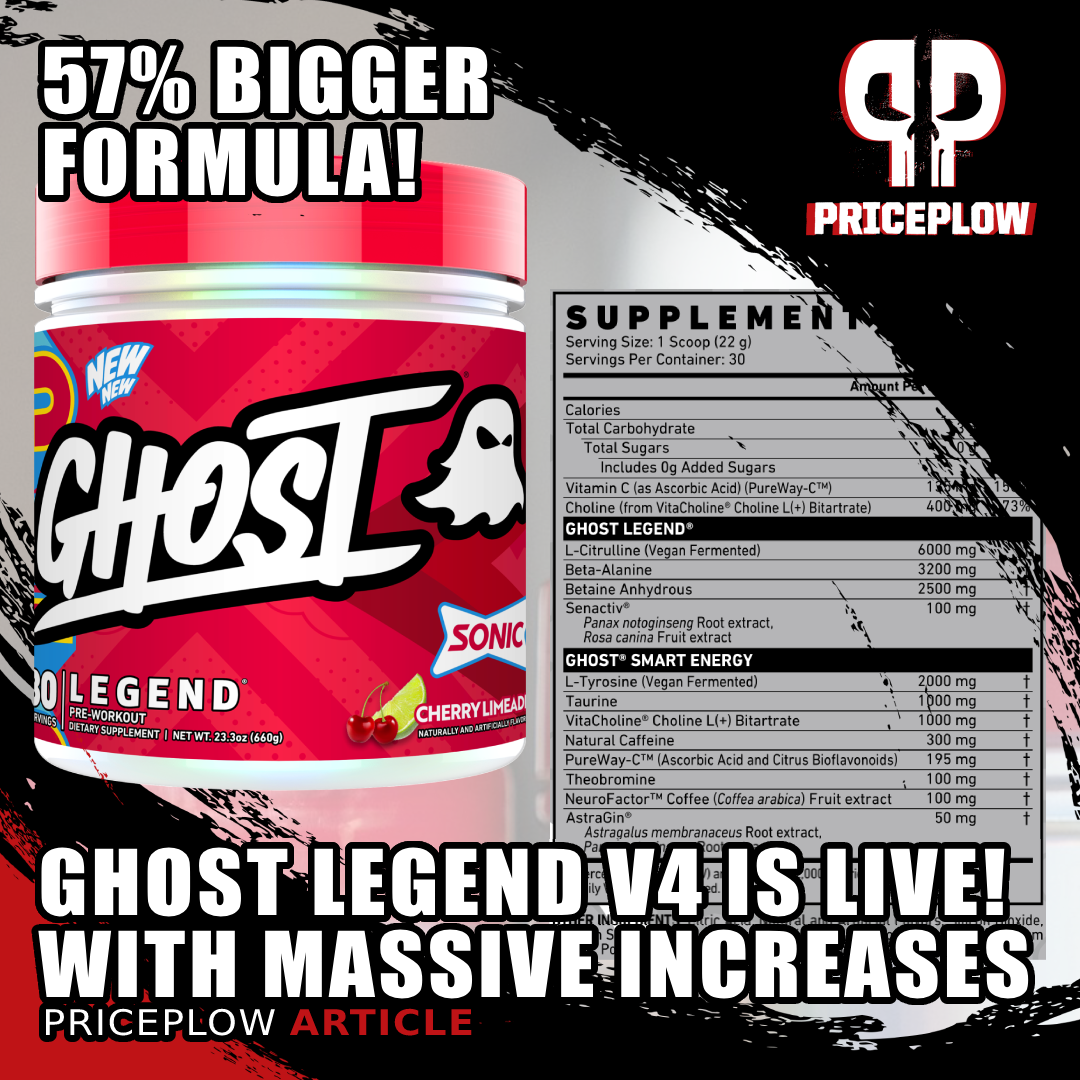
Ghost Legend V4 is now out, with a 57% bigger tub! This article covers the major changes, including a bump to 300mg caffeine, more citrulline, and the additions of betaine, taurine, and tyrosine!
At 2.5g, Legend Non-Stim matches the most-studied daily dose in betaine's performance research. A 2024 meta-analysis of 17 studies found that taking betaine for at least seven days significantly improved maximal strength, with the clearest gains in lower-body strength.[15] Individual 2.5g trials fill in the details. About two weeks of betaine increased vertical jump power, isometric squat and bench press force, and bench press throw power in resistance-trained men,[16] and one week raised cycling sprint power by about 5.5% in active men and women.[17]
Over a longer stretch, six weeks of 2.5g per day alongside training increased lean mass and decreased fat mass in experienced lifters, who also handled more bench press volume in parts of the program.[18] Between betaine for strength and beta-alanine for endurance, Legend Non-Stim covers a lot more than pumps.
-
Alpha-GPC (Alpha-Glyceryl Phosphoryl Choline 50%) - 300mg
Alpha-GPC is one of the most bioavailable choline sources, at roughly 40% choline by weight. After absorption, its choline reaches the brain and becomes raw material for acetylcholine, the neurotransmitter involved in attention and in the signal from nerve to muscle.[19] Note that this is 300mg of a 50% alpha-GPC, which delivers 150mg of actual alpha-GPC.
Research in healthy, active adults is still emerging, but it's encouraging. In a 7-day trial of 48 college-aged men, 250mg per day produced the greatest improvements in countermovement jump velocity and power among four groups that also included 500mg of alpha-GPC, 200mg of caffeine, and placebo.[20] For focus, a single 315mg (yield) dose improved Stroop cognitive test scores versus placebo in resistance-trained men.[21]

On its own, the 150mg here sits below those study doses. Pair it with the GHOST Energy can it was built for, though, and the can's label adds another 150mg of the same 50% alpha-GPC. That's roughly 225mg of actual alpha-GPC between the two, just under the 250mg dose that won the jump tests above, and exactly the kind of stacking logic we like to see.
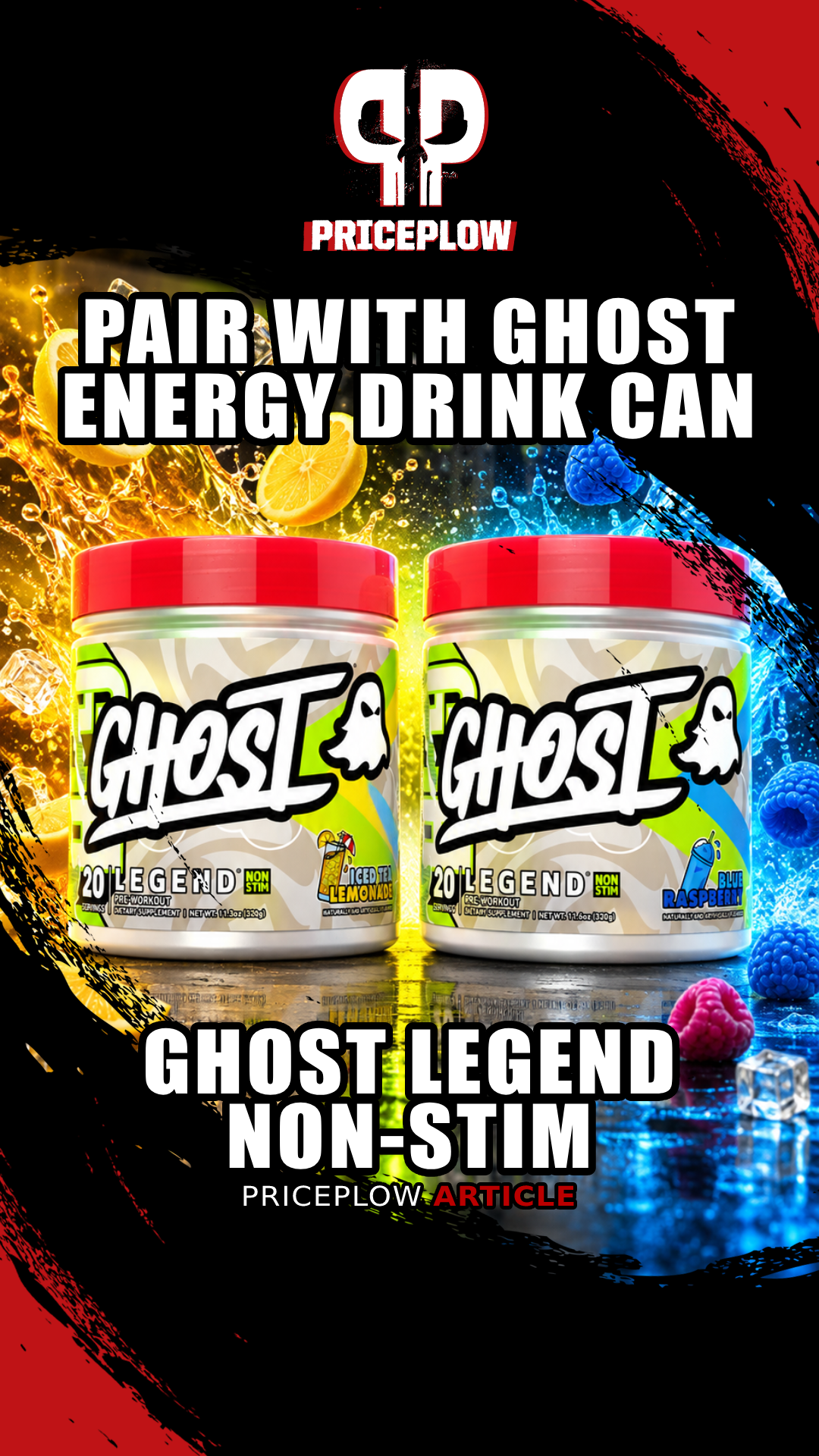
Flavors Available
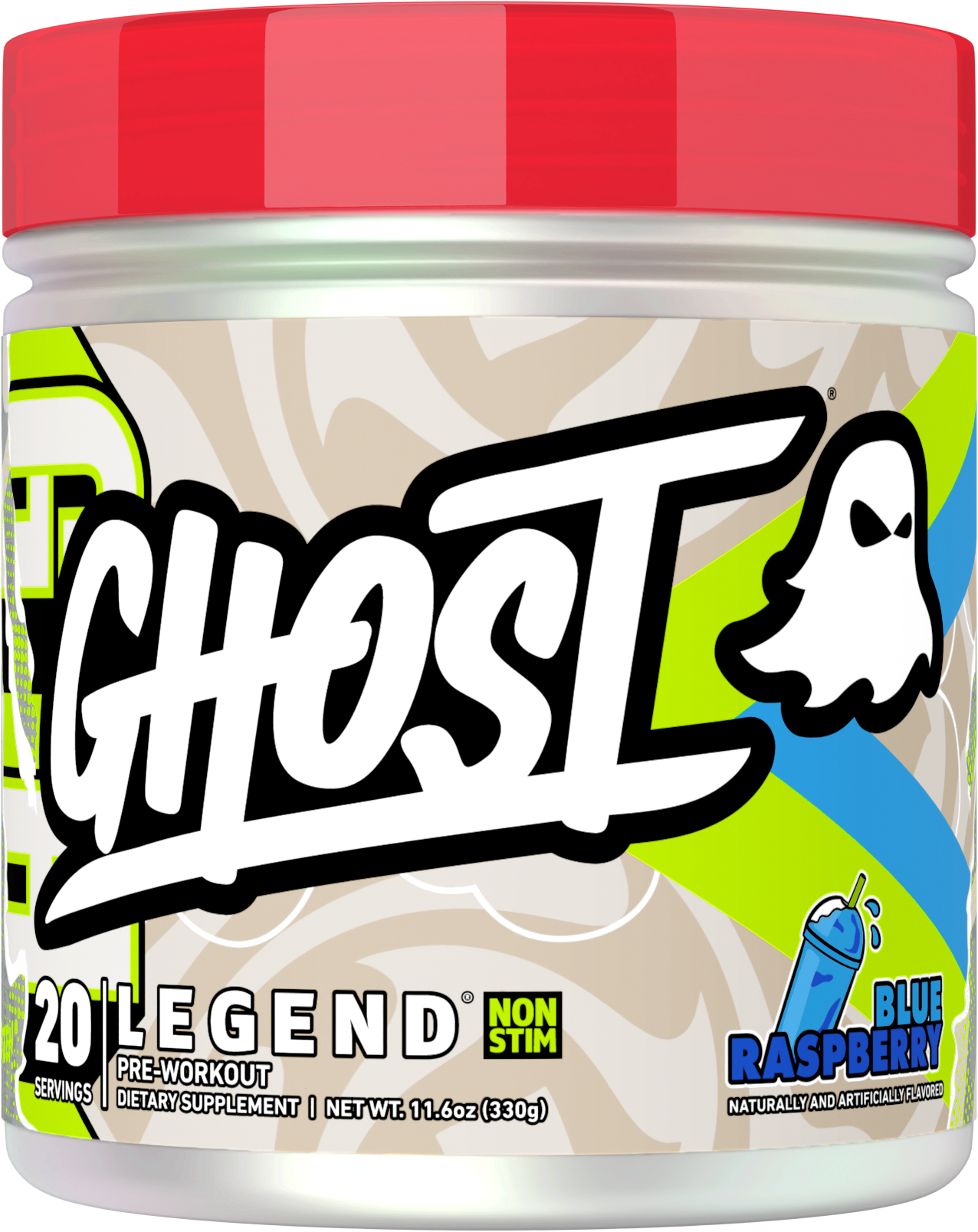
Legend Non-Stim launches in Blue Raspberry and Iced Tea Lemonade, both sweetened with sucralose and coming in at 5 calories and zero sugar per scoop. Blue Raspberry gets its color from spirulina extract and Iced Tea Lemonade from fruit juice powder, and both labels carry vegan-friendly, gluten-free, and soy-free callouts.
Here's an up-to-date list of all flavors of GHOST Legend Non-Stim:
How to Use
- When to take it: Mix one scoop and drink it before exercise on training days, per the label.
- With GHOST Energy: Drink your can before or during the workout, whichever you prefer. Legend Non-Stim has no stimulants, so the can's 200mg of natural caffeine is the only caffeine in the stack.
Stacks Well With
- GHOST Energy: The can Legend Non-Stim was built around, with 200mg of natural caffeine plus alpha-GPC of its own to round out the scoop.
- GHOST Creatine: Legend Non-Stim doesn't include creatine, and GHOST's OptiCreatine™ creatine monohydrate fills that gap.
Who It's For
- Lifters who already train with an energy drink: If a GHOST Energy is already in your gym bag, Legend Non-Stim adds the pump, endurance, and strength ingredients the can doesn't carry, without doubling up on caffeine.
- Anyone training without stimulants: Night owls, caffeine-sensitive lifters, and anyone on a stim break get research-backed doses of citrulline, beta-alanine, and betaine with no stimulants at all.
Conclusion: Your Pre-Workout, Your GHOST Energy, Your Call
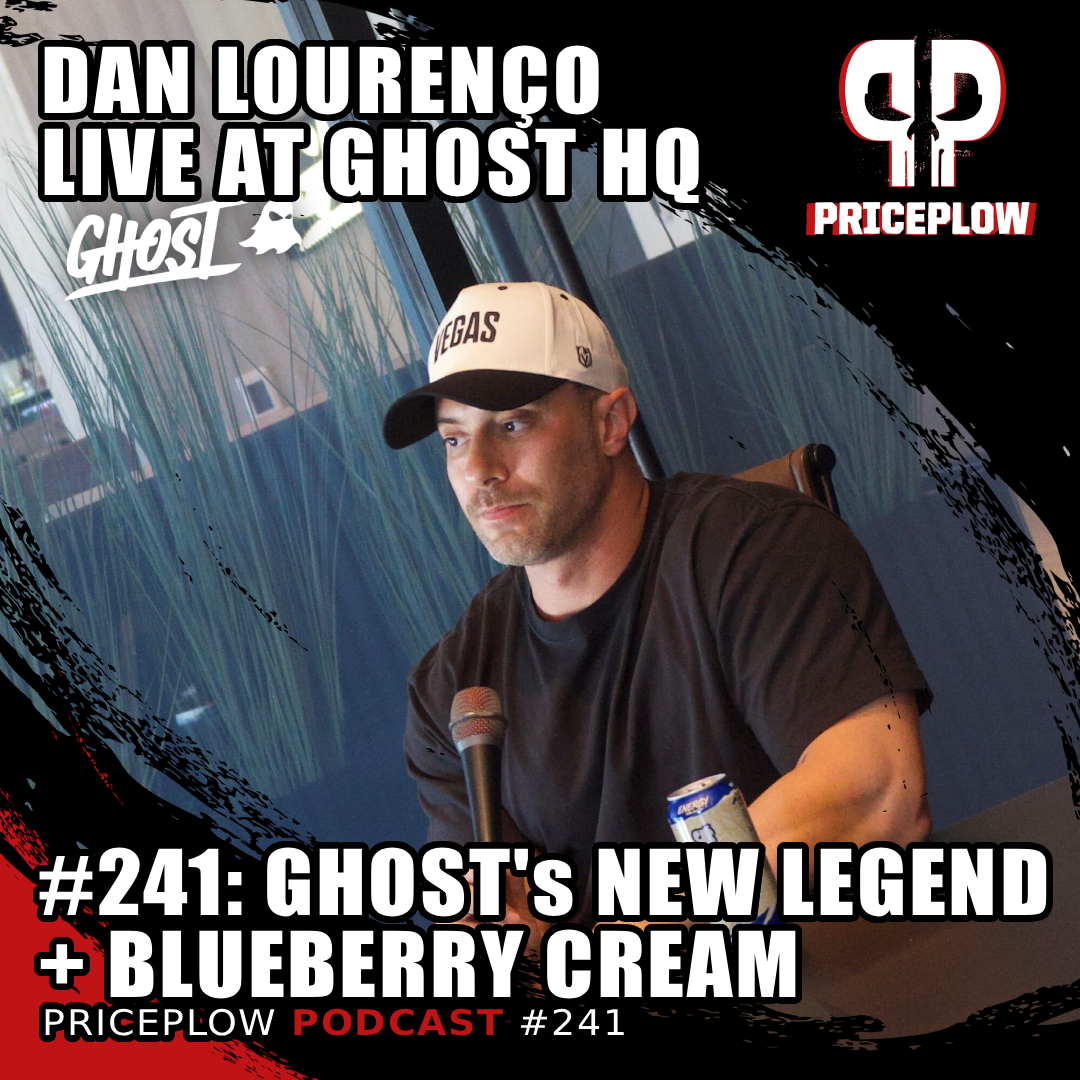
GHOST co-founder and CEO Dan Lourenço hosts what he calls the first official Blueberry Cream flavor review at GHOST HQ, then previews the three-product Legend lineup, protein bar improvements, and the Yoo-hoo launch story on Episode #241 of the PricePlow Podcast.
GHOST Legend Non-Stim takes a habit GHOST fans already have and gives it a real pre-workout foundation. Instead of telling lifters to put down their cans, GHOST built the other half: the same 6g of L-citrulline, 3.2g of beta-alanine, and 2.5g of betaine found in Legend V4, plus 150mg of alpha-GPC, with zero stimulants and a smaller scoop. As Dan put it, "sometimes the best innovation is inches, not miles", and we like this inch a lot!
Hear Dan tell the whole story, gym-floor shortcut included, on Episode #241 of the PricePlow Podcast, and watch for the update to our main GHOST Legend article coming soon.
Legend Non-Stim drops November 27, 2026 in Blue Raspberry and Iced Tea Lemonade, in the US and Australia. Check prices and availability below -- it's not the only GHOST news headed your way for Black Friday and Cyber Monday, either, so sign up for GHOST news alerts to catch the rest first:
GHOST Legend Non-Stim – Deals and Price Drop Alerts
Get Price Alerts
No spam, no scams.
Disclosure: PricePlow relies on pricing from stores with which we have a business relationship. We work hard to keep pricing current, but you may find a better offer.
Posts are sponsored in part by the retailers and/or brands listed on this page.
Comments and Discussion (Powered by the PricePlow Forum)