Ralf Jaeger said it on our podcast three years ago. The human body is lazy. So when the body spends its own ATP turning leucine into dileucine, without a supplement label involved, that's worth a closer look. The case for DL185 is in the cost.
On Episode #078 of the PricePlow Podcast, Ralf Jaeger dropped a line that's quietly shaped how we think about peptide ingredients ever since: "the human body is lazy".
But not in a bad way. Instead, it's in the specific, useful way that a species doesn't survive countless years and generations spending energy on processes that don't pay for themselves. If the body goes out of its way to build something, keep something around, or run an extra chemical step it didn't strictly need, that's usually a clue that something important is happening.
That clue applies directly to NNB Nutrition's DL185® (dileucine). The easy way to describe it is "two leucine molecules bonded together for faster absorption". While that's technically accurate, it actually undersells the more interesting fact sitting underneath it: your body already knows how to make this molecule, in small amounts, with no supplement label involved.
The real question isn't whether dileucine works. It's why a body built to conserve energy would bother spending time and energy making it at all. Clearly, it's important.
This article dives into that question. It's one that's not fully understood, but it's something we've been kicking around since that incredible episode with Ralf three years ago. Before getting into it, sign up for our NNB Nutrition news so that you don't miss new research as it comes:
Subscribe to PricePlow's Newsletter and Alerts on These Topics

Not Just Another Form of Leucine
Leucine earned its reputation as the amino acid most responsible for triggering muscle protein synthesis (MPS) through the mTOR pathway, and it's anchored BCAA and EAA products for two decades.[1] It's also, by itself, a less dependable tool than its reputation suggests. A 2014 critical review concluded that leucine alone doesn't hold up as a standalone treatment for muscle wasting, despite plenty of short-term studies showing it spikes protein synthesis acutely.[2] The signal is there... it just doesn't reliably turn into the outcome people actually want.
Dileucine often initially gets filed under the "better leucine delivery" category by newcomers, and it's true that this dipeptide bond of two leucine molecules absorbs faster than the free amino acid on its own. But that description centers on the wrong fact.
The body also converts some of its own dietary leucine into dileucine, with no supplementation involved whatsoever, through a step it didn't strictly need to run. Once that's on the table, dileucine stops looking like a cool delivery mechanism for leucine, and starts looking like something more. The body converts leucine into because it wants the molecule in that specific form, whether it shows up in a capsule, a protein blend, or a clear protein beverage.
The Peptide Your Body Already Makes
Free amino acids aren't the only thing that shows up in the bloodstream after a meal. When researchers compared hydrolyzed whey and soy protein to their intact counterparts, the hydrolysates produced measurably higher circulating levels of leucine-containing dipeptides like Val-Leu and Ile-Leu, alongside faster amino acid absorption overall.[3] Dipeptides moving through the gut fully intact isn't new science either. Work going back to the early 1970s showed the intestine absorbs certain dipeptides faster than the free amino acids that make them up, using transport machinery separate from standard amino acid transporters.[4] None of this is exotic. It's how digestion already works.
NNB's own research pushes the idea further, though it's still early and unpublished. According to Shawn Wells, NNB's Chief Science Officer, internal analysis has detected dileucine circulating in blood even in subjects given nothing but free leucine, not dileucine itself. If that holds up under further scrutiny, it points to the body running its own leucine-to-dileucine conversion on demand, independent of diet.
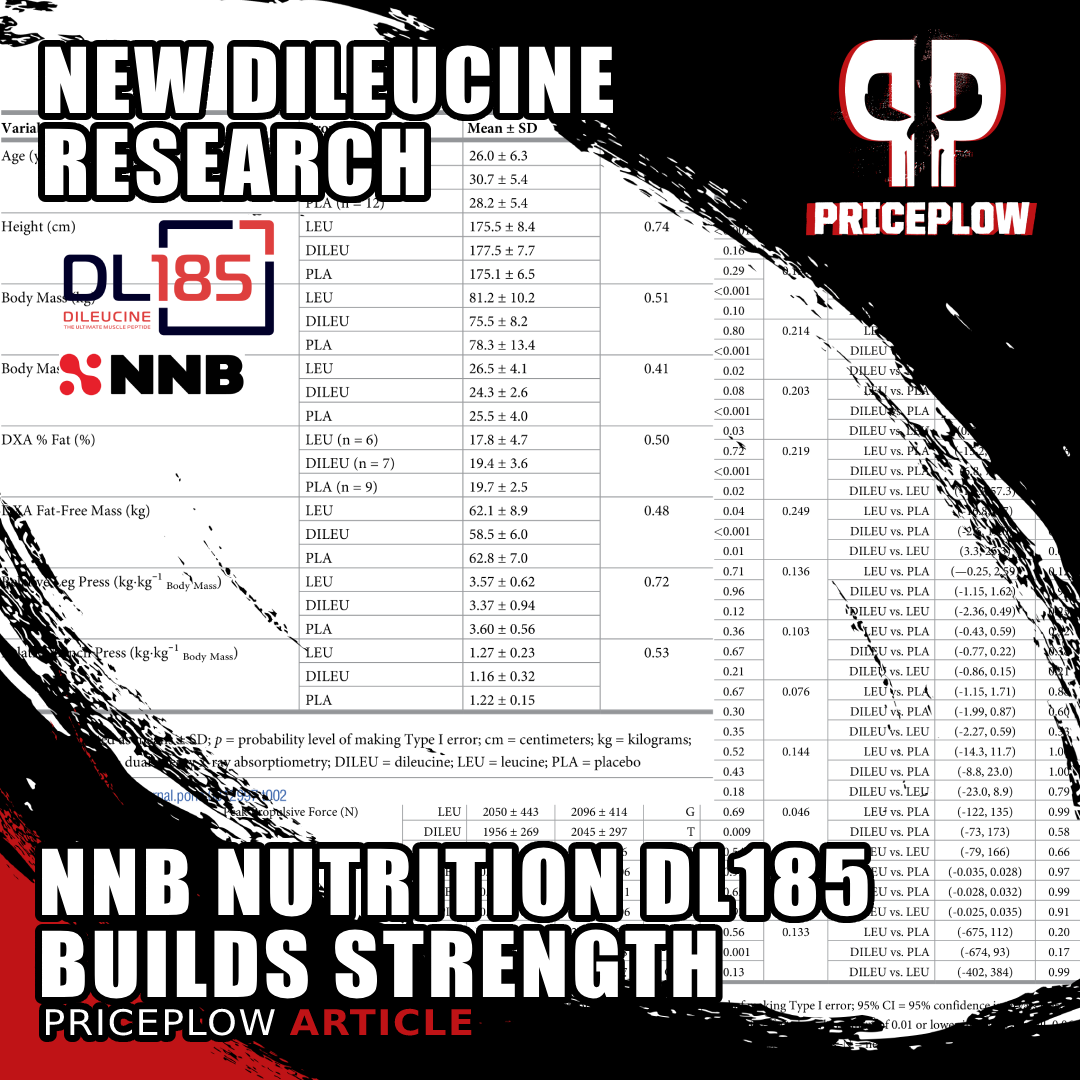
Groundbreaking research published in PLOS ONE demonstrates NNB Nutrition's DL185 dileucine boosts lower body strength more effectively than leucine. 2g daily improved leg press strength and muscular endurance in 10-week study. Science continues supporting this novel ingredient.
That's a preliminary, in-house finding rather than a peer-reviewed result, and NNB is continuing to investigate exactly what's happening and why before treating it as a settled claim. But it's the detail that makes the "lazy body" framing worth taking seriously in the first place. A body that doesn't waste movement on unnecessary chemistry is an unlikely candidate to run a leucine-to-dileucine conversion for no reason at all.
An Expensive Habit to Keep Around
Here's why that conversion step matters more than one would think. Building new protein is one of the most expensive things a resting body does. Of all the ATP mammalian cells actually put to use, an estimated 25% to 30% goes toward protein synthesis alone, a share edged out only by the 19% to 28% claimed by the sodium-potassium pump (the Na+/K+-ATPase) that maintains electrical charge across every cell membrane in the body. Protein synthesis comfortably outspends muscle contraction, glucose production, and urea synthesis combined![5]
What a Peptide Bond Actually Costs
Zoom into a single peptide bond and the math gets even more impactful. Forming one costs the equivalent of 4 ATP molecules, roughly 63kJ/mol of energy spent, while the bond itself only holds onto about 13kJ/mol of that as usable chemical potential. The rest is lost as heat, working out to roughly 5% efficiency.[5] Protein synthesis is expensive at the aggregate level and inefficient at the level of every individual bond formed.
That conversion isn't free. It runs through the same costly, inefficient machinery as every other peptide bond in the body, competing for ATP against a pump that's already claiming a fifth to a quarter of the entire resting energy budget on its own.
Homeostasis Isn't Passive
Three theories, one name. Shawn Wells' "GLP-1 Drag" ties together muscle loss, mitochondrial fatigue, and dopamine flattening on weight loss drugs.
In the above cited research, Rolfe and Brown make a related point in their own conclusions. Most of the energy-dissipating reactions running through a resting body are unlikely to be accidental. If they were pure waste, natural selection has had plenty of opportunity to eliminate them, since a slower resting metabolism would have been the cheaper option. Cold-blooded animals of similar size and structure get by on a fraction of a mammal's resting energy use, which the authors point to as evidence that most of what a mammal's metabolism spends its energy on is doing real work, not leaking it away.[5]
That's the more general version of what NNB has been arguing about dileucine specifically.
"Lazy" and "intentional" end up describing the same behavior from two different angles! Lazy means the body skips anything that doesn't pay for itself. Intentional means whatever survives that filter is doing something worth the cost. Generations upon generations running through that filter tends to produce a body that's efficient with shortcuts and unforgiving toward chemical dead weight.
What We Actually Know
Set the endogenous-production theory aside for a moment, since dileucine's track record doesn't need to depend on it. In a crossover trial giving healthy young men 2g of leucine or 2g of dileucine, only the dileucine group showed a significant rise in muscle protein synthesis at rest. Leucine alone didn't move the needle.[6]
Over a longer timeline, a 10-week resistance training trial found 2g of daily dileucine produced significantly greater leg press strength and more reps to failure than either 2g of leucine or placebo, with leucine failing to separate from placebo on those same measures.[7] We covered that trial in more depth in our dileucine strength research article.
We've floated the idea elsewhere, in our GLP-1 Drag piece, that dileucine's role might run deeper than a faster-absorbing leucine signal, possibly even ahead of leucine itself as the actual trigger muscle tissue is waiting for. That's a bigger claim than this article is making. This one only argues that the body's own decision to keep making dileucine deserves attention on its own terms.
Theory vs. Data, Clearly Labeled
It's worth being direct about what's established here and what isn't. The ATP cost of protein synthesis is measured, published, and about as "settled" as bioenergetics gets. However, the argument that dileucine specifically appears in circulation after free leucine intake is NNB's internal, unpublished observation, so it's not yet a citable data point, and it deserves the same skepticism any preliminary finding does before it clears peer review.
This means the argument will rest on two different kinds of evidence: measured outcomes showing dileucine outperforming leucine in specific trials, and a more theoretical case, grounded in real bioenergetics, for why the body would bother making the molecule at all. Both are worth knowing. They aren't the same thing, and we've tried not to blur them in this article.
The Case is in the Cost
Go back to the original claim, which stands: DL185 isn't a clever way to bond two leucine molecules together. It's a molecule the body appears to build for itself, running some of the most expensive, least efficient machinery it owns, without being asked to.
A body built to conserve energy doesn't run that process for nothing. It runs it because, somewhere in the accounting, dileucine earns its keep. And now we can give it more, because that's what we do in sports nutrition, and like creatine, betaine, HMB, ATP, and other incredible supplement ingredients before it... it's a strategy that works.


Comments and Discussion (Powered by the PricePlow Forum)