Most folate marketing stops at "bioactive." Balchem's Optifolin+ goes further by pairing 5-MTHF with two choline ions, which brings 7 methyl groups per molecule instead of 1.
When we covered Balchem's Optifolin+ in July, the question was form. Most folate on the market is still folic acid, a problematic synthetic precursor that must clear several enzymatic conversion steps before your cells can use it. Advances in folate science have led to growing interest in bioactive forms such as L-5-MTHF. Optifolin+ skips that queue by arriving as (6S)-5-methyltetrahydrofolate, the bioactive form already present in circulation.
Choosing a bioactive folate settles whether the folate is usable. But it doesn't settle a second question that matters just as much for methylation: how much methyl-group currency shows up alongside it.
Optifolin+: Every Methyl Counts
For years, conversations around folate have focused on bioavailability. But another question is becoming increasingly important: what role do folate and other methyl-donor nutrients play in supporting one-carbon metabolism? Commercial L-5-MTHF ingredients are supplied in salt forms, commonly paired with counterions such as calcium or glucosamine. Optifolin+ instead pairs 5-MTHF with two choline ions. Because choline itself carries methyl groups, that changes the methyl arithmetic of the ingredient, all while supporting shelf stability.
Balchem quantifies this distinction as a 7x methyl donor advantage over other folates. In this article, we explore the science behind that claim and work out where the figure comes from. We'll follow the methyl groups through one-carbon metabolism and look at what the epigenetic aging research supports.
This is the second part of a multi-part series. If you want to follow Optifolin+ to see future articles and the products adopting it, sign up for updates before continuing:
Subscribe to PricePlow's Newsletter and Alerts on These Topics
The Methyl Pool: One-Carbon Metabolism's Shared Currency
Methylation is the transfer of a single carbon group (CH3) onto another molecule, and your body does it constantly to DNA, proteins, hormones, and neurotransmitters. The machinery that supplies those methyl groups is one-carbon metabolism, which runs on two interlocking cycles.

When a label says "folate," you'd assume you're getting what your body actually uses. Often you're not. Balchem's Optifolin+ delivers active 5-MTHF folate directly, and a 2025 trial found it absorbs 2.6x better than folic acid.
In the folate cycle, dietary folate becomes 5-MTHF, which transfers its methyl group to the amino acid homocysteine. That reaction is run by methionine synthase using vitamin B12 as a cofactor, and it converts homocysteine into methionine, the immediate precursor of S-adenosylmethionine (SAM).[1]
SAM is the "universal methyl donor". Nearly every methyltransferase enzyme in the body spends SAM to do its job. Once SAM gives up its methyl group it becomes S-adenosylhomocysteine (SAH), which gets hydrolyzed back to homocysteine and remethylated again, provided there's enough folate and B12 on hand.[1]
The useful way to picture the whole system is as a shared reservoir, sometimes called the methyl pool. Nutrients deposit methyl groups into it. Methylation reactions withdraw from it. Two things follow from that framing:
- First, folate and choline contribute methyl groups through interconnected pathways that help maintain one-carbon metabolism.
- Second, folate isn't the only nutrient making deposits. Choline feeds the same pool through a separate route, which is where Optifolin+'s chemistry starts to matter.
This brings us to the 7x advantage.
Counting Methyl Groups: Where the 7x Comes From
Optifolin+ is dicholine (6S)-5-methyltetrahydrofolate. Balchem synthesizes it in two steps from L-5-MTHF acid and choline hydroxide. Once you have the structure, the methyl count is straightforward arithmetic.
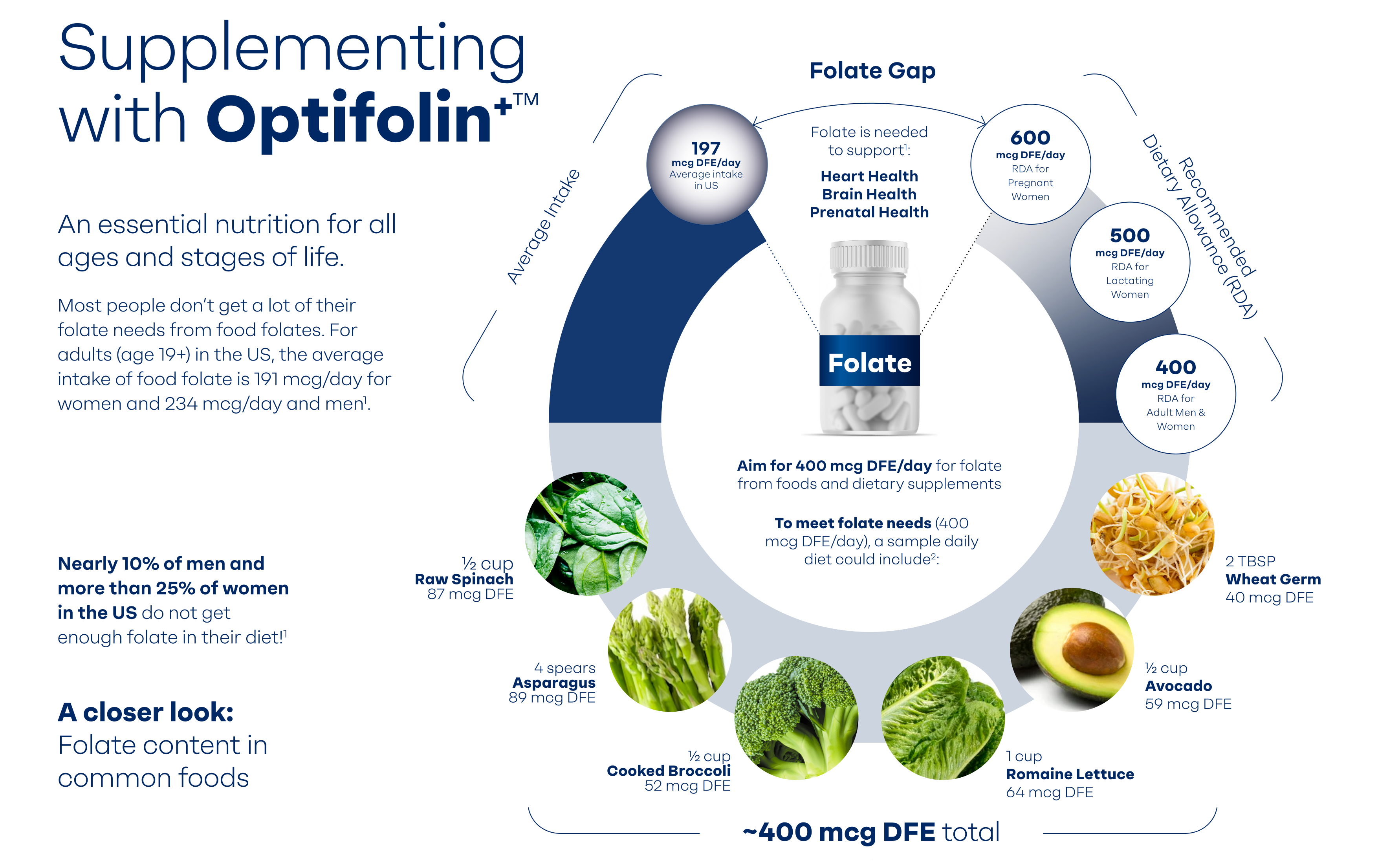
Average US adults take in 197mcg DFE daily while the RDA runs from 400mcg to 600mcg depending on life stage, and the food circle shows how spinach, asparagus, broccoli, romaine, avocado, and wheat germ stack up to roughly 400mcg DFE.
5-MTHF carries a single methyl group, at the 5-position, which is exactly what the "5-methyl" in its name refers to. Choline, meanwhile, is trimethylethanolamine, and its quaternary nitrogen carries three methyl groups. Optifolin+ pairs each folate anion with two cholines. So:
- 1 methyl group from the 5-MTHF anion
- 6 methyl groups from two choline counterions, at three apiece
- equaling 7 methyl groups total per molecule
Now compare that against a calcium or glucosamine 5-MTHF salt carrying the identical folate load. Neither calcium nor glucosamine contributes any methyl groups, so those forms deliver one methyl group where Optifolin+ delivers seven.
Balchem illustrates the same point in molar terms. At an equimolar 5-MTHF dose, calcium and glucosamine salts supply roughly 6.0 x 10^17 methyl groups, while Optifolin+ supplies roughly 42.2 x 10^17. Divide one into the other and you see the 7x.
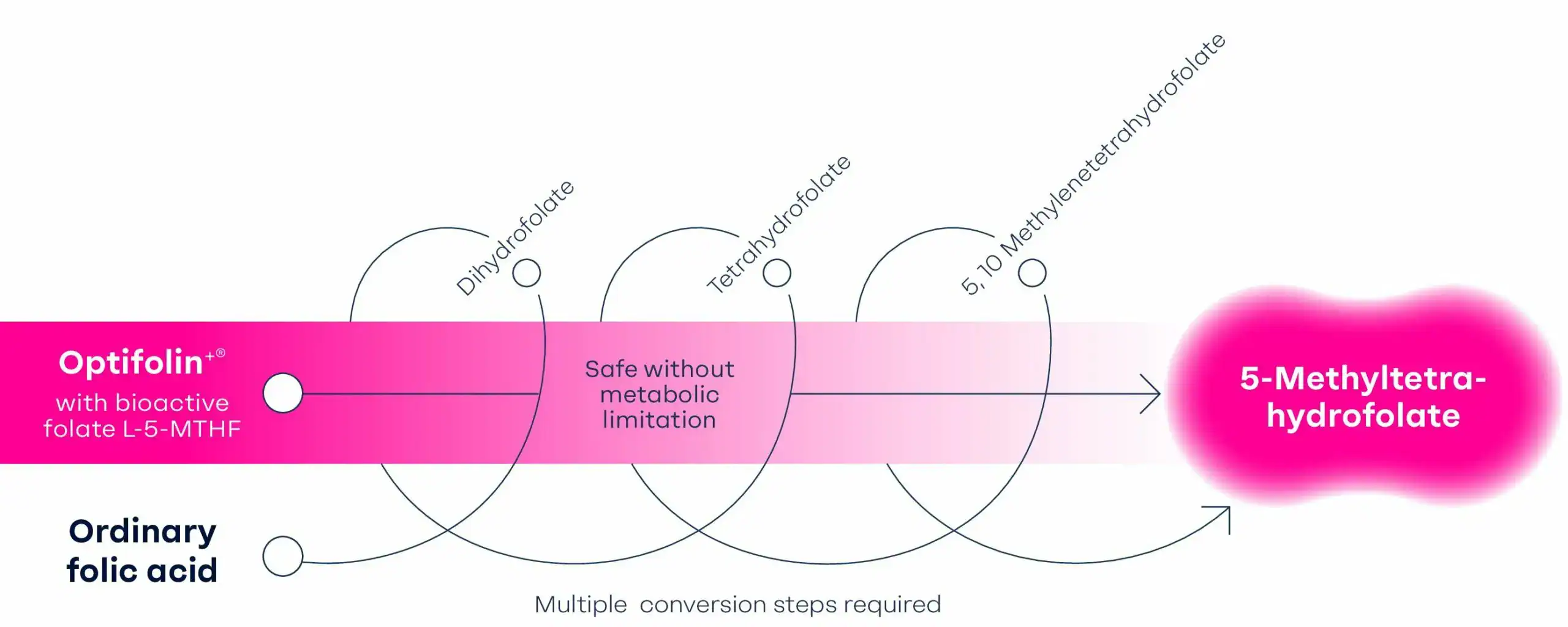
Optifolin+ enters the body as bioactive L-5-MTHF and reaches the active folate form without metabolic limitation, while ordinary folic acid has to clear several enzyme conversion steps first.
Note that this comparison baseline is other commercial 5-MTHF salts, not folic acid. Folic acid carries no methyl group at all, so the 7x doesn't apply to it. Also, 7x is a statement about composition. It describes methyl groups delivered per molecule of folate, which is not the same as claiming that methylation activity or any health outcome increases sevenfold.
How Choline's Three Methyl Groups Actually Move
A natural question is whether choline's three methyl groups should be counted when comparing methyl donor potential, and what the science says about their biological availability. Bortz and Obeid answered it directly in their 2025 review looking at labeled choline through the pathways. [2]
Choline first gets oxidized to betaine by choline dehydrogenase (CHDH). From there, the three methyl groups take different routes:[2]
- The first methyl group goes to homocysteine through betaine homocysteine methyltransferase (BHMT), producing methionine and then SAM
- The second, carried on dimethylglycine, ends up in 5,10-methylenetetrahydrofolate
- The third travels via sarcosine to tetrahydrofolate, also arriving at 5,10-methylenetetrahydrofolate
Each oxidized choline molecule therefore does contribute three methyl groups to the methyl reservoir. [2]

This means that the seven-methyl count holds up, but there's one thing to add. Only the first of choline's three methyl groups reaches SAM directly through BHMT. The other two re-enter the folate pathway at 5,10-methylenetetrahydrofolate, which still requires the MTHFR enzyme to reach 5-MTHF.
Regardless, Optifolin+'s folate portion bypasses that enzymatic step by definition, since it's already 5-MTHF. What comes from choline is icing on the cake.
A Note on the 98% Figure
Balchem's materials pair the 7x figure with a second claim, 98% methyl capacity. According to Balchem, this means 98% of the ingredient delivers a methylating nutrient, either folate or choline. The figure comes from the product specification, which calls for 95% to 103% dicholine 5-MTHF, with 98% as the average.
That figure is separate from a similar-looking number in the folate literature: L-5-MTHF accounts for roughly 95% to 98% of the folate circulating in serum and red blood cells.[3]
Two Routes, One Reservoir
There's more synergy to consider with Optifolin+.
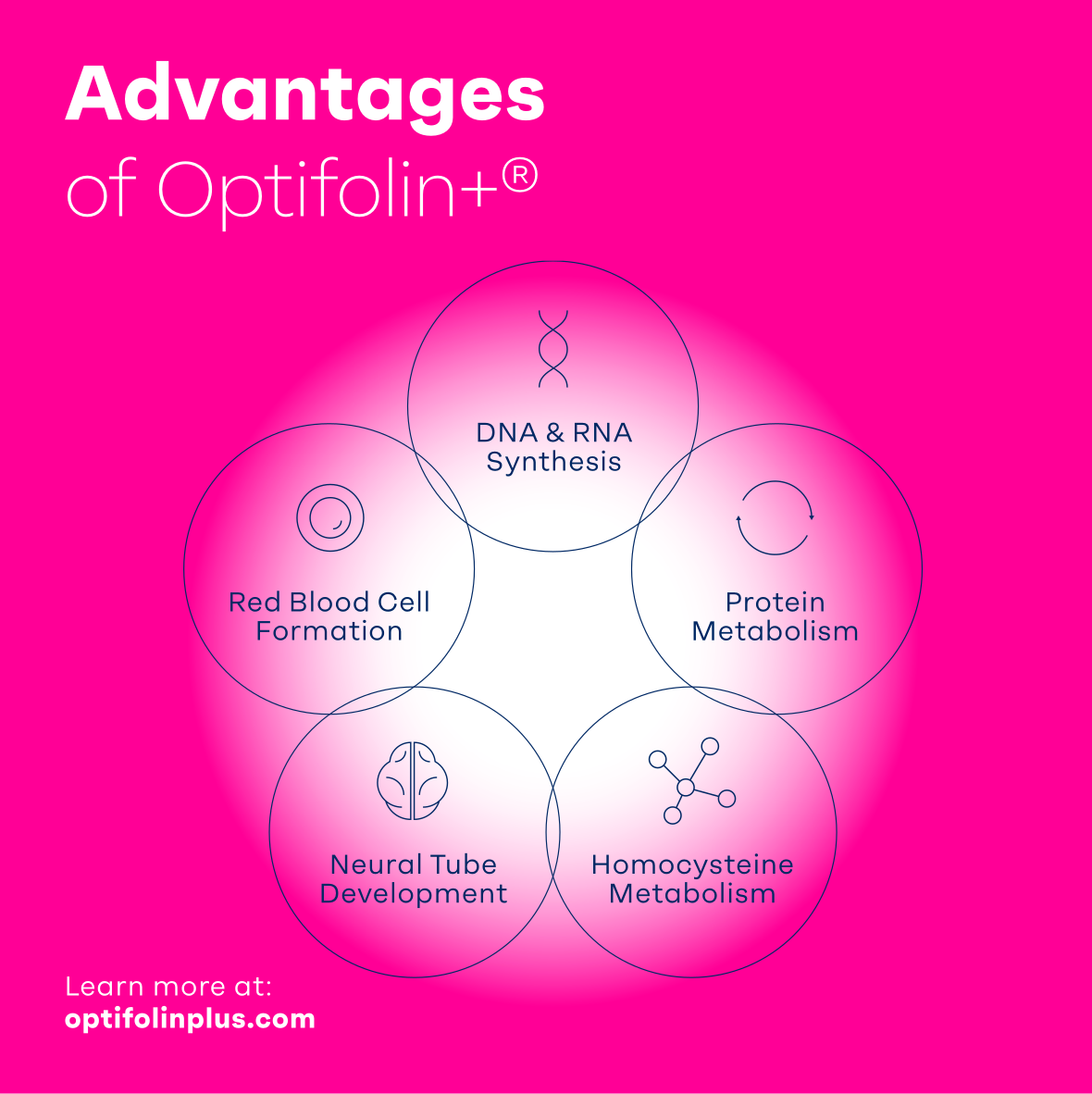
Balchem's graphic lists five body processes folate supports, covering DNA and RNA synthesis, protein metabolism, homocysteine metabolism, neural tube development, and red blood cell formation.
Methionine synthase and BHMT both remethylate homocysteine, and they work as parallel routes into the same reservoir. One depends on folate, the other on choline by way of betaine. The pair is also interdependent in ways that show up clearly when either nutrient runs short.
In animal models, a choline-deficient diet reduces SAM by around 50% and lowers liver folate by 31% to 40%. Running the deficiency the other direction, low folate cuts homocysteine remethylation to methionine by roughly 37%.[2] Neither pathway operates in isolation, and shorting one drags on the other.
This is the rationale for combining the two nutrients in a single molecule. Optifolin+ deposits into both remethylation routes from one ingredient, which is an incredible biochemical convenience. Balchem has spent years on the choline side of this equation with VitaCholine, so the pairing follows their existing expertise rather than departing from it.
Methylation, Epigenetics, and Healthy Aging
Methylation isn't only a metabolic housekeeping function. When methyl groups get attached to DNA, they influence whether nearby genes are switched on or off, without changing the underlying sequence. That's the core of what people mean by epigenetics.
Those patterns shift over a lifetime, and the shifts aren't random. Epigenetic alterations are one of the 14 hallmarks of aging catalogued in the geroscience literature, classified among the primary hallmarks rather than downstream consequences.[4]
Researchers have built that observation into measurement tools. Epigenetic clocks estimate biological age from methylation levels at specific DNA sites, and the gap between a person's clock estimate and their actual age is called epigenetic age deviation.
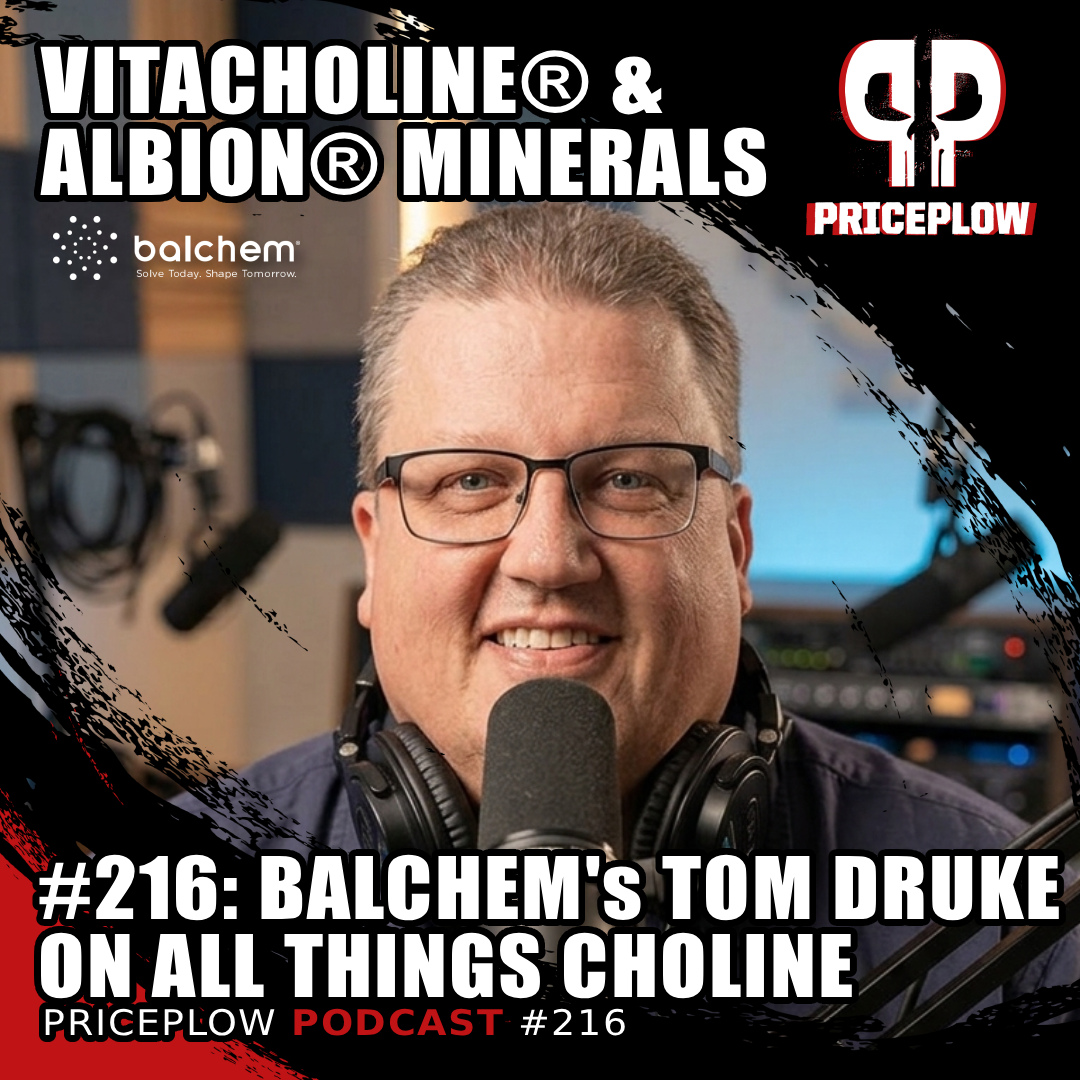
Tom Druke, Senior Marketing Manager at Balchem, breaks down the science of VitaCholine®, Albion® chelated minerals, and K2VITAL® on Episode #216 of the PricePlow Podcast. Plus: the story behind Balchem's first-of-its-kind New York Jets ingredient partnership.
So, methylation draws on the methyl pool, methyl-donor nutrients supply that pool, and methylation patterns track with aging. Those are three well-supported statements. Chaining them into "more methyl donors means slower epigenetic aging" is a good argument, but note that it's not a fully demonstrated result. This is an area of science that continues to mature, and it's worth understanding how far along the scientific community is with this -- long-term trials on aging are obviously difficult to control.
What the Epigenetic Aging Research Shows
The most relevant study here is a 2025 analysis in The American Journal of Clinical Nutrition that examined one-carbon metabolism biomarkers against seven established epigenetic aging measures. Researchers used cross-sectional NHANES data from 1999 to 2002, covering 2,346 US adults aged 50 and over, with a mean age of 65.[1]
On folate, each doubling of serum folate concentration was associated with 0.82 years lower GrimAge2 epigenetic age deviation and 0.13 standard deviations lower on the DunedinPoAm pace-of-aging measure. After the researchers further adjusted for smoking status, alcohol intake, and kidney function, those associations pointed in the same direction but were no longer statistically significant.[1]
The sturdier finding was homocysteine, and it points the same way from the opposite side. Each doubling of homocysteine was associated with 1.93 years greater GrimAge2 deviation, and that association held at 1.23 years even after full adjustment. Elevated homocysteine is a recognized indicator of one-carbon insufficiency.

Obviously a study like this has many limits. The design is cross-sectional, so it can't establish cause. Nearly every participant was folate replete, with only five of 2,346 falling below the deficiency reference, so this was a well-nourished, post-fortification population. The authors call for long-term randomized trials, and they note they couldn't test whether MTHFR variants changed the picture, which is the exact subgroup a bioactive folate argument cares most about. The study also measured serum folate status, not folate intake.[1]
However, it's still useful information that routes back to the chemistry above. The most consistent signal in the dataset involves homocysteine, and homocysteine remethylation is precisely where folate and choline both act, through methionine synthase and BHMT respectively. Supporting healthy homocysteine metabolism is well-demonstrated ground for both nutrients, and it's a more reasonable discussion than talking about epigenetic clocks.
Notes for Formulators
Panel declaration, stability data, solubility, and NDI status were all covered in our first Optifolin+ article, so we won't rehash them. The short version is that the choline salt holds label claim across a 36-month shelf life and dissolves readily, which widens the format range to tablets, capsules, powders, and sachets.
On the methyl payload specifically, the 2025 pharmacokinetic trial found that Optifolin+ absorbed 2.6x better than folic acid.[5] This can be reviewed in our main article linked above.
Form, Then Payload
Part one of this series was about which molecule shows up. This one is about what it brings with it.
The key takeaway is not simply that Optifolin+ contains more methyl groups. It's that it brings together two nutrients involved in one-carbon metabolism within a single molecular structure. That combination creates a truly differentiated platform for formulators seeking bioactive folate paired with choline, and tracing work confirms that all three methyl groups on each choline do reach the methyl reservoir.
The research linking one-carbon status to epigenetic clocks is early, cross-sectional, and pointed most consistently at homocysteine, which is strong and solid evidence.
Next in this series, we're turning to a question formulators keep raising about this category: whether the methylfolate on the label is the methylfolate in the capsule. NIH and USDA researchers tested 43 commercial 5-MTHF products for label accuracy, disintegration, and dissolution, and the results deserve their own article.


Comments and Discussion (Powered by the PricePlow Forum)