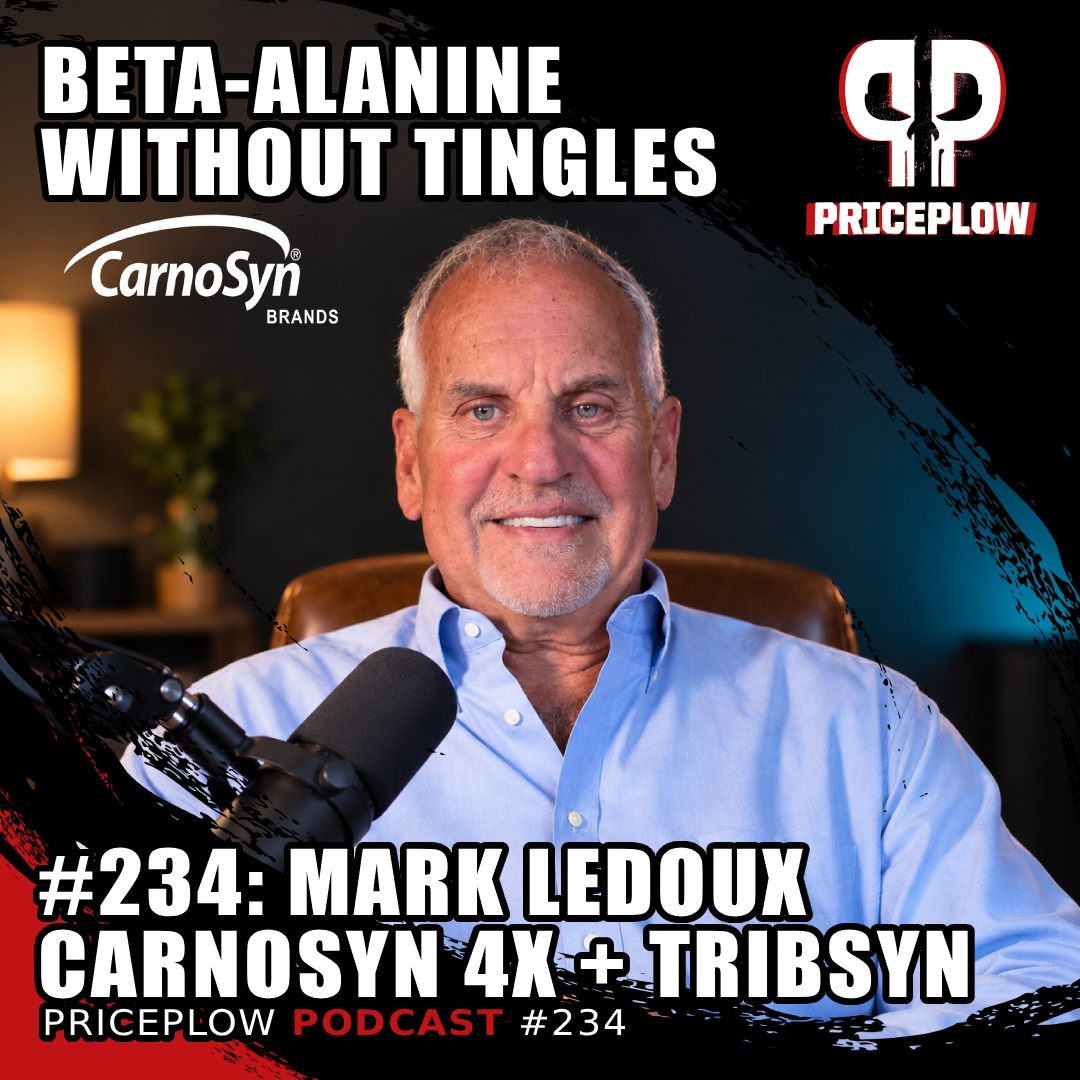
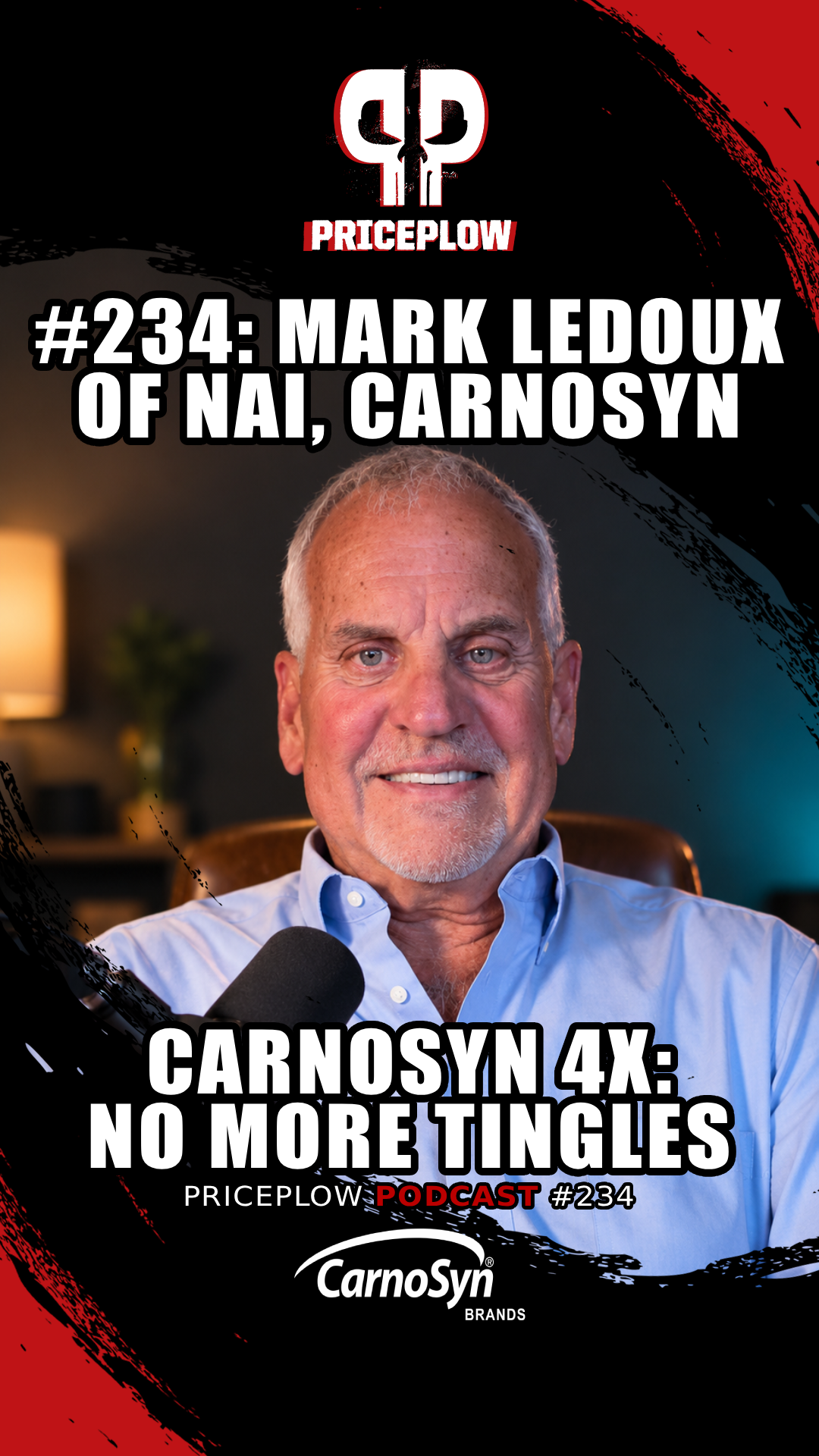
Mark LeDoux, founder and CEO of Natural Alternatives International, breaks down CarnoSyn 4X and TriBsyn, NAI's next-generation beta-alanine technologies, on Episode #234 of the PricePlow Podcast.
Mark LeDoux is back on the PricePlow Podcast, and this time the conversation goes well beyond a pre-workout scoop. In Episode #234, Mike sits down with the founder, chairman, and CEO of Natural Alternatives International (NAI) (the company behind CarnoSyn® Beta-Alanine) for an update on where NAI's research has gone since Mark's last appearance on the show.
Get Ready for Tingle-Free Beta-Alanine with CarnoSyn® 4X and TriBsyn®
The headline is CarnoSyn® 4X, a liposomal beta-alanine engineered for 4x the bioavailability of the standard ingredient, meaning an 800mg dose can deliver the equivalent of a 3.2g loading dose without the paresthesia (tingling) that turns off a huge share of potential users. NAI also markets this technology under a second brand name, TriBsyn®, aimed at the wellness and healthy-aging market rather than sports nutrition.
Mark and Mike also dig into why beta-alanine matters more than ever in the GLP-1 era, where rapid weight loss often comes with unwanted muscle loss. As Mike digs in, he realizes that there are dozens of benefits to increased carnosine stores, but in sports nutrition, we only concern ourselves with just one. This ingredient goes a lot further than we give it credit for, and Mark is ready to take it to the next level through NAI's platform.
Subscribe to the PricePlow Podcast on your favorite platform and sign up for NAI alerts before diving in.
Subscribe to the PricePlow Podcast on Your Favorite Service (RSS)

Apple Podcasts

Spotify

YouTube
https://blog.priceplow.com/podcast/mark-ledoux-carnosyn-tribsyn-234
Video: CarnoSyn® 4X, TriBsyn®, and Beta-Alanine’s Next Chapter

Podcast: Play in new window | Download (Duration: 1:25:11 — 70.0MB)
Detailed Show Notes: Mark LeDoux of Natural Alternatives International (NAI)
-
0:00 - Introductions
Mike welcomes Mark LeDoux back to the show for the first time since 2024's NPA Fly-In Day episode, where he gave a longer introduction to his career and NAI's origins (around the 1:23:15 timeframe). Mark reflects on how quickly the supplement marketplace has shifted since the COVID era, with a new generation of consumers doing their own research and growing skeptical of media narratives dressed up as science.
That skepticism, Mark says, extends to pharma too. He points to the rise of GLP-1 and GIP peptide drugs like tirzepatide as a case study in how a legitimate breakthrough can still carry an overlooked downside, setting up the episode's central theme.
-
2:45 - GLP-1 Drugs and Muscle Loss
Mark explains how GLP-1 and GIP receptor agonists work by mimicking the body's own satiety signals, telling the brain it's full even when it isn't. The result is dramatic weight loss, but often at the expense of lean muscle, since a falling appetite means less protein intake overall.
That matters for beta-alanine specifically, Mark notes, because the compound is found almost exclusively in animal meat. As GLP-1 users eat less meat, they also lose one of their only dietary sources of an amino acid the body needs to build carnosine and protect muscle mass during rapid weight loss.
-
7:15 - CarnoSyn® 4X: No More Tingles
Mark traces his approach back to a 46-year career built on finding natural alternatives to pharmaceuticals, citing examples like willow bark's connection to aspirin and foxglove's link to digitalis. That philosophy led NAI to spend roughly 12 years developing CarnoSyn® 4X, a liposomal form of beta-alanine.
The payoff: an 800mg dose of CarnoSyn® 4X delivers the equivalent of a 3.2g standard beta-alanine dose without the paresthesia many users find uncomfortable, with patents pending. At 72, Mark takes it daily and still water-skis at his family's lake home in Wisconsin, evidence, he says, that it works.
-
11:45 - TriBsyn®: One Technology, Two Names

NAI markets its high-bioavailability beta-alanine technology under two names depending on the application: CarnoSyn® 4X for sports performance, and TriBsyn® (pronounced "try-buh-sin") for the broader wellness and healthy-aging market. Mark says the ingredient has been engineered into multiple formats, including extruded food bars, gummies, ready-to-drink beverages, and powders, with conversations underway with major beverage brands he wasn't yet able to name.
As early proof of concept, Mark points to a company-sponsored study at a Brazilian nursing home, where non-ambulatory residents given high daily doses of beta-alanine were reportedly walking again within four weeks.
-
14:15 - Clinical Proof: From Chicken Soup to Nursing Homes
Ben asks how NAI actually measured the bioavailability improvement behind CarnoSyn® 4X. Mark credits the late Dr. Roger Harris, the researcher credited with discovering creatine, for first identifying beta-alanine's presence in chicken soup decades ago, which helped kickstart NAI's research program. Mark says NAI now has more than 50 published studies behind the ingredient (see PricePlow's beta-alanine guide for the fundamentals).
He also outlines carnosine's roughly 25 metabolic functions, from buffering lactic acid during exercise to supporting the nervous, cardiac, and immune systems. NAI's newer research targets demographics beyond athletes, including older adults, women seeking creatine's benefits without the tingling, and vegetarians who fall short on dietary beta-alanine.
-
18:00 - Brain Health and Cellular Cleanup
Mark goes deeper on the liposomal coating technology behind CarnoSyn® 4X and TriBsyn®, then pivots to carnosine's role clearing metabolic "debris" from the nervous system. He connects faster neuron-to-neuron communication to adequate carnosine levels, and raises Alzheimer's-related plaque buildup as an open research question NAI is watching, rather than a claim tied to any specific product.

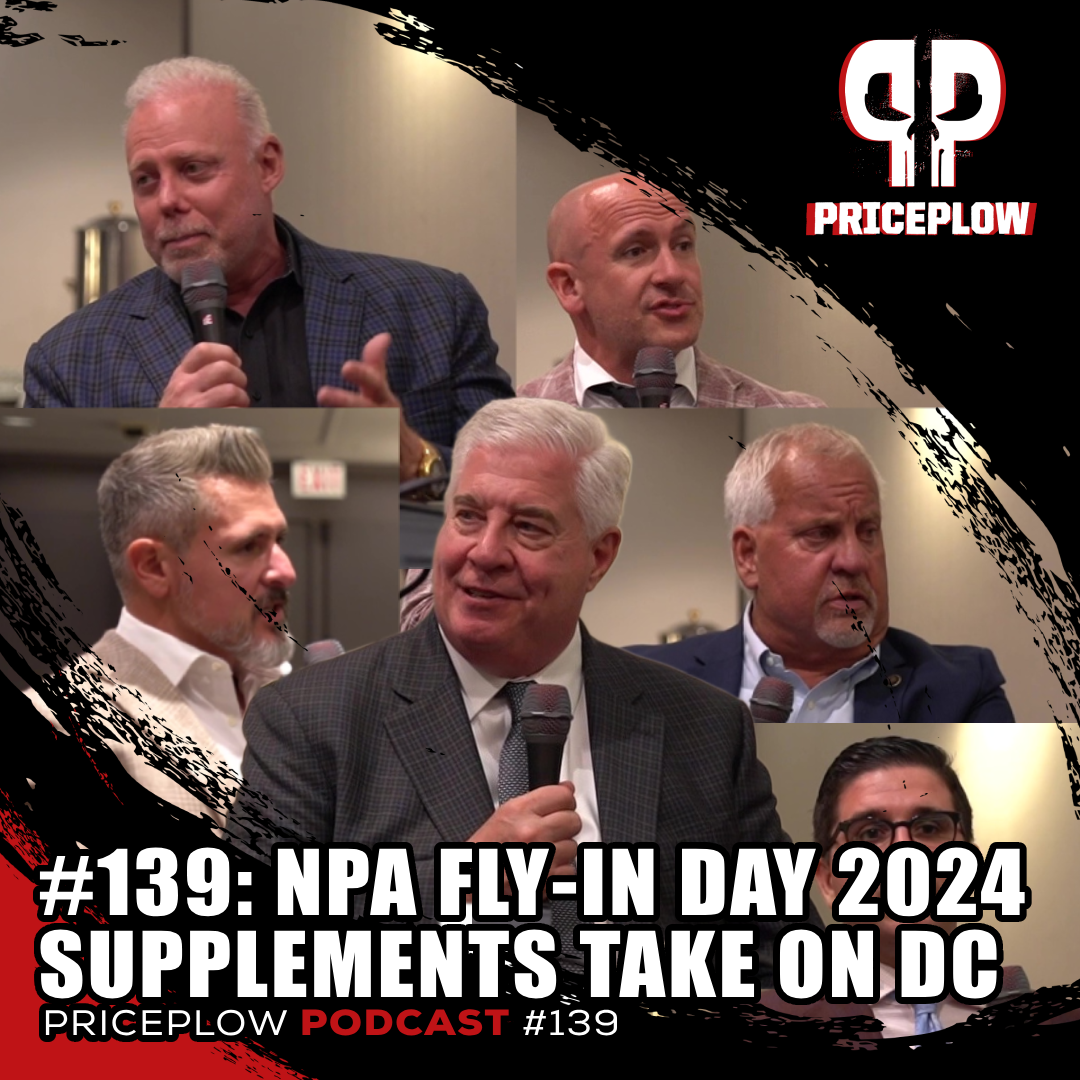
Team PricePlow's Back in Washington DC for the 2024 NPA Fly-In Day, and this podcast has an epic cast: Jim Emme, Rick Collins, Mark Ledoux, Mike DiMaggio, and more! Listen to it in Episode #139 of the PricePlow Podcast!
This ties into NAI's broader "beyond the gym" positioning for TriBsyn®, framing carnosine support as relevant to brain health and healthy aging generally, not just workout recovery, matching the cognitive-performance and healthy-aging categories listed on TriBsyn's own site.
-
20:30 - Mark's Take on Food Quality
Mark pivots into a broader riff on food quality, arguing that ultra-processed ingredients and seed oils have reshaped American health for the worse compared to when he was growing up in the 1970s. He points to Steak 'n Shake's switch from seed oils to beef tallow as a sign that consumer preferences are shifting back toward less-processed options.
The through-line, in Mark's view, is that food and supplements should hold up to scrutiny. If something spoils naturally, he argues, that's often a better sign of real nutritional content than a product engineered to sit on a shelf indefinitely.
-
27:30 - Policing Industry Fraud
Mark shifts to industry accountability, describing cases where third-party testing found supplement gummies with zero milligrams of advertised ingredients like vitamin C. He credits organizations like the Natural Products Association for working to identify and report fraudulent products to regulators, and argues consumers and lawmakers need to keep pressure on the FDA to enforce existing rules.
He also recounts decades-old anecdotes about natural alternatives facing pushback, including a contentious radio interview about vitamin E and fibrocystic breast disease and NAC's use during COVID-19, before noting that recent FDA and NIH decisions have begun approving certain peptide therapies that were previously restricted.
-
38:00 - What's Next: Sarcopenia and Longevity

Looking ahead, Mark says NAI's research agenda is shifting toward a wider demographic than the traditional gym-goer. Priorities include women who want creatine's benefits without beta-alanine's tingling, and applications in parenteral and clinical nutrition, similar to products like Ensure or Boost, where preserving lean mass matters for people with reduced appetites.
Much of this ties back to sarcopenia, the gradual, age-related loss of muscle mass that typically accelerates after age 40 or 45. Mark says NAI is also studying how beta-alanine might pair with other nutrients people commonly fall short on, including citrulline, magnesium bisglycinate, chromium, and boron.
-
46:00 - Carnosine's Hidden Benefits
Mike shares his own research into carnosine's broader detox functions, including evidence that carnosine can quench 4-HNE, a reactive aldehyde generated during lipid peroxidation of omega-6 fatty acids such as linoleic acid.[1][2] He also points to animal research on carnosine in liver fibrosis and hyperammonemia, as well as ethanol-induced liver injury.[3][4] He notes these carnosine-specific findings don't automatically transfer to beta-alanine on their own, though beta-alanine is the precursor the body needs to build carnosine in the first place.[5]
Ben adds that mainstream acceptance of creatine has helped pave the way for people to embrace ingredients like beta-alanine, noting his own parents take creatine but have avoided beta-alanine because of the tingling. Mark also references a study in elite Israeli combat soldiers in which beta-alanine supplementation improved aspects of tactical performance — including marksmanship and target-engagement speed — without improving the cognitive task.[6] He also references a murine predator-scent stress model in which beta-alanine supplementation was associated with greater behavioral resilience after stress exposure.[7]
-
56:15 - Real-World Proof: FeelGood Company's Creatine+

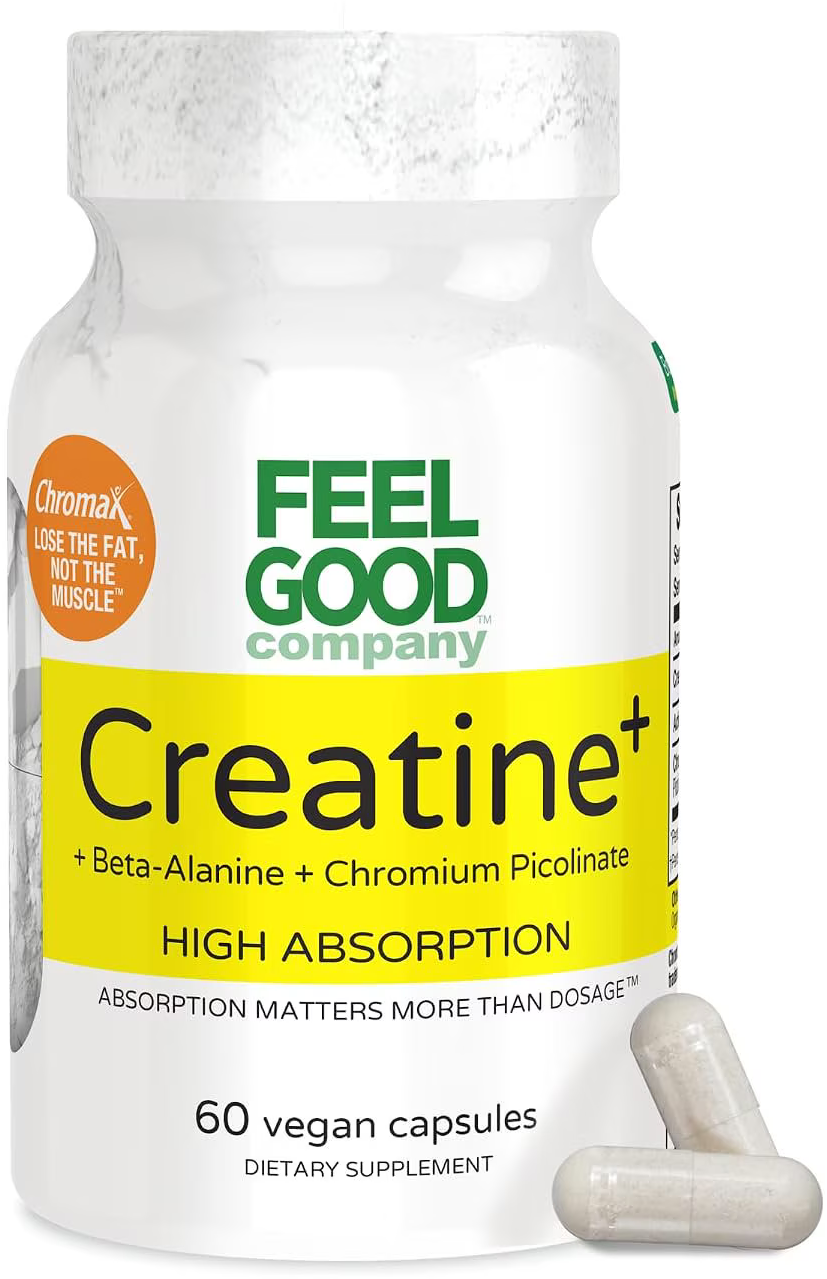
Mike asks about real-world availability, and Mark points to FeelGood Company's Creatine+ capsules, sold at Costco and online, which combine creatine hydrochloride with CarnoSyn® 4X beta-alanine and chromium picolinate (as Chromax®). Suggested use is 2 to 4 capsules daily for general health, or 4 to 6 capsules for intense exercise, with each two-capsule serving providing 720mg of active beta-alanine.
Mark says NAI is selective about which brands it partners with, prioritizing companies built for the long haul, and expects more retailers, including Vitamin Shoppe and GNC, to carry similar products by this fall's retail resets.
-
1:04:15 - Cognitive Health and the Stacking Case
Mark connects carnosine's cellular cleanup role to cognitive health, noting that neurons communicate in milliseconds and framing faster processing as a marker of a sharper, more youthful brain. Mike agrees and points to a well-established data point: a 2006 study by Hoffman and colleagues found that the creatine + beta-alanine group had greater improvements in lean body mass and percent body fat than the creatine-only and placebo groups.[8]
Mike notes the finding is nearly two decades old but still underappreciated, and the two agree a dedicated PricePlow article on the creatine and beta-alanine stack is overdue given how much research already supports it.
-
1:12:45 - Regulatory Wins and Staying Engaged
Mark pivots to the regulatory environment, recalling how NAI had to argue that dietary supplement manufacturing was an essential activity to avoid COVID-era shutdowns. He points to recent changes he's encouraged by, including the removal of synthetic dyes like Red 40 and Yellow 5 from many products and a renewed openness to peptide therapies that were previously restricted.
Mark's takeaway is that lasting change usually comes from consumer pressure rather than waiting on any single administration, encouraging listeners to stay engaged with organizations like the NPA rather than assuming regulators will act on their own.
-
1:18:30 - Connecting with Mark and a Final Story
As the conversation wraps, Mark shares that he's active on LinkedIn, with around 1,700 connections, and plans to launch a weekly blog from NAI's Switzerland facility once he's settled back in, aiming for an October start.
Mark closes with a story from before the Barcelona Olympics, when he had to convince a skeptical US Olympic Committee nutritionist that supplements had merit. NAI became the first company authorized to supply US Olympians, and beta-alanine went on to fuel velodrome cycling medals for Great Britain, the Netherlands, and South Korea in the years that followed, with credit to researchers Roger Harris and Craig Sale.
Where to Follow and Learn More
Connect with Mark LeDoux and Natural Alternatives International
- LinkedIn: Mark LeDoux
- LinkedIn: Natural Alternatives International
- Instagram: @carnosyn
- Natural Alternatives International on PricePlow - Sign up for news alerts
Resources Mentioned
- Previous Episode: NPA DC Fly-In Day 2024 (Episode #139)
- TriBsyn®: Official Site
- CarnoSyn®: Official Site
- Natural Alternatives International: Corporate Site
- PricePlow's Beta-Alanine Guide
Products Discussed
Mark LeDoux has been at this for 46 years, and CarnoSyn® 4X and TriBsyn® show he's not slowing down anytime soon. Thanks to Mark for making time to catch up, and we're looking forward to his upcoming blog from NAI's Switzerland office this fall.
We also have to thank Darren Thompson and Perfect Shaker for sponsoring this episode. Grab one of their incredible shaker cups at PricePlow.com/perfect-shaker or hear more from Darren himself in Episode #209.
Subscribe to the PricePlow Podcast on any platform, sign up for Natural Alternatives International news on PricePlow, and leave us a great review on iTunes and Spotify!
Subscribe to the PricePlow Podcast on Your Favorite Service (RSS)
Apple Podcasts
Spotify
YouTube

Comments and Discussion (Powered by the PricePlow Forum)