Your lab says ferritin 22ng/mL is normal. ASH's new 2026 guidelines say that's iron deficiency. The cutoff doubled from 15ng/mL to 30ng/mL, and most reference ranges haven't caught up. Here's what to ask your doctor for.
On September 16, 2026, the American Society of Hematology (ASH) issued new clinical practice guidelines for diagnosing iron deficiency.[1] The headline change: most adults, including menstruating and pregnant individuals, are now considered iron deficient at a serum ferritin of 30ng/mL or lower. The cutoff commonly used for adults had been 15ng/mL.
Before this change, a ferritin of 22ng/mL could be printed as "normal" on a lab report. Under the new ASH standard, it's now iron deficiency. We actually flagged this gap in our Iron and Women article: lab reference ranges bottom out around 12 to 15ng/mL, while hair-loss research in women pointed to trouble at much higher levels. ASH has now moved the line in the same direction.
The guidelines cover diagnosis only, with treatment guidance expected in 2027. But diagnosis connects directly to our iron homeostasis series with Helaina: why the "just take more iron" philosophy so often fails, and how effera®, Helaina's human-identical lactoferrin, takes a regulatory and transport approach to the problem instead.
There's a lot happening in the world of iron and lactoferrin, so sign up for Helaina and effera® news alerts before we dig in:
Subscribe to PricePlow's Newsletter and Alerts on These Topics

The New ASH Ferritin Thresholds
ASH's new serum ferritin cutoffs for diagnosing iron deficiency:[1]
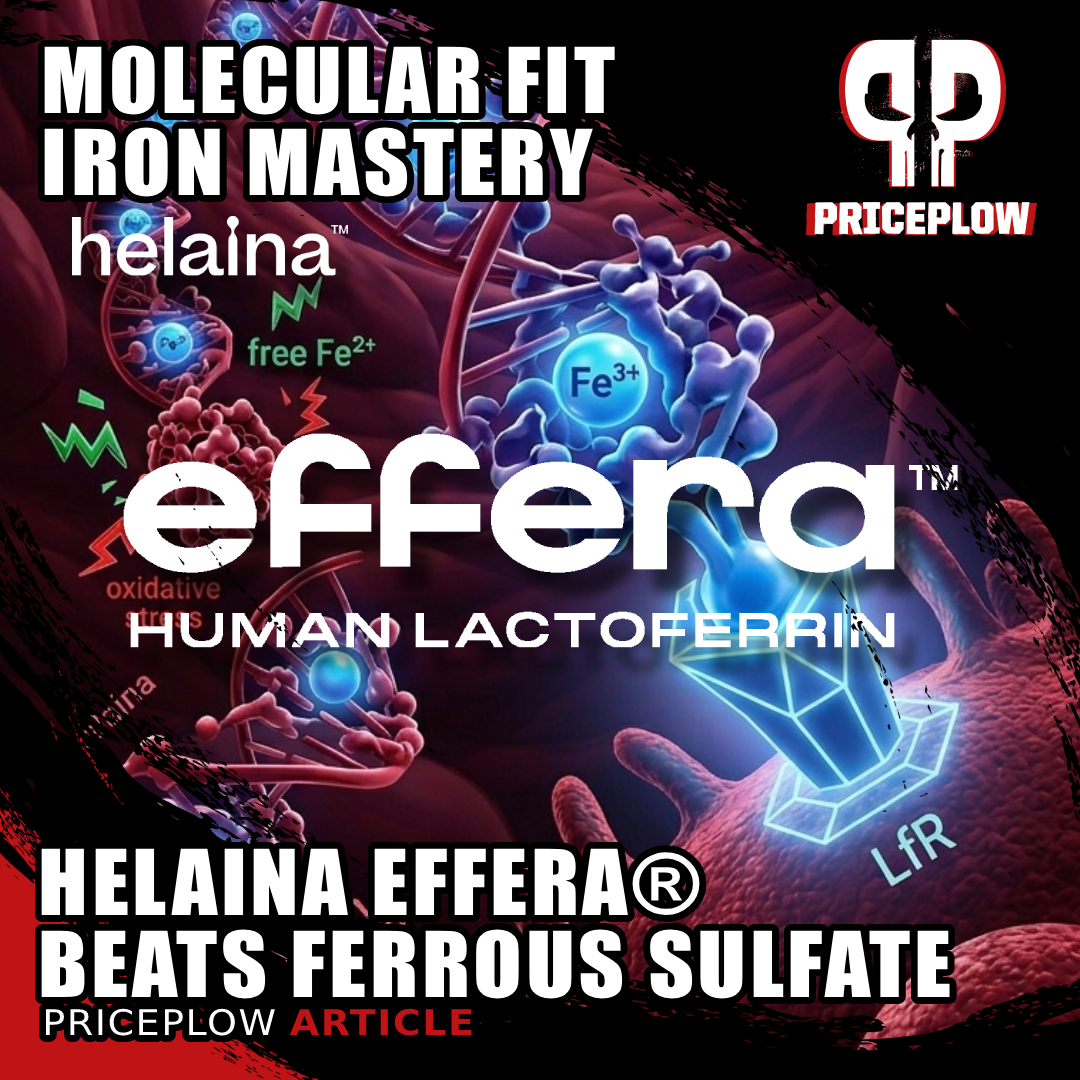
Why does lactoferrin beat ferrous sulfate despite absorbing less iron? The answer is structural. It binds Fe³⁺ safely, uses a dedicated gut receptor, and avoids the inflammation cascade that strands iron before it ever reaches your blood.
- Children aged 9 months to 4 years: 20ng/mL or lower
- Adults, and menstruating or pregnant individuals: 30ng/mL or lower
- High-risk groups, including heavy menstrual bleeding and pregnant individuals with anemia: 50ng/mL or lower
- Adults with inflammation, including cancer, inflammatory bowel disease, or infectious disease: ferritin under 100ng/mL or transferrin saturation (TSAT) under 20%
More details are added in the full guideline in Blood Advances, from a multidisciplinary panel chaired by Dr. Jacquelyn Powers of Texas Children's Hospital and Baylor College of Medicine. Prior thresholds were generally 12ng/mL for young children and 15ng/mL for adults. The 50ng/mL cutoff may be appropriate for adults with symptoms or ongoing risk factors, menstruating individuals with heavy or abnormal bleeding or plans for pregnancy, and pregnant individuals with anemia.[2]
As Dr. Powers put it, "These updated ferritin thresholds provide clear guidance in an area where consensus has been lacking".
Honest About the Evidence

Women's iron needs change at every life stage, and standard iron supplements don't account for that. This piece covers the research on lactoferrin from menstruation through perimenopause and what it means for ferritin, hair loss, and pregnancy outcomes.
The panel used the GRADE framework and is upfront about the limits. The recommendations adopting the higher ferritin thresholds are conditional and generally rest on low-certainty evidence. One notable exception is pregnancy: ASH strongly recommends against using the old 15ng/mL threshold, despite low-certainty evidence.[2]
That candor cuts both ways. The panel described prior diagnostic guidance as limited and not evidence based, so the old numbers weren't standing on firmer ground. ASH chose to prioritize catching deficiency that would otherwise be missed, and for a condition that's inexpensive to test, that's a defensible trade.
As you'll see, this is a topic of vast research, and the scientific community still doesn't have a perfect grip on the nuances, especially in terms of what we can get from bloodwork. A big part of the growth in this area will come from better understanding of the surrounding proteins such as lactoferrin, a tool we're finding to be greatly underutilized.
Inflammation Changes the Math
Ferritin is an acute-phase reactant, meaning it rises with inflammation regardless of how much iron is actually stored. Someone with inflammatory bowel disease, kidney disease, or heart failure can post a "normal" ferritin while iron is actually running low. That's why ASH suggests measuring ferritin and TSAT together in adults with anemia of inflammation, with a 100ng/mL ferritin cutoff.
One useful detail: the panel advises drawing TSAT after a 5 to 9 hour fast, including avoiding iron-containing supplements, since recent intake skews the result.[2]
How Many People This Affects
Female athletes lose iron through training inflammation, menstruation, and foot-strike hemolysis. Lactoferrin works with the body to maintain iron status.
ASH's "one in three" estimate comes from a 2024 JAMA Network Open analysis of 8,021 U.S. adults in NHANES, which used the same 30ng/mL cutoff ASH now recommends:[3]
- 14% had absolute iron deficiency (ferritin under 30ng/mL)
- 15% had functional iron deficiency (ferritin at or above 30ng/mL, but TSAT under 20%)
- Among adults without anemia, heart failure, kidney disease, or pregnancy, the figures were still 11% and 15%
- Only 22% to 35% of women with iron deficiency used an iron supplement, depending on age
Worldwide, a 2025 JAMA review puts iron deficiency at about 2 billion people and estimates that roughly 38% of non-pregnant, reproductive-age women in high-income countries have iron deficiency without anemia.[4]
Why Hemoglobin Screening Misses So Much
Routine bloodwork usually screens for anemia through hemoglobin, but anemia is a late-stage signal. People can experience fatigue, difficulty concentrating, exercise intolerance, and restless legs well before it appears.[4] A CDC-authored NHANES analysis found that relying on hemoglobin misses more than 70% of iron deficiency in pregnant women and children.[5]
Ferritin measures the fuel tank. Hemoglobin only tells you the engine is still running.
Two Kinds of Low: Empty Tank vs. Locked Tank
The absolute-versus-functional split is the core idea behind our Iron Homeostasis series.
More iron won't fix deficiency when inflammation blocks absorption. Lactoferrin supports iron homeostasis by reducing inflammation and restoring balance.
- Absolute deficiency is an empty tank. Stores are drained by blood loss, low intake, poor absorption, or pregnancy.
- Functional deficiency is more like a locked tank. Iron stores are present, but not enough iron is available where it's needed.
Hepcidin is one major mechanism that can create that lock, especially during inflammation: the liver hormone shuts down ferroportin (the only known cellular iron exporter) and traps iron inside gut cells, macrophages, and the liver. Inflammatory cytokines like IL-6 switch on hepcidin through STAT3 signaling.[6] Exercise can transiently raise hepcidin as well, creating another obstacle to iron absorption and availability in athletes (see Iron and the Female Athlete).[7]
The NHANES data suggest low iron availability is about as common as depleted iron stores. Functional deficiency outpaced absolute deficiency in every U.S. adult group except women under 50.[3] ASH's separate inflammation threshold formally acknowledges that ferritin alone can't see this problem.
But that's one place conventional oral iron can struggle. When hepcidin remains elevated, simply supplying more ferrous iron often does not fully solve the availability problem, and ferrous sulfate's GI side effects are a main reason people quit. We covered that cycle in Iron Meets Immunity, and why lactoferrin handles iron differently in Iron Fit.
Where Lactoferrin Fits
Laura Katz, founder and CEO of Helaina, discusses the revolutionary effera™ human-identical lactoferrin technology and precision fermentation platform on Episode #167 of the PricePlow Podcast.
Lactoferrin, an iron-binding glycoprotein found in human milk and our own body fluids, carries very little iron. Its value appears to be more regulatory.
Rosa and colleagues' review describes lactoferrin countering IL-6 in inflamed cells, which upregulates ferroportin and transferrin receptor 1. In pregnant women with anemia of inflammation, oral lactoferrin lowered IL-6 and improved hematological parameters while supplying only a sliver of daily iron needs (about 80µg versus 1 to 2mg).[8]
The Meta-Analysis: Lactoferrin vs. Ferrous Sulfate
Zhao et al.'s 2022 meta-analysis pooled 11 studies (9 randomized) and 1,262 participants comparing oral lactoferrin with ferrous sulfate. Relative to ferrous sulfate, lactoferrin produced greater improvements in:[9]
- Serum iron: +41.44µg/dL
- Serum ferritin: +13.6ng/mL
- Hemoglobin: +11.8g/L (about 1.18g/dL)
- IL-6: 45.59pg/mL lower
Interestingly, fractional iron absorption was lower with lactoferrin (by 2.08%). Less iron absorbed, yet better iron status! The authors proposed that lactoferrin's anti-inflammatory effect may help explain the "paradox", which is consistent with the hepcidin model above, although the meta-analysis itself cannot establish that mechanism.[9]
Put the ferritin result next to the new guidelines: 13.6ng/mL is nearly the entire distance between the old adult cutoff (15ng/mL) and the new one (30ng/mL). That's of course a pooled average and you can't promise that for an individual, but it's interesting and highly relevant nonetheless.
Iron and immunity aren't separate systems -- they share the same signals. Lactoferrin sits at that intersection, and effera® delivers it in the human-identical form your body actually recognizes.
There are also some caveats: Most participants were pregnant women, heterogeneity was high (I² of 96% to 99% for the main iron outcomes), some studies lacked randomization or blinding, and the trials used bovine lactoferrin.[9] But given the pervasive problem of iron, and the fact that iron supplementation is not always effective, it's paramount that practitioners learn about these studies.
Tolerability Is Half the Battle
Meanwhile, a supplement only works if people keep taking it. In a randomized, double-blind trial of 100 pregnant women with iron deficiency anemia, 100mg of bovine lactoferrin twice daily matched 520mg of ferrous sulfate once daily for improving hemoglobin, ferritin, and serum iron over 30 days, with significantly lower abdominal pain and constipation scores.[10] Less side effects means greater compliance. And once again, if lactoferrin, a molecule that itself doesn't carry that much iron, supports the users in the same way that iron did, perhaps total iron body stores aren't always the issue in the first place.
effera®: Human-Identical Lactoferrin
Nearly all of that research used bovine lactoferrin. effera® is made through precision fermentation in the yeast Komagataella phaffii, yielding lactoferrin structurally equivalent to the human protein. In simulated adult digestion, peptides released from effera® correlated strongly with those from human milk lactoferrin, while bovine lactoferrin's peptide profile was significantly different.[11]
Human identity also changes the immunogenicity picture. In a 66-person randomized, double-blind trial, 3.4g/day bovine lactoferrin roughly tripled anti-bovine lactoferrin antibodies by Day 56. But 0.34g or 3.4g/day of effera® produced no increase in anti-human lactoferrin antibodies and no evidence of alloimmunization.[12] We covered that study in The Landmark Lactoferrin Trial That Changed Everything, and newer ex vivo gut-barrier data in our ISSN 2026 coverage.

Laura Katz and Pamela Besada-Lombana take us inside Helaina's Manhattan R&D facility to reveal the precision fermentation science, clinical breakthroughs, and empathy-driven culture behind effera® lactoferrin on Episode #197 of the PricePlow Podcast.
The First effera® Iron Data
In April 2026, researchers published the first iron-status observations with effera® itself, a two-person case series in Cureus.[13] Both women were physically active, had long histories of low iron, and had struggled with oral iron. Each took 100mg of effera® daily:
- Case 1 (age 31, 20 weeks): ferritin rose from 11 to 57ng/mL
- Case 2 (age 39, 6 weeks): ferritin rose from 22 to 34ng/mL, serum iron from 41 to 143µg/dL, and TSAT from 11% to 43%, while C-reactive protein fell from 1.7 to 0.8mg/L
Both reported more energy and no GI problems.
Look at Case 2's starting ferritin. Her lab's reference range was 16 to 154ng/mL, so 22ng/mL would be printed as "normal", despite a long history of dizziness, fainting episodes, and fatigue. Under ASH's new adult threshold, that's iron deficiency. Six weeks later, she was above 30ng/mL. The falling CRP matters too: because ferritin rises with inflammation, a ferritin gain alongside lower CRP points to improved stores rather than an inflammatory bump, as the authors noted.[13]
The limitations are just as clear: two people, no control group, self-directed lab testing, and other supplements in the mix (Case 2 also took vitamin C, which enhances iron absorption). We have to note that three of the four authors are Helaina employees. The authors fairly call it a preliminary signal that warrants controlled trials, and we agree. Speaking honestly, we'd go with a higher dose next time, too.
What the New Guidelines Mean for You
Dan DeMarino and Anthony Clark from Helaina dive deep into precision fermentation technology and effera™ human-equivalent lactoferrin, revealing how 5-week development cycles and machine learning models are revolutionizing bioactive protein production on Episode #180 of the PricePlow Podcast.
If you've ever been told your iron is "fine", the new guidelines are a reason to look again:
- Ask for your actual ferritin number. Many lab reference ranges haven't caught up to ASH, so compare your result with the thresholds above.
- Know your risk context. Heavy periods, pregnancy plans, and ongoing symptoms can put you in the 50ng/mL conversation.
- Ask about TSAT if you have an inflammatory condition. Ferritin can look normal when stores are low, and TSAT should be drawn fasted, without iron supplements beforehand.
- Look for the cause. The guideline calls for a detailed menstrual history and for addressing abnormal bleeding at its source, rather than treating the iron number alone.[2]
- Retest. Whatever you try, ferritin is how you'll know whether things are moving in the right direction.
Importantly, diagnosis and treatment belong with a clinician. For people who tolerate ferrous sulfate poorly, or whose ferritin won't budge, lactoferrin is a research-backed option to raise in that conversation for supporting healthy iron status.
Go Deeper: The Iron Series and Podcasts
Our iron homeostasis series covers the mechanisms in depth:
- Iron Homeostasis and effera® Human Lactoferrin: hepcidin, inflammation, and the Zhao meta-analysis
- Iron Meets Immunity: why iron regulation and immune defense share signals
- Iron Fit: how lactoferrin's structure yields better iron outcomes despite lower absorption
- Iron and Women: iron needs from menstruation through perimenopause
- Iron and the Female Athlete: why training suppresses iron absorption
And from the people behind it:
- Episode #167: Helaina founder and CEO Laura Katz on building human-identical lactoferrin
- Episode #180: Business Development Director Dan DeMarino and CTO Anthony Clark on precision fermentation and lactoferrin as an iron "air traffic controller"
- Episode #197: Laura Katz and Director of Early R&D Pamela Besada-Lombana inside Helaina's Manhattan lab
Conclusion: Thirty Is the New Ferritin Floor
ASH has given clinicians what they've been missing: evidence-graded ferritin thresholds and clear support for diagnosing iron deficiency before anemia sets in. For millions of people, a lab result once filed under "normal" now has a name.
The harder question is treatment, with ASH guidance expected in 2027. Some people newly identified by the higher ferritin thresholds simply have depleted stores. Others — particularly those with inflammation or low TSAT despite preserved ferritin — have a more complicated problem involving iron availability, hepcidin, and ferroportin. That second problem is where lactoferrin biology gets especially interesting, and why we'll keep following Helaina's research as more human effera® iron data arrives.
Brands interested in effera® can reach out to Helaina directly. Sign up below for effera®, Helaina, and iron research updates:


Comments and Discussion (Powered by the PricePlow Forum)