Female athletes lose iron through training inflammation, menstruation, and foot-strike hemolysis. Lactoferrin works with the body to maintain iron status.
She does everything right: takes her iron supplement daily, eats her meat and spinach, sleeps enough, and gets bloodwork done when her doctor asks. But six months later, her ferritin has barely moved, she still fades at mile eight of every long run, and her coach is suggesting she double her dose.
She's not doing anything wrong. The problem is that her training is actively working against her supplementation... and conventional iron supplements alone simply can't account for that.
This is Part 5 of our ongoing series on iron homeostasis and effera®, Helaina's precision-fermented human lactoferrin. The earlier articles built the mechanistic foundation: how hepcidin controls iron availability, why ferrous sulfate triggers the very inflammatory cascade that locks iron away, and what makes lactoferrin's regulatory approach structurally different. Here, we apply that framework specifically to active women.
The female athlete's iron problem is compounded in ways the general population's isn't. Menstrual loss, exercise-induced inflammation, and sports culture pressure around body composition can pile onto each other in ways that make the regulatory argument more important here than in any population we've covered so far.
Subscribe to PricePlow's Newsletter and Alerts on These Topics

The Iron Drain Adds Up Differently in Athletes
Iron loss in female athletes doesn't come from one source. It comes from several, simultaneously, and in ways you might have never considered.
The most familiar contributors are menstrual blood loss and dietary gaps, both covered in Iron and Women. But training itself creates iron losses on top of those, through distinct mechanisms that compound without necessarily announcing themselves. Iron is the raw material for hemoglobin, and hemoglobin is what fills red blood cells with oxygen-carrying capacity. So when iron status erodes, red blood cell quality and count follow:[1]
Women's iron needs change at every life stage, and standard iron supplements don't account for that. This piece covers the research on lactoferrin from menstruation through perimenopause and what it means for ferritin, hair loss, and pregnancy outcomes.
- Foot-strike hemolysis breaks red blood cells through the mechanical force of foot impact against the ground. The harder and longer the run, the more pronounced this effect becomes. Hemoglobin released from ruptured cells can pass into the urine, taking iron with it.
- Gastrointestinal bleeding occurs because intense exercise redirects blood flow away from the gut, causing mucosal ischemia and microscopic damage to the intestinal lining, often without noticeable symptoms.
- Sweat iron loss adds a smaller but continuous drain across long training sessions.
- And hematuria (blood in the urine) occurs from exercise-induced trauma to the urinary tract and bladder during high-impact activity.
These losses are modest in isolation. In an athlete training daily, they accumulate across weeks and seasons, stacking directly on top of the menstrual iron loss that already puts female endurance athletes at elevated baseline risk.[1]
Koikawa et al. made this risk profile explicit: female distance runners who menstruate and strictly control body weight are among the populations most prone to developing sports anemia as well as amenorrhea.[2] The two conditions reinforce each other: iron deficiency can suppress the hormonal signaling needed for regular menstruation, and amenorrhea removes a regular marker that would otherwise prompt earlier intervention. The downstream consequences extend well beyond athletic performance, touching fertility, bone density, and long-term hormonal health.
Exercise Triggers Its Own Iron Lockdown
Beyond the mechanical losses, there's a second layer that gets far less attention: training creates an inflammatory signal that directly suppresses iron absorption. And it does so predictably, after every hard session.
More iron won't fix deficiency when inflammation blocks absorption. Lactoferrin supports iron homeostasis by reducing inflammation and restoring balance.
-
The Post-Workout Cascade
Every intense training session triggers an acute-phase response, the same inflammatory reaction the immune system uses during infection. A key cytokine in this response is interleukin-6 (IL-6), which spikes sharply after hard or prolonged exercise. Once IL-6 rises, it signals the liver to produce more hepcidin. Hepcidin then binds to ferroportin, the body's only cellular iron exporter, and internalizes it, shutting down iron absorption in the gut and iron release from storage cells until hepcidin clears.[1]
We covered this cascade and its molecular mechanics in Iron Homeostasis and effera® and Iron Meets Immunity. The difference in the athletic context is frequency: for a sedentary person with chronic inflammation, hepcidin stays elevated as a background condition. For an athlete, hepcidin spikes acutely, recovers, and spikes again with the next hard workout. This means the disruption is built into the training schedule itself.
-
Measured in Marathoners
Roecker et al. put numbers to this directly, measuring urinary hepcidin in 14 female runners before and after the 2004 Berlin Marathon. Hepcidin rose significantly at 24 hours post-race, climbing from a pre-race mean of 34 ng/mg creatinine to a post-race mean of 85 ng/mg creatinine (a 2.5-fold increase across the group). By day three, values had returned to pre-race baseline.[3]

Iron and immunity aren't separate systems -- they share the same signals. Lactoferrin sits at that intersection, and effera® delivers it in the human-identical form your body actually recognizes.
Among the eight strongest responders, individual peak hepcidin values ranged from four to twenty-seven times their pre-race levels. In those athletes, that's a near-complete block on iron absorption during the 24-hour window when nutritional timing and tissue repair matter most.[3]
The athlete who takes her iron supplement post-run (arguably the most intuitive time to supplement) is supplementing directly into that window.
Peeling et al. drew a comparison between the inflammatory profile following intense exercise and what's seen during chronic disease states. The liver doesn't distinguish between "I just ran 26 miles" and "I'm fighting an infection." It simply sees elevated IL-6 and produces hepcidin accordingly.[1] For an athlete training five or six days per week, this is a recurring suppressive event baked into the program, and it needs to be taken seriously.
RED-S: When Energy Restriction Compounds Everything
Many female athletes carry a third compounding factor that doesn't announce itself as an iron problem: low energy availability.
-
From Triad to RED-S
For decades, sports medicine described the "Female Athlete Triad" as three interconnected conditions:[4]
Helaina's effera™ is revolutionizing supplements with the first human-equivalent lactoferrin. Research shows better bioavailability and reduced immune response compared to bovine sources.
- disordered eating,
- menstrual dysfunction, and
- low bone density.
In 2014, the International Olympic Committee convened an expert panel to update that framework. The result was Relative Energy Deficiency in Sport (RED-S), a broader term designed to capture what the old Triad missed: a single underlying driver producing a wide range of physiological consequences.[4]
That driver is an energy deficit relative to what health, daily life, and sport all require. RED-S describes a syndrome that disrupts metabolic rate, menstrual function, bone health, immunity, protein synthesis, cardiovascular health, and iron status, all from the same root cause. And critically, it doesn't require clinical disordered eating to develop. Sports culture pressure around weight and lean physique can produce a meaningful energy deficit in athletes who meet no formal diagnostic threshold for an eating disorder.[4]
-
How Energy Deficit Undermines Iron
The connection between caloric restriction and iron runs in several directions at once.
The most direct path is dietary. An athlete eating 1,600 kilocalories to stay at race weight is unlikely to hit even the standard RDA for iron, let alone the elevated need her training creates. Iron-rich foods like red meat and legumes tend to be among the first casualties when total caloric intake drops.
effera™ human-identical lactoferrin demonstrates no alloimmune response in groundbreaking clinical trial, while bovine lactoferrin triggered antibody responses in over 50% of participants. First study to definitively answer the alloimmunization question for precision-fermented proteins.
Below the diet level, caloric restriction raises cortisol, which amplifies baseline inflammatory signaling and can worsen the post-exercise hepcidin response. Erythropoiesis (red blood cell production) depends on adequate protein and overall energy availability. The International Olympic Committee consensus explicitly identifies impaired protein synthesis as a RED-S consequence, and hemoglobin synthesis is protein-dependent. Even transferrin, the transport protein that carries iron through the bloodstream, requires adequate protein synthesis to maintain circulating concentrations.[4]
What makes RED-S especially difficult to catch in the iron context is that its components each look like separate, manageable problems. The athlete restricts a bit. The training is hard. She gets tired. Her bloodwork shows low ferritin. Her doctor prescribes more iron. None of the underlying dynamics change, and the numbers don't respond.
The result is an athlete who needs more iron than average, absorbs less of it than average, and can't fully utilize what she does absorb. Her coach suggests she double her dose. Her supplement adds inflammatory pressure to a gut that's already overwhelmed... and the vicious cycle continues.
Why Ferrous Sulfate Fails Athletes Especially
Ferrous sulfate's limitations in general populations are significant on their own. In athletes, they compound.
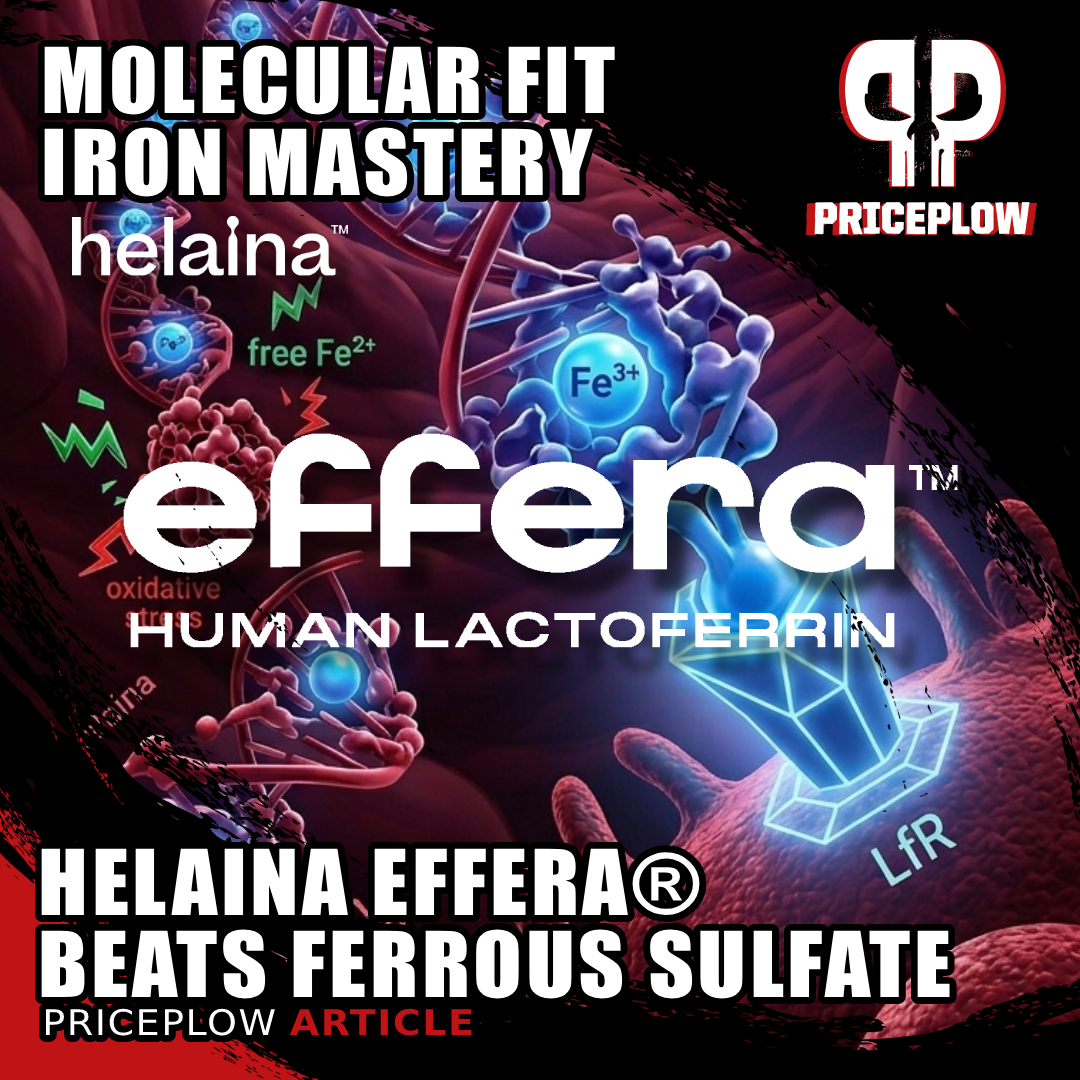
Why does lactoferrin beat ferrous sulfate despite absorbing less iron? The answer is structural. It binds Fe³⁺ safely, uses a dedicated gut receptor, and avoids the inflammation cascade that strands iron before it ever reaches your blood.
Ferrous sulfate delivers a high dose of ferrous iron (Fe²⁺) that generates reactive oxygen species (ROS) during absorption. Those ROS drive gut-level oxidative stress, which elevates IL-6, which triggers additional hepcidin production. This is the cascade covered in detail in our "Iron Fit" article. For a sedentary person with a low inflammatory baseline, it's a manageable tradeoff. For an athlete whose IL-6 is already elevated post-training, the supplement adds inflammatory burden on top of exercise-induced inflammatory burden, generating more hepcidin, which further suppresses ferroportin.
The Zhao 2022 meta-analysis quantified this directly: across 11 pooled clinical trials, ferrous sulfate elevated IL-6 by a weighted mean of 45.59 pg/mL more than lactoferrin (p<0.00001).[5] That's in general populations, without the added training load. For an athlete, that additional IL-6 burden lands on a system already under stress. And unlike the post-exercise hepcidin spike (which resolves within a few days as inflammation clears), the inflammatory effect of ferrous sulfate recurs with every daily dose.
What the Data Show: Lactoferrin in Female Runners
Koikawa et al. designed their RCT around exactly this population: 16 female competitive long-distance runners from Juntendo University's athletics club, training through the summer season, a period of high iron-deficiency risk.[2] All 16 were randomized in a double-blind design: eight received bovine lactoferrin (1.8g/day) plus 6mg of iron daily, and eight received iron alone at the same 6mg dose. Both groups trained comparable distances, consumed similar diets tracked across multiple measurement points, and started from matched baselines on every measured variable.
-
The Eight-Week Results
By the end of the study, the two groups had diverged sharply on every iron-status measure.
We went behind the scenes at Helaina's Manhattan lab to see how they make human-identical effera™ lactoferrin through precision fermentation.
In the iron-only control group, serum ferritin fell significantly from 19.6 to 13.5 ng/mL (p<0.05). Serum iron dropped from 104.4 to 75.8 µg/dL (p<0.05). Red blood cell count fell from 4.2 to 3.9 x10⁶/mL (p<0.05). These athletes supplemented daily with iron throughout the entire study, and their iron status still declined through eight weeks of summer training.
In the lactoferrin group, ferritin fell from 34.1 to 21.4 ng/mL, a decline that didn't reach statistical significance. Serum iron and red blood cell count showed no significant change. After 8 weeks, the lactoferrin group's red blood cell count was significantly higher than the iron-only group's (p<0.01).[2]
The lactoferrin group didn't dramatically improve these numbers, but it maintained them while the control group deteriorated. In a training season that lasts months, "holding stable" versus "declining steadily" is the difference between a strong late season and spending its second half compensating for accumulated iron depletion.
-
Performance, Not Just Lab Values
The trial's most telling data came from the 3,000-meter pace run conducted before and after the study period.
Blood lactate measured immediately after a standardized running effort reflects how efficiently muscles are using oxygen. When iron status is adequate, aerobic metabolism runs cleanly. When iron is compromised, the anaerobic contribution increases, lactate climbs, and the athlete works harder for the same or less output.
Laura Katz and Pamela Besada-Lombana take us inside Helaina's Manhattan R&D facility to reveal the precision fermentation science, clinical breakthroughs, and empathy-driven culture behind effera® lactoferrin on Episode #197 of the PricePlow Podcast.
In the iron-only group, post-run blood lactate climbed significantly from 7.5 to 11.3 mM over the 8 weeks (p<0.01). The lactoferrin group held from 7.0 to 8.3 mM, with no significant change. The difference between the two groups at end-of-study was significant (p<0.05).[2]
That's a functional performance finding, not a biomarker shift in a tube. The iron-only athletes grew measurably less efficient at clearing lactate over eight weeks of the same training program, but the lactoferrin athletes didn't.
For broader context: the Zhao 2022 meta-analysis found lactoferrin produced a weighted mean ferritin advantage of +13.60 ng/mL over ferrous sulfate across diverse clinical populations (p=0.003).[5] In athletes, whose hepcidin environment is significantly more challenging than a general population's, the regulatory advantage should matter even more.


Why effera® Fits the Athletic Context
effera® is precision-fermented human lactoferrin, structurally identical to the lactoferrin the human body produces. The benefits of using human-bioequivalent lactoferrin are especially important in an athletic context.
The body's iron transport and signaling systems evolved around human lactoferrin. The intelectin-1 receptor mediates lactoferrin uptake in intestinal enterocytes and recognizes the human form with high specificity. Bovine lactoferrin differs at the amino acid level, which matters for sustained daily use: in Peterson et al.'s 2024 randomized controlled trial, bovine lactoferrin triggered a significant anti-lactoferrin antibody response (post/pre ratio of 3.01 by day 56), while effera® at both tested doses showed no significant antibody formation (post/pre ratios of 1.07 and 1.02, respectively).[6] For an athlete supplementing daily through a full training season, that's not a minor distinction. The full trial is covered in our alloimmunization deep dive.
The research context for athletes is consistent with how lactoferrin works, as explained in the rest of this series: By modulating the IL-6 pathway, it supports a healthy inflammatory response during the recovery window that follows hard training. Iron availability downstream of that shift supports oxygen delivery to working muscle and the protein synthesis required for muscle repair. When the hepcidin-ferroportin axis is working properly, the system that supports performance can work properly too.
The molecular design behind this, covering the Fe³⁺ binding chemistry, the intelectin-1 receptor pathway, and the downstream avoidance of the oxidative cascade that ferrous sulfate triggers, is laid out fully in Iron Fit: How Lactoferrin's Molecular Design Solves What Ferrous Sulfate Can't.
The Takeaway
The female athlete's iron problem isn't a dosing problem. It's a regulatory problem with three compounding layers that brute-force iron supplementation can't resolve.
Exercise generates an acute hepcidin spike that suppresses absorption in the post-workout window. Energy restriction reduces dietary iron intake, impairs erythropoiesis, and limits the protein synthesis required to use iron once it's absorbed. And ferrous sulfate adds oxidative inflammatory pressure to a gut and immune system already working hard. All of this compounds on top of the baseline menstrual losses that put female athletes at higher starting risk to begin with.
But lactoferrin works at the regulatory level. The Koikawa data showed it translated directly to maintained red blood cell counts and better lactate clearance during standardized running over eight weeks. The Zhao 2022 meta-analysis showed a consistent ferritin advantage across clinical populations. effera® brings that mechanism in human-identical form, without triggering the antibody response that bovine lactoferrin produces in long-term use.
If you've been supplementing iron without results, the regulatory approach using lactoferrin is worth understanding, and this series has the science behind it, with effera® leading the way as the industry's human-bioequivalent option.


Comments and Discussion (Powered by the PricePlow Forum)