Most cognitive-support ingredients on the market pull from the same short list of raw materials: caffeine for alertness, L-theanine to smooth it out, alpha-GPC or citicoline for a choline boost, and a rotating cast of adaptogens for "balance". Maypro's newest ingredient launch skips that list entirely and starts somewhere else: milk.
Maypro's cognitive ingredient starts with milk. PeptiDrive-LNDP is a 19-amino-acid casein peptide with human research on memory, attention, and focus going back to 2017.
PeptiDrive-LNDP™ is a standardized peptide derived from casein, the primary protein in cow's milk, built around a 19-amino-acid fragment called Lactononadecapeptide (LNDP). Maypro Industries and Asahi Group Foods announced a global distribution partnership to bring the ingredient into North America in June 2026, positioning it for the cognitive health category with research supporting focus, memory, attention, and information processing.
PeptiDrive-LNDP™: A Nootropic Peptide from Maypro with Acute Effects
If the name Asahi Group Foods sounds familiar, it should. It's the same manufacturer behind VasoDrive-AP®, the ACE-inhibiting blood pressure peptide Maypro also distributes, which we've covered before. PeptiDrive-LNDP comes out of the same broad tradition of Japanese fermented-dairy peptide research and the same corporate lineage, but it's aimed at a completely different system.
VasoDrive-AP works on blood vessels. PeptiDrive-LNDP works on the brain.
A few reasons this one is worth a closer look:
- It's from the same trusted manufacturer and a research heritage with VasoDrive-AP®, but with a different peptide and mechanism.
- Human research on the underlying peptide dates back to 2017, a great starting point for a newly-launched branded ingredient.
- The newest human trial measured same-day effects from a single dose, not results that only show up after weeks of loading.
- It's built around a general, everyday mental performance story, useful for a work deadline, a study session, a training block, or, yes, a gaming session, rather than one narrow use case.
- Beverage applications just opened up for the first time, bringing the exciting new category to both this and VasoDrive-AP
We'll walk through where this peptide came from, how it's made, what the mechanistic and clinical research shows, and how it's dosed below. Before jumping in, sign up for our Maypro and PeptiDrive alerts so you don't miss out on any major launches:
Subscribe to PricePlow's Newsletter and Alerts on These Topics
PeptiDrive-LNDP and VasoDrive-AP: One Company, Two Peptides
Casein doesn't just supply amino acids for muscle protein synthesis. When it's broken down by enzymes during hydrolysis, it releases smaller bioactive peptide fragments, which are chains of a handful of amino acids that can have biological effects of their own, separate from their value as a protein source.
Most of the sports nutrition industry's attention on milk peptides has gone toward cardiovascular effects, mostly because of VasoDrive-AP® (also sold as AmealPeptide®). That ingredient is a pair of tripeptides, Valyl-Prolyl-Proline and Isoleucyl-Prolyl-Proline, discovered in the 1990s through Japanese research into Lactobacillus helveticus-fermented milk and its effects on blood pressure.
That research tradition goes back further than either peptide. Japanese interest in fermented milk's health effects traces to a "longevity theory" the Pasteur Institute's Élie Metchnikoff proposed in the early 1900s, which helped launch decades of Japanese cultured-dairy research. Asahi Group Foods eventually absorbed Calpis, the sour-milk company behind much of that early L. helveticus fermentation work, giving VasoDrive-AP and LNDP a shared origin point in the same corporate and scientific lineage well before either peptide had a name.
Lactononadecapeptide (LNDP): A 19-Amino-Acid Peptide
Lactononadecapeptide comes out of that same research tradition, but it's a different discovery entirely. Researchers screening peptide fractions from L. helveticus-fermented sour milk whey for their ability to protect against drug-induced memory problems in mice found that a specific 19-residue fragment of beta-casein outperformed the other candidates tested.[1] That fragment, sequence NIPPLTQTPVVVPPFLQPE, is what eventually became known as lactononadecapeptide (LNDP), a name that just describes what it is: a nonadecapeptide, or "19-amino-acid peptide", from milk.
This is important so that we understand the differences between VasoDrive-AP and PeptiDrive-LNDP. They're both casein-derived peptides manufactured by Asahi Group Foods and distributed by Maypro, but that's really where the similarity ends:
- VasoDrive-AP's tripeptides are three amino acids long and work primarily through ACE inhibition, the same pathway targeted by a class of blood pressure medications.
- LNDP is more than six times longer, structurally unrelated, and works through a separate set of pathways tied to brain-derived neurotrophic factor and cholinergic signaling rather than blood vessel dilation.
Same manufacturer, same overall category of milk-derived bioactive peptides... but different molecule and target.
Not a New Ingredient, But New to the West
Cognitive-focused milk peptides have gotten far less commercial attention than their blood-pressure-focused cousins, mostly because the underlying research stayed inside Japanese nutrition journals and conference posters the past decade and haven't crossed over into a branded, US-marketed ingredient. PeptiDrive-LNDP is Maypro and Asahi's tag-team attempt to change that, packaging close to a decade of academic research on the peptide into a single standardized raw material formulators can actually use.
From Fermented Milk to Standardized Powder
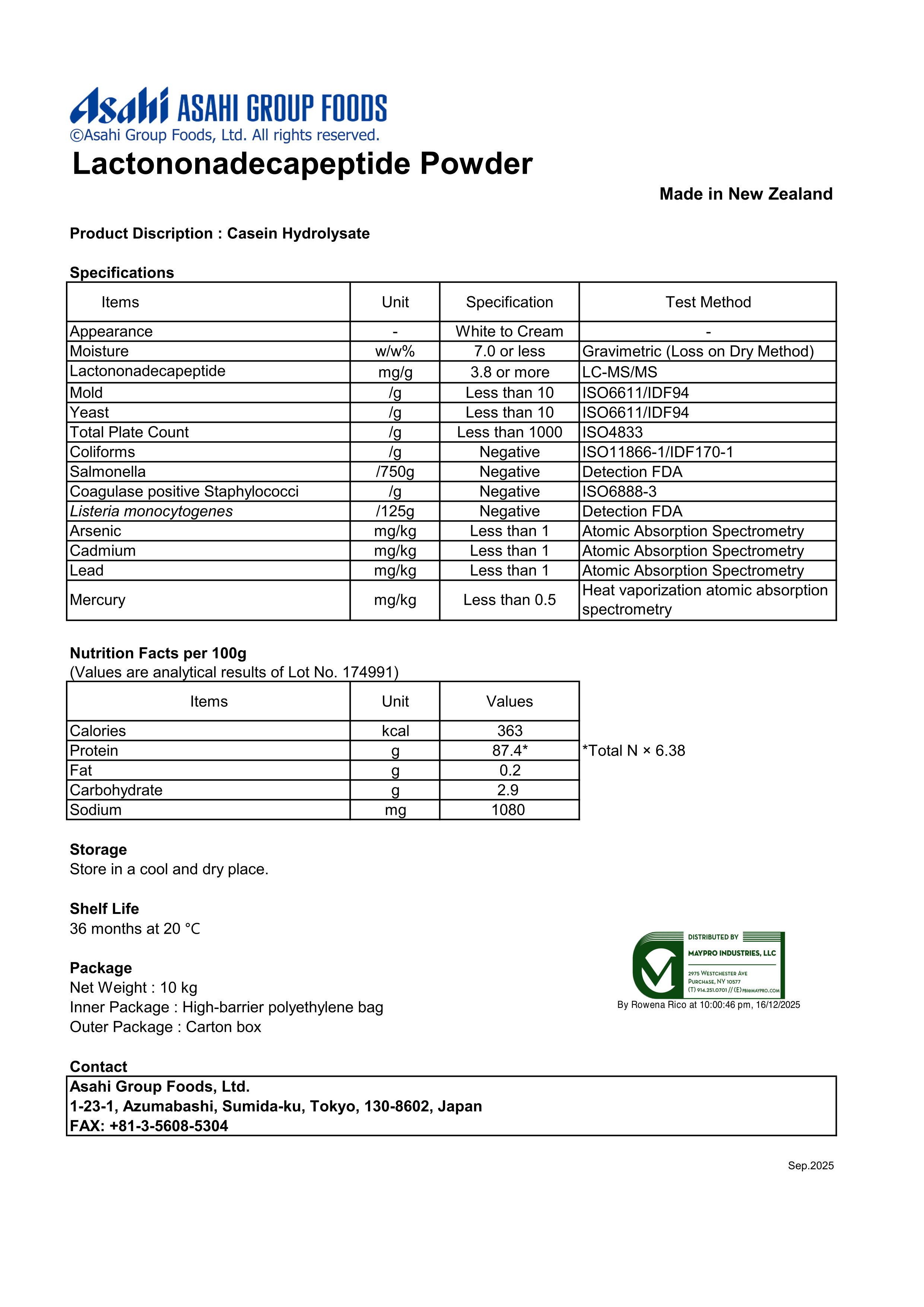
Asahi's spec sheet for the New Zealand made casein hydrolysate behind PeptiDrive-LNDP, guaranteeing at least 3.8mg of lactononadecapeptide per gram alongside heavy metal and microbial limits.
Most of the early human research on LNDP used one of two forms: a tablet made from an extracted casein hydrolysate, or an actual L. helveticus-fermented milk drink consumed daily. Both work fine for a clinical trial, but neither gives a formulator a way to guarantee exactly how much of the peptide ends up in a finished product, since the peptide content of a fermented milk drink depends on the specifics of that batch's fermentation.
Thankfully, PeptiDrive-LNDP is made differently. Asahi Group Foods manufactures it in New Zealand through a defined enzymatic hydrolysis of sodium caseinate using a bacterial protease, a controlled process built to release the target peptide at a guaranteed, standardized concentration instead of whatever a fermentation happens to produce. The finished raw material is standardized to a minimum of 3.8mg of LNDP per gram, letting a formula built around it deliver a specific, repeatable peptide dose instead of an estimate.
But that standardization only matters if the peptide survives long enough in the body to actually do something. A 2024 study on LNDP's behavior in the digestive tract found that it retained more than 90% of its structure after two hours of exposure to gastrointestinal enzymes, and that it crosses the intestinal wall in Caco-2 cell models primarily through the PEPT1 peptide transporter rather than breaking down into individual amino acids first.[2] This is great news, and it's the same basic premise behind VasoDrive-AP's tripeptides surviving digestion intact, only applied to a much longer peptide chain here.
How PeptiDrive-LNDP Works: BDNF, Acetylcholine, and Beyond
The most detailed look at what LNDP might be doing at a molecular level comes from a 2026 study using human neurons grown from stem cells.[3], Researchers exposed the cultured neurons to LNDP and measured gene expression tied to two separate systems: neuroplasticity and cholinergic signaling. LNDP significantly increased expression of BDNF (brain-derived neurotrophic factor), TrkB (the receptor BDNF acts through), and NGF (nerve growth factor), three genes tied to how neurons grow, survive, and form new connections. It also increased expression of ChAT, the enzyme that produces the neurotransmitter acetylcholine, along with the CHRM1 and NMDAR NR1 receptors involved in cholinergic and glutamatergic signaling. A parallel safety screen in PC12 cells found no evidence of toxicity at the concentrations tested.[3]
Mechanisms Match with Preclinical Data
Realize that gene expression in cultured neurons is a mechanistic signal, not a direct measurement of brain chemistry in a living person. But it lines up with two things researchers had already observed in mice years earlier. In the same peptide-screening study that first identified LNDP, the peptide reduced memory impairment in mice given scopolamine, a drug commonly used to disrupt memory temporarily for research purposes, with treated mice showing more correct alternations on a maze task than untreated controls.[1] A separate study used amyloid-beta, a peptide fragment researchers use to model age-related memory changes in animals, to impair memory before testing LNDP against a control group. Oral LNDP intake reduced the impairment on maze-based memory testing compared to the untreated group.[4]

Between the gene expression data and the two mouse models, the current mechanistic story for LNDP centers on neurotrophin support (BDNF and its relatives) and cholinergic signaling (acetylcholine production and receptor activity).
Clinical Evidence: What the Studies Show
-
Early Trials: Tablets and Fermented Milk (2017-2018)
The first published human trial on LNDP ran in 2017: a 12-week, randomized, double-blind, placebo-controlled trial in 72 healthy Japanese adults ranging from middle-aged to senior, taking tablets delivering 2.1mg of LNDP daily. Based upon Uchida-Kraepelin test measurements, cognitive function changed significantly more in the LNDP group than placebo over the 12 weeks. Looking at subscores on the SF-36 questionnaire, several quality-of-life, including social functioning, vitality, and the mental component summary, also improved significantly in the LNDP group with no matching change in placebo. No adverse events were attributed to the tablets, and blood and urine testing showed no notable changes in either group.[5]
A year later, a different research group tested LNDP in its original delivery format: an actual L. helveticus-fermented milk drink. Healthy adults aged 50 to 70 drank either 190g per day of a fermented milk drink providing 2.4mg of LNDP, or a placebo drink, for eight weeks, with cognitive function assessed using the RBANS neuropsychological battery. Total score, attention score, and delayed memory score all improved significantly in the LNDP-based fermented-milk group, and the attention score specifically differed from placebo by the eight-week mark.[6]
-
Two More 2018 Trials: Memory and Information Processing
Two more Japanese trials that same year dosed LNDP considerably higher, at 4.2mg daily, and ran even longer.

Peptides are having a moment in sports nutrition. VasoDrive-AP® didn't arrive with the wave. It's been a clinically studied cardiovascular ingredient for 30 years, and a new 2026 study finally tests it for muscle pump in lifters.
The first screened 137 adults aged 40 to 70 who'd either noticed their own memory lapses or had family or friends point them out, who were then narrowed down to 90 participants after excluding low baseline cognitive scores and statistical outliers. Participants took a placebo tablet or a 4.2mg LNDP tablet daily before breakfast for 16 weeks, with memory assessed using the Wechsler Memory Scale-Revised. In the subgroup of participants whose baseline memory scores were below their age-group average, the LNDP group showed significantly better visual memory and delayed recall than placebo.[7] The effects weren't significant in the full group, but a real effect in people who started below average for their age is a great result for cognitive interventions, and it suggests LNDP's memory benefit may show up most clearly in people who have more room to improve.
A second trial ran the same year at the same 4.2mg dose, in a different population, over a longer 24-week stretch. Researchers screened 140 adults aged 35 to 54 who'd noticed their own decline in reading comprehension, calculation, or general comprehension speed, narrowing to 100 participants with the same cognitive-screening criteria as above. Information-processing ability was assessed with the Wechsler Adult Intelligence Scale. On the object assembly subtest, which measures the ability to mentally assemble visual pieces into a whole, the LNDP group improved significantly more than placebo over the 24 weeks.[8]
-
The Acute Effect: Same-Day Results Under Load
Most of the research above required weeks of consistent daily intake before cognitive changes showed up. A 2021 trial asked a different question: does a single dose do anything, and does it matter if the brain is already under strain?
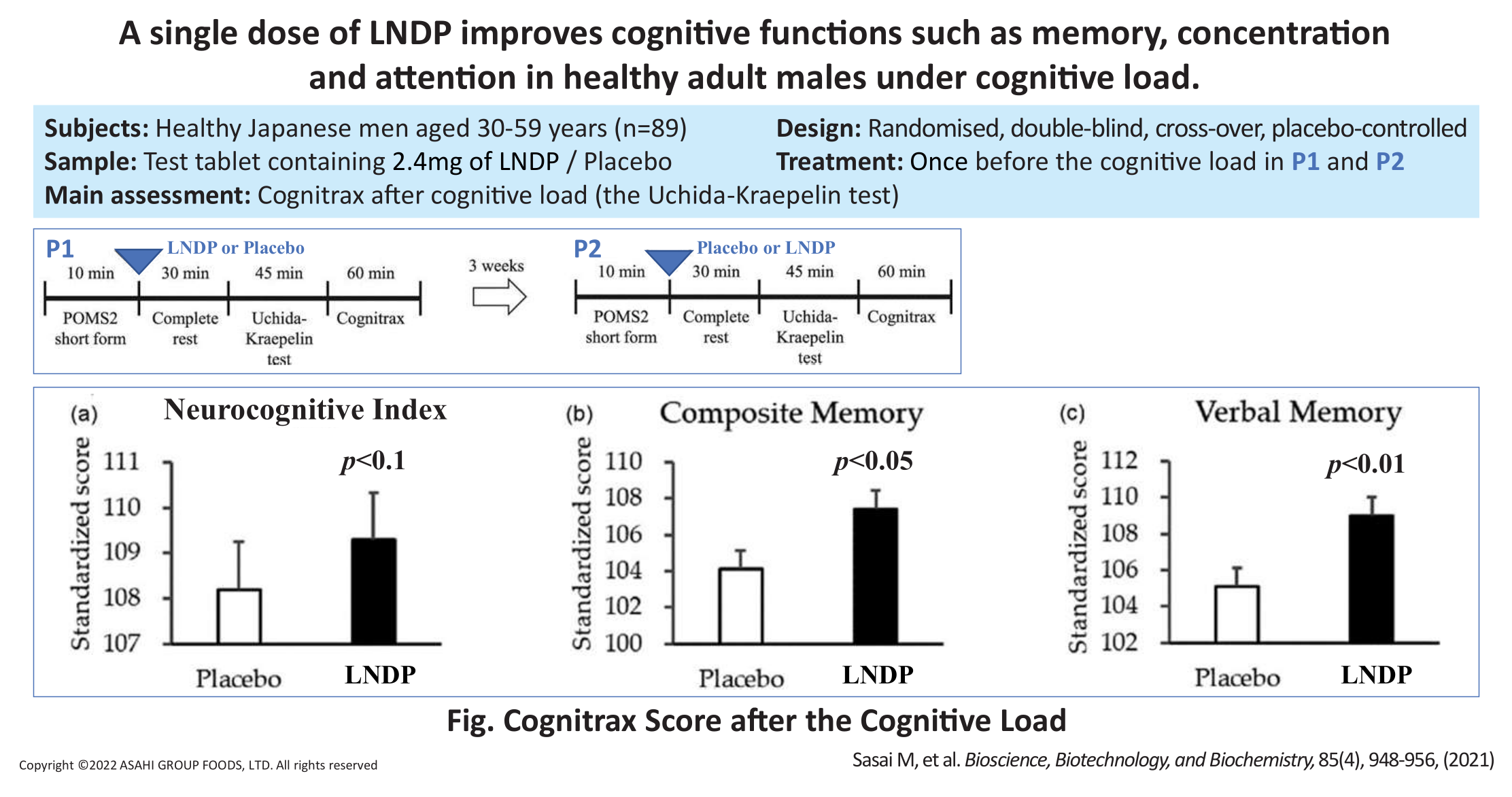
Researchers recruited 89 healthy Japanese men aged 30 to 59 for a randomized, double-blind, cross-over, placebo-controlled trial. Each participant took a single dose of either LNDP or placebo, then completed the Uchida-Kraepelin test, a timed arithmetic task used specifically to induce mental fatigue and cognitive load, before cognitive function was assessed using the Japanese version of CNS Vital Signs. Composite memory and verbal memory scores were significantly higher after LNDP than after placebo, with composite memory reaching significance at p<0.05 and verbal memory at p<0.01. The broader neurocognitive index also trended higher in the LNDP group. Participants who took LNDP scored higher on processing speed, executive function, and cognitive flexibility than those who took placebo.[9]

In Sasai's 2021 crossover trial, 89 healthy men took one 2.4mg LNDP tablet before a timed arithmetic stressor, and composite and verbal memory scores both beat placebo the same day.[9]
This kind of data is great news for nootropic users. Most cognitive-support ingredients that show same-day effects lean on stimulants or fast-acting nutrients like caffeine. A milk-derived peptide showing measurable memory differences from one dose, under an actively induced mental workload, is an exciting result compared to the multi-week loading protocols that dominate most nootropic literature, and it's the study Maypro leans on hardest in its own clinical materials for the ingredient.
This makes sense, too -- users are looking for fast-acting, experiential ingredients, especially in the beverage space. This is a perfect addition to our growing list of exciting functional ingredients that can work in a feel-good beverage or energy drink.
-
Extending the Data Into Older Adults
The newest human trial as of publication took the opposite approach: instead of a single dose, it followed 65-and-older Japanese adults for 24 weeks, comparing daily intake of an LNDP-containing test food against placebo. Using the Rey-Osterrieth Complex Figure test and the Symbol Digit Modalities Test, memory function improved significantly more in the LNDP group over that stretch than in placebo.[10] It's the longest supplementation window tested so far and the first trial to specifically target an older population, a logical next step given the neurotrophin-related mechanisms discussed above.
A lychee-derived polyphenol helped recreational runners run farther while it felt easier. That's the headline from a fresh 2026 randomized trial on Oligonol.
Note one limitation: every human trial on LNDP to date has been conducted in Japanese cohorts. That's obvious given where the ingredient was discovered and developed, but it also means there's no published data yet on how the effects generalize to other populations, similar to where VasoDrive-AP's own research base stood before its more geographically varied trials came along.
Safety, Tolerability, and Regulatory Status
The clinical safety data on LNDP is thin compared with a three-decade-old ingredient like VasoDrive-AP, but what exists is still extremely clean. The 2017 tablet trial specifically tracked adverse events over its 12-week duration and reported none attributed to LNDP, along with no notable shifts in blood or urine markers between groups.[5] The 2026 cell-based mechanism study also included a cytotoxicity screen in PC12 cells alongside its gene expression work and found no toxicity signal at the concentrations tested.[3]
On the manufacturing side, PeptiDrive-LNDP carries self-affirmed Generally Recognized As Safe (GRAS) status for use in foods and dietary supplements, along with gluten-free, Kosher, and Halal certifications. The raw material also goes through standard food-safety testing for heavy metals, microbial contaminants, and common pathogens as part of its certificate of analysis. Because it's derived from milk casein, anyone with a milk protein allergy should treat it like any other dairy-derived ingredient.
Applications and Dosing
Across the six human trials in LNDP's research base, doses range from 2.1mg to 4.2mg daily, in formats spanning tablets, fermented milk drinks, and test foods. Maypro's standardized material sits at the lower end of that range: PeptiDrive-LNDP is used at 632mg, delivering 2.4mg of standardized LNDP, matching the acute single-dose study and the fermented-milk trial directly, and giving formulators a defined clinical reference point to build around.
Timing depends on the use case. The single-dose trial dosed participants once before an induced mental workload, supporting same-day, situational use. The longer trials dosed daily for 8 to 24 weeks, supporting an ongoing daily-intake approach instead. There's human data for both long-term and short-term research, giving formulators room to build either a take-it-when-you-need-it product or a daily cognitive-support product around the same ingredient.
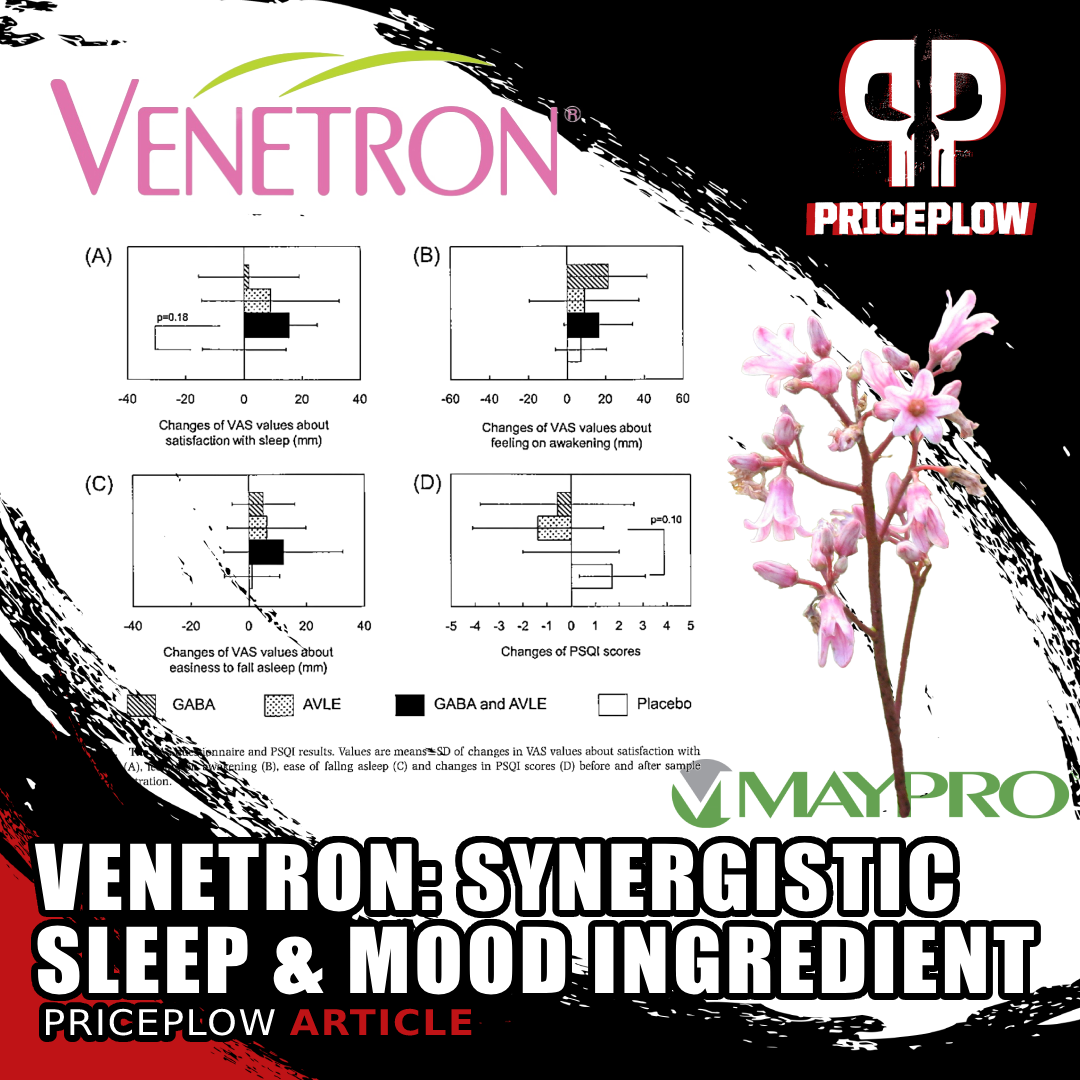
Venetron is an Apocynum venetum extract developed for sleep and stress support by Tokiwa Phytochemical and sold and distributed by Maypro Industries. It synergizes very well with GABA , with constituents that inhibit the metabolism of serotonin.
Format-wise, PeptiDrive-LNDP is available for capsules, tablets, gummies, and powder applications, giving it a place in everything from a daily capsule stack to a beverage or gummy built around focus.
A New Category Opens: Beverages
For most of both peptides' history, Maypro hasn't been able to offer VasoDrive-AP or PeptiDrive-LNDP for beverage use. Asahi Group Foods, which manufactures both, also owns its own beverage business, and that had kept both ingredients out of drinks.
That's changed for PeptiDrive-LNDP. Maypro tells us the restriction has been lifted, proudly opening the door to energy drinks, functional beverages, and other ready-to-drink formats for the first time.
The timing fits the research well. The single-dose acute study covered above measured same-day cognitive effects, exactly the "feel it now" story beverage brands look for, and Maypro reports the ingredient holds up reasonably well in liquid: some cloudiness in solution, but no added color, no odor, and only a mild taste that's easily masked. That's a solid contrast with VasoDrive-AP, which is known in the industry for a noticeably astringent taste and smell despite coming from the same casein-derived peptide family.
None of this comes from a published stability or sensory study, so it's worth treating as an early look with further testing required. But between the acute clinical angle and a taste profile that sounds relatively easy to mask, this looks like a real candidate for the beverage side of the cognitive-health category.
PeptiDrive-LNDP™ also fits naturally alongside other ingredients already in Maypro's lineup. Venetron®, a Valeriana fauriei root extract studied for mood, stress, and sleep, complements the same everyday-mental-performance story from the calming side rather than the focus side. Oligonol®, a low-molecular-weight lychee polyphenol studied for endurance and healthy aging, rounds out a broader stack aimed at long-term brain and body health rather than a single use case.
The Bottom Line on PeptiDrive-LNDP™: A Nootropic Peptide
PeptiDrive-LNDP has a longer research trail than most newly launched ingredients get, especially in the buzzword-heavy peptide space. The underlying peptide's human studies go back to 2017, and Maypro and Asahi Group Foods spent the years since standardizing that research into a single, repeatable raw material before bringing it to North America in June 2026.
VasoDrive-AP and PeptiDrive-LNDP sound similar, but they're much different and work through separate pathways aimed at separate systems: one at blood vessels, one at the brain. What they do share is a conservative research-first approach, with real peer-reviewed trials arriving well before a commercial launch.
The pace of new LNDP research is also worth watching. Two of the studies in this article, the iPSC mechanism study and the 24-week elderly trial, were published in 2026 alone, and they both read like it's just the tip of the iceberg. Between the mechanistic data building a plausible case and the acute study giving formulators a same-day story to build around, PeptiDrive-LNDP™ has more to work with at launch than most newly branded ingredients do.
Whether you're building around a work-focus angle, a study-season stack, a training-day capsule, or now a beverage, keep an eye on where this one shows up first.


Comments and Discussion (Powered by the PricePlow Forum)