
Tea drinkers finally get the functional treatment. Brew Shockalaka Tea Evolved uses real brewed black, green, and white tea extracts, not one variety propped up by flavoring. 160mg caffeine, 160mg L-theanine, CognatiQ coffee fruit, and a disclosed electrolyte panel.
Brew Shockalaka built its name on Coffee Evolved, a zero-sugar nootropic RTD coffee that turned heads with 200mg of natural caffeine and a stacked functional panel in a 45-calorie can. Now the brand's tea-drinking half gets its own lineup: Tea Evolved, a zero-sugar nootropic tea built on brewed black, green, and white tea instead of cold brew.
Making Coffee and Tea Cool Again at Brew Shockalaka
The launch leans directly into that split. Brew Shockalaka is running Tea Evolved under a "Making Coffee & Tea Cool Again" campaign that treats Coffee Evolved and Tea Evolved as friendly rivals inside the same brand. Coffee Evolved isn't going anywhere, and it's still the more-caffeinated of the two. But Tea Evolved is a separately-tuned formula for people who reach for tea first, or who want a gentler option in rotation.
Each 16oz can carries 160mg of natural caffeine and 160mg of L-theanine in a 1:1 ratio, a calmer pairing than Coffee Evolved's original 2:1, caffeine-forward ratio. It also includes 100mg of the same CognatiQ coffee fruit extract used in the Coffee Evolved formula, 1,000mg of taurine that doesn't appear in the coffee version at all, and a fully disclosed electrolyte panel built around a notable dose of magnesium. That magnesium content comes with a specific regulatory story, which we'll unpack in detail below -- it's officially an "excellent source" of magnesium per US labeling guidelines.
Tea Evolved spans three flavors so far, Lemon Wedge Tea, Mixed Berry, and Peach, all built on the same base formula. Below we have the full breakdown of what's actually in the can, starting with the tea itself, but first check out pricing and availability through PricePlow:
Brew Shockalaka Tea Evolved – Deals and Price Drop Alerts
Get Price Alerts
No spam, no scams.
Disclosure: PricePlow relies on pricing from stores with which we have a business relationship. We work hard to keep pricing current, but you may find a better offer.
Posts are sponsored in part by the retailers and/or brands listed on this page.
This area is reserved for Team PricePlow's upcoming videos.
Subscribe to our channel and sign up for notifications so you catch it when it goes live!

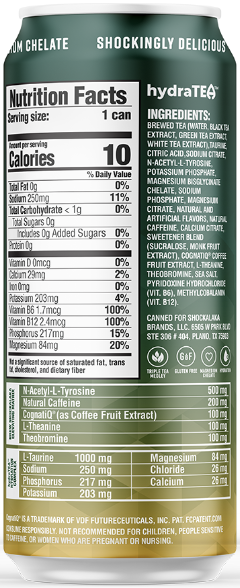
Brew Shockalaka Tea Evolved Nutrition Facts
-
Calories - 10
-
Total Fat - 0g
-
Total Carbohydrate - <1g
-
Total Sugars - 0g
-
Added Sugar - 0g
-
-
-
Protein - 0g
-
Vitamins and Minerals
-
Vitamin B6 - 1.7mg (100% DV)
-
Vitamin B12 - 2.4mcg (100% DV)
-
Magnesium - 84mg (20% DV)
-
Phosphorus - 217mg (15% DV)
-
Sodium - 250mg (11% DV)
-
Potassium - 203mg (4% DV)
-
Calcium - 29mg (2% DV)
-
Brew Shockalaka Tea Evolved Ingredients
Each 16oz can provides the following:
-
Triple Tea Medley: Black, Green & White Tea Extracts
Tea Evolved starts where a tea belongs: with actual brewed tea, specifically a blend of black tea extract, green tea extract, and white tea extract instead of just a single tea type. Most RTD teas use only one variety and lean on added flavoring to do the rest of the work, but Max Fairchild and his team at Brew Shock thought smarter.
It turns out the underlying chemistry backs that decision up, too: each processing method locks in a different set of polyphenols, so blending all three broadens the phytochemical profile beyond what any single tea variety delivers alone. Let's nerd out on tea for just a moment here:
- Black tea is fully oxidized, converting catechins into theaflavins and thearubigins, the reddish-brown polyphenols responsible for its darker color and bolder taste.
A 2025 narrative review of black tea's clinical trial evidence found consistent improvements in vascular and endothelial function, most notably flow-mediated vasodilation, alongside antioxidant, anti-inflammatory, and gut-microbiota effects that favor beneficial species like Flavonifractor plautii. Effects on cognitive function tracked closely with the tea's caffeine and L-theanine content rather than the polyphenols themselves, although effects on lipids and blood glucose were a bit less consistent across trials,[1] but don't worry, green tea has you covered there:
- Green tea skips oxidation entirely, preserving catechins like epigallocatechin gallate (EGCG) largely intact rather than converting them into the compounds found in black tea.

EGCG is both the most abundant and most researched catechin in the Camellia sinensis plant, and it's the reason green tea carries the deepest cardiometabolic evidence base of the three. A massive systematic review and meta-analysis of 55 randomized trials in 4,874 participants found green tea supplementation significantly reduced total cholesterol, LDL cholesterol, fasting blood sugar, and HbA1c, while significantly raising HDL cholesterol and lowering diastolic blood pressure.[2] Those effects are generally tied to EGCG's ability to bind dietary lipids in the gut and inhibit the enzyme that breaks down norepinephrine.
Because of these benefits, green tea is a must-have in a true tea-based beverage. But don't sleep on white tea, which almost nobody includes:
- White tea is the least processed of the three, made from young leaves and buds with minimal oxidation, which preserves the broadest range of fresh-leaf phytochemicals of any tea type here.
A 2025 review of white tea's clinical and mechanistic literature found supporting evidence across weight management, oxidative stress reduction, skin and anti-aging outcomes (including anti-melanogenic effects), glycemic control, and early neuroprotective and liver-protective signals, though the evidence base is obviously smaller and less mature than green or black tea's.[3]
Blending all three means Tea Evolved isn't relying on one tea's polyphenol profile to do all the work. That's a genuine benefit built into the formula, not just a flavor choice. The blend also contributes a modest amount of naturally occurring caffeine on its own, though most of the can's 160mg total comes from the separately labeled Natural Caffeine, discussed next:
- Black tea is fully oxidized, converting catechins into theaflavins and thearubigins, the reddish-brown polyphenols responsible for its darker color and bolder taste.
-
Natural Caffeine - 160mg
Natural Caffeine leads the can's stimulant profile at 160mg, sourced from green coffee beans rather than the tea blend itself. Caffeine's primary mechanism is the antagonism of adenosine receptors in the brain and periphery. Adenosine builds up during wakefulness and promotes fatigue, so blocking it increases the availability of stimulating neurotransmitters including dopamine, norepinephrine, and serotonin. That cascade is what drives caffeine's well-documented benefits for attention, vigilance, and reaction time, especially on sustained or monotonous tasks.[4]

At 160mg, Tea Evolved sits comfortably below the FDA's cited 400mg per day threshold for healthy adults, a level a large systematic review found unassociated with adverse cardiovascular, behavioral, or reproductive effects.[5] It's also decently below the 200mg in BrewShock's Coffee Evolved, which makes sense -- Tea Evolved deserves slightly calmer positioning.
One caffeine-specific timing note worth knowing: a controlled sleep study found that caffeine taken as late as six hours before bedtime still measurably reduced total sleep time relative to placebo,[6] which is worth factoring into when you reach for a can. Your cut-off time will depend on your tolerance and how fast of a caffeine metabolizer you are, as it's genetically determined.
-
L-Theanine - 160mg
L-Theanine matches caffeine milligram for milligram here, an even 1:1 ratio rather than Coffee Evolved's 2:1 caffeine-forward pairing. Unlike the coffee formula, where theanine is simply an added nootropic, this tea's base already also contains it naturally.
L-theanine is an amino acid found almost exclusively in Camellia sinensis, the tea plant, and it's part of why tea has a reputation for calmer energy than coffee. Mechanistically, it dampens excitatory glutamate signaling, boosts brain GABA levels, and promotes alpha brain wave activity, the same relaxed-but-alert state associated with meditation.[7] Theanine alone produces fairly modest cognitive effects, but paired with caffeine the combination very reliably outperforms either ingredient by itself on alertness and attentional switching, an effect a meta-analysis of 11 randomized trials confirmed.[8]
One crossover trial using 200mg theanine alongside 160mg caffeine, Tea Evolved's exact caffeine dose, found the combination improved visual reaction time more than either ingredient alone.[9] A separate trial found theanine plus caffeine improved simple reaction time, working memory speed, and sentence verification accuracy versus placebo in ways neither ingredient replicated solo.[10]
-
CognatiQ® Coffee Fruit Extract - 100mg
CognatiQ carries over from Coffee Evolved at the identical 100mg dose, as it's a different kind of coffee ingredient. Most coffee products use only the bean, discarding the fruit (the "cherry") that surrounds it. CognatiQ is made from that discarded whole fruit, concentrated for polyphenols and chlorogenic acids that never survive the roasting process used on beans. Its standout finding is an effect on brain-derived neurotrophic factor, or BDNF, a protein tied to neuroplasticity and cognitive resilience.

An initial human trial found whole coffee fruit concentrate raised plasma BDNF by roughly 137% to 143% within two hours, a much larger increase than a caffeine-only or polyphenol-only comparator produced,[11] and a follow-up crossover study replicated the BDNF increase against both placebo and brewed coffee.[12] Acute cognitive-performance findings at this exact 100mg dose are more mixed than the BDNF data. One four-arm trial using this same standardized extract at 40% chlorogenic acids found the 100mg dose actually increased mental fatigue and reduced sustained-attention accuracy at 60 minutes versus placebo, with no effect at 300mg,[13] while an earlier trial using the same commercial extract line found both 100mg and 300mg reduced fatigue and preserved alertness after demanding cognitive tasks.[14]
The honest read: CognatiQ's neurotrophic signal is well-replicated, but it isn't an acute focus switch the way caffeine is. That's fine, we'll take both. We covered the full mechanism and BDNF research in more depth when this same ingredient debuted in Coffee Evolved.
-
L-Taurine - 1,000mg
This is the ingredient that doesn't show up in Coffee Evolved at all. L-Taurine is a sulfur-containing amino acid that isn't built into proteins the way most amino acids are. Instead, it exists as a free molecule at high concentrations in electrically active tissue: heart, skeletal muscle, brain, and retina.[15] Its best-known role is as a cellular osmolyte, meaning it helps regulate how much water moves in and out of cells, which ties directly into Tea Evolved's hydraTEA positioning.
Taurine also concentrates in mitochondria, where deficiency has been shown to impair oxidative phosphorylation, so it's more than just a simple antioxidant. Where taurine claims tend to get overstated is cognition, but it does synergize with caffeine: A systematic review of 8 acute human trials found isolated taurine produced small, inconsistent cognitive effects at best, with more reliable benefits showing up only when it's combined with caffeine, which is exactly the context it's in here.[16]
A 2025 network meta-analysis of caffeine and taurine co-supplementation also found the combination consistently outperformed either ingredient alone for reaction time and anaerobic capacity.[17]

Taurine's more durable evidence sits in cardiovascular health, where a meta-analysis of 20 randomized trials using doses of roughly 500mg to 6,000mg daily found meaningful reductions in heart rate and blood pressure,[18] though most of those trials used doses at or above Tea Evolved's 1,000mg, so this can shouldn't be read as a blood-pressure intervention on its own. Still, good to know -- we talk about taurine all the time, and still find ways to claim it's underrated.
-
Magnesium (from Magnesium Bisglycinate Chelate and Magnesium Citrate) - 84mg (20% DV)
This is the part of the formula where Brew Shockalaka is making a bit of extra noise, and diving into the story, it makes for something special that Max and his team have identified. Magnesium is a cofactor for somewhere between 300 and 600 enzymatic reactions in the body, covering ATP energy production, muscle contraction, nerve conduction, and blood pressure regulation.[19] But it's also a widespread shortfall nutrient -- you've likely heard how many people are deficient. The review cited above notes that a majority of Americans consume less than the RDA of 400mg to 420mg per day for adult men, and a similar shortfall shows up in women against their lower 310mg to 320mg target.
Magnesium Glycinate for the Win
Tea Evolved's 84mg comes mainly from magnesium bisglycinate chelate, with a smaller contribution from magnesium citrate. The chelate form is important for a specific chemical reason: magnesium bound to the amino acid glycine can be absorbed in part through amino acid and dipeptide transport pathways in the small intestine, a route separate from the simple ionic diffusion that inorganic forms like magnesium oxide rely on. A bioavailability study in patients with impaired absorption (due to prior intestinal surgery) found magnesium diglycinate was absorbed at roughly twice the rate of magnesium oxide in the most absorption-impaired subjects.[20] Chelated forms also tend to sit easier on the stomach: a crossover trial comparing magnesium sources found bisglycinate improved fecal consistency scores relative to citrate and placebo, with no meaningful increase in GI side effects.[21] In a clinical trial specifically using magnesium bisglycinate chelate at 300mg per day, researchers attributed the form's stronger outcomes partly to its higher bioavailability compared with the lactate and citrate forms tested in earlier cramp studies.[22]
An Excellent Source of Magnesium

Brew Shockalaka RTD coffee delivers zero sugar cognitive enhancement with 200mg natural caffeine + 1000mg nootropics. Three dessert-inspired flavors at just 45 calories.
Now, the regulatory number itself. Federal nutrient content claim rules under 21 CFR 101.54 set the bar for a "good source" claim at 10% to 19% of a nutrient's Daily Value, and a "high" or "excellent source" claim at 20% or more.[23] Magnesium's Daily Value is 420mg, and 84mg works out to exactly 20% of that, which technically lands Tea Evolved's total magnesium content in "excellent source" territory, above even being merely a "good source".
Note, that math applies to the can's total magnesium from both the chelate and the citrate combined, not to the chelate alone. We don't have the individual milligram split between the two forms to verify a claim scoped just to the chelate, but we believe the glycinate form alone is good enough for a "good source" claim too. Brew Shockalaka says Tea Evolved may be the first ready-to-drink beverage on the market to hit this threshold from magnesium bisglycinate chelate specifically, though we haven't fully verified that since there are many drinks on the market. Point is, they're few and far between, if any, with this much magnesium glycinate.
Back to the broader health story, magnesium supplementation does modestly lower blood pressure: an umbrella review of 8,610 participants found reductions of roughly 1.25 mmHg systolic and 1.40 mmHg diastolic overall, with the more meaningful effects concentrated in trials dosing 400mg or more per day,[24] well above what's in one can. Treat the 84mg here as an excellent daily contribution toward a nutrient most people are already short on. It's not a standalone therapeutic dose, but it's not meant to be, either.
-
Electrolyte Complex: Sodium, Potassium, Phosphorus, Calcium & Chloride
Beyond magnesium, Tea Evolved carries a fully disclosed electrolyte profile rather than a proprietary blend, delivered through sodium citrate, potassium phosphate, sodium phosphate, calcium citrate malate, and a touch of sea salt.
- Sodium (250mg, 11% DV) and its counterpart chloride (26mg) are the primary electrolytes lost through sweat and are essential for fluid balance and nerve signaling.
- Potassium (203mg, 4% DV) works opposite sodium as the body's main intracellular cation, supporting nerve transmission and muscle contraction, and it's a nutrient most Western diets under-deliver.
- Phosphorus (217mg, 15% DV) is a structural component of ATP itself, making it directly relevant to the cellular energy production that caffeine and the rest of this formula are trying to support.
- Calcium (29mg, 2% DV) rounds out the panel in a supporting role for muscle and nerve function, though at this dose it's a minor contributor rather than a meaningful source relative to the 1,300mg adult Daily Value.
-
Organic Agave Inulin
Brew Shockalaka's formula explained: 500mg NALT for neurotransmitter support, 100mg CognatiQ (143% BDNF increase), 200mg caffeine with 100mg L-theanine (2:1 ratio), plus theobromine and MCTs. Every ingredient clinically dosed. Zero sugar, zero dairy.
Organic Agave Inulin is a prebiotic fructan fiber, chemically similar to the more common chicory-root inulin found in most fiber-fortified foods. Inulin resists digestion in the small intestine and travels to the colon, where gut bacteria, most notably Bifidobacterium species, ferment it into short-chain fatty acids that support gut barrier function. The clinical studies showing real-deal glycemic or metabolic benefits from inulin generally use doses of 10 grams per day or more,[25] so we don't have that, but this isn't marketed as a glycemic inclusion anyway.
At beverage-level doses, expect a mild prebiotic assist rather than a clinical dose, and no meaningful tolerability concerns. A comprehensive tolerability review found low doses of inulin (under 5 grams per day) are also safe,[26] since extremely high doses of inulin can get cumbersome.
-
Vitamin B6 (Pyridoxine Hydrochloride) - 1.7mg (100% DV)
Vitamin B6 lands at 100% of the Daily Value, a normal, non-excessive amount rather than a megadose. As pyridoxal-5'-phosphate, its active coenzyme form, B6 participates in more than 140 enzymatic reactions, including the synthesis of neurotransmitters like serotonin, dopamine, GABA, and norepinephrine.[27] Pyridoxine hydrochloride, the form used here, is the stable, standard form found in most fortified foods and multivitamins.
-
Vitamin B12 (Methylcobalamin) - 2.4mcg (100% DV)
Vitamin B12 rounds out the can at 100% DV, delivered as methylcobalamin, one of the coenzyme forms of the vitamin rather than the more common synthetic cyanocobalamin. B12 is essential for red blood cell formation, nervous system maintenance, and the methionine cycle. 2.4mcg covers the standard adult RDA.
-
Zero-Sugar Sweetening System
Tea Evolved hits its 10-calorie, zero-sugar profile using a blend of natural and artificial sweeteners rather than table sugar or high-fructose corn syrup we see in so many tea drinks that have fallen out of favor the past couple decades. What matters for the label is the outcome: zero grams of sugar, zero added sugars, and less than 1 gram of total carbohydrate per can, well outside the 35 to 47 grams of sugar found in a typical bottled RTD tea or energy drink.





Flavors Available

Brew Shockalaka just hit three major fitness chains. The zero-sugar nootropic coffee with 200mg caffeine and CognatiQ is now at Onelife Fitness, The Edge Fitness Clubs, and Fitness Connection locations across the Mid-Atlantic, Northeast, Georgia, Texas, and Nevada.
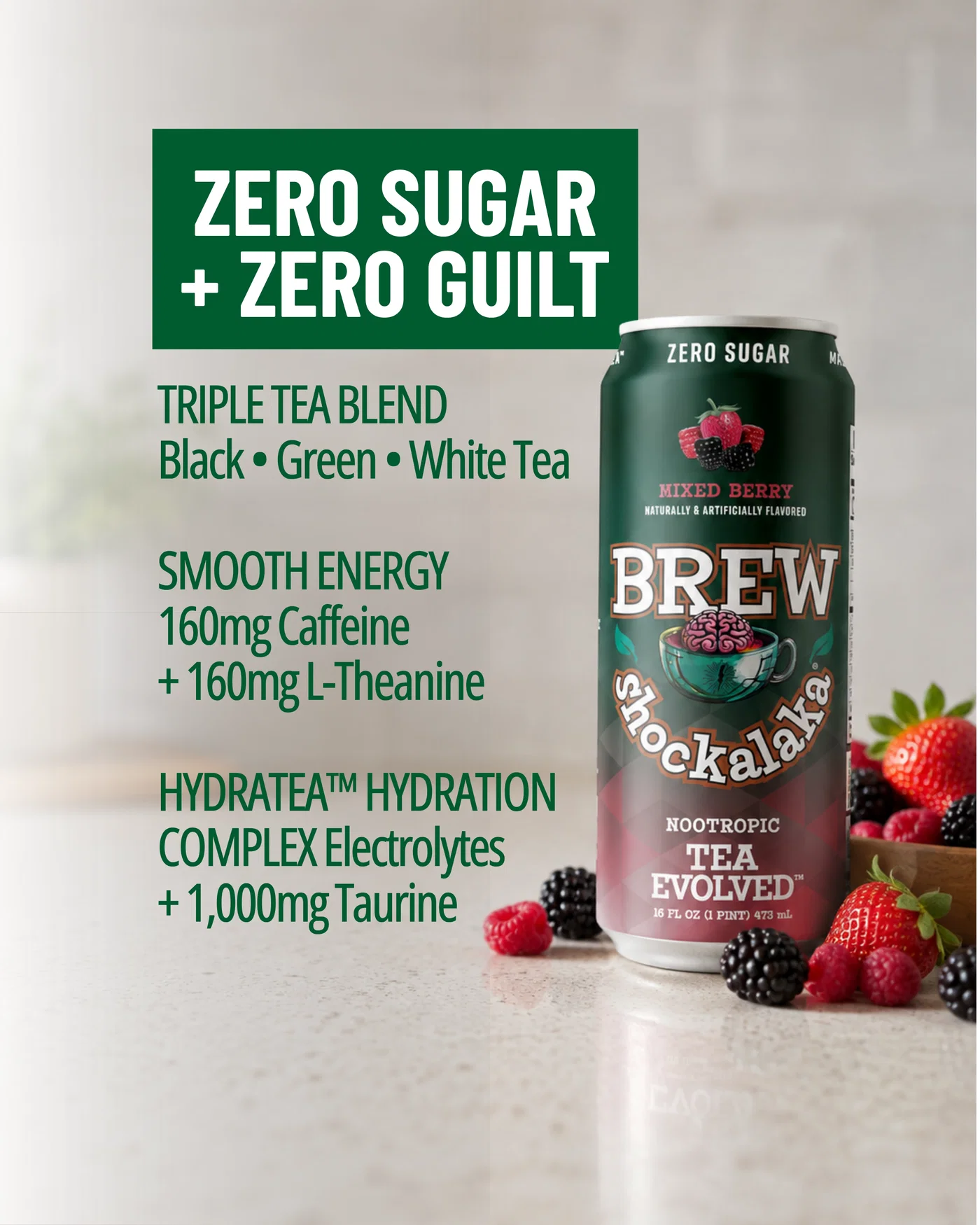
Tea Evolved spans three flavors: Lemon Wedge Tea, Mixed Berry, and Peach. Here's an up-to-date list as availability rolls out:
How to Use
- When to take it: Morning or midday works well given the moderate 160mg caffeine dose, similar to how you'd time a strong cup of tea or coffee.
- With or without food: Either way. There's nothing in this formula, no harsh stimulants, no high fiber load, that should cause issues on an empty stomach.
- Timing note: Caffeine can measurably disrupt sleep even when consumed several hours before bed, so most people should stop drinking it well ahead of bedtime.
Who It's For
- Tea drinkers who want function: If you're tired of RTD teas that are either loaded with sugar or completely flat on ingredients, Tea Evolved gives you a genuine functional formula in a tea-based package.
- Energy drink or RTD coffee switchers: Anyone drinking sweetened iced teas or traditional energy drinks for the caffeine and flavor gets a cleaner alternative here, with a gentler 1:1 caffeine-to-theanine ratio instead of a harder stimulant hit.
- Coffee Evolved fans who want a rotation option: If you already like Brew Shockalaka's coffee formula but want a lower-caffeine, tea-based option for the afternoon, Tea Evolved is built for exactly that.
It's about time tea got some new attention here. The category has greatly needed innovation.
Conclusion: A Worthy Rival to Its Own Coffee
So what team are you on, coffee or tea?

Max Fairchild, Chuck Letchman, and Daniel Pierce reveal how they're revolutionizing the RTD coffee market with Brew Shockalaka's zero-sugar, nootropic-enhanced formula on Episode #182 of the PricePlow Podcast.
Tea Evolved isn't Brew Shock's coffee formula poured into a tea can. Line the two up and you'll find specific, concrete changes: taurine and a fully disclosed electrolyte panel replace the collagen and MCT oil found in Coffee Evolved, the caffeine-to-theanine ratio drops from a stimulant-forward 2:1 to a calmer 1:1, and the calorie count falls from 45 to 10. The one constant is CognatiQ, carried over at the identical 100mg dose, which makes sense given how well it fits the brand's broader nootropic-beverage identity.
Making Coffee & Tea Cool Again
The "Making Coffee & Tea Cool Again" mantra is a fun way to package it, but the formula work Max and his team have done with Tea Evolved is what makes it more than a marketing angle. That's consistent with what Max and Chuck Letchman discussed on our podcast when Coffee Evolved first launched, and it lines up with a brand that's been expanding its retail footprint well beyond its original launch, including a recent nationwide push into major fitness chains.
Whether you're firmly on Team Coffee, Team Tea, or ready to rotate between both, sign up for Brew Shockalaka alerts below to catch availability as Tea Evolved rolls out, and check PricePlow for current pricing on both lines.
Brew Shockalaka Tea Evolved – Deals and Price Drop Alerts
Get Price Alerts
No spam, no scams.
Disclosure: PricePlow relies on pricing from stores with which we have a business relationship. We work hard to keep pricing current, but you may find a better offer.
Posts are sponsored in part by the retailers and/or brands listed on this page.


Comments and Discussion (Powered by the PricePlow Forum)