What happens when a 64-year-old woman takes 10mg of Rg1 before leg press? Muscle biopsies showed a 173% jump in mitochondrial content, a 92% progesterone increase, and no estradiol drop. NuLiv Science's first women's health study on Senactiv.
Most of Senactiv's research story has been performed on young, trained men in their twenties. Cycling tests, squat sessions, and muscle biopsies from twenty-somethings pushing themselves in a lab: that's where the ginsenoside Rg1 in Senactiv® built its senolytic reputation over the past decade.
A new trial changes who's in the room.
Senactiv Supports Postmenopausal Women, Boosting Mitochondria
Researchers at the University of Taipei just published the first Rg1 trial conducted in postmenopausal women, testing whether the senescent-cell-clearing, mitochondria-boosting effects seen in young athletes also show up in women ages 60 to 73 recovering from resistance exercise. NuLiv Science, the ingredient's developer and a longtime PricePlow partner, supplied the Rg1 used in the trial. Luis Gonzalez of NuLiv teased this data back on Episode #217 of the PricePlow Podcast, and we're excited to finally dig into the published numbers.
If you want the full background on how Senactiv works, our Senactiv ingredient overview covers the senolytic mechanism in depth. This piece is about what's new: what happens when a postmenopausal woman takes a single dose of Rg1 before she trains. Subscribe for our news alerts, and then let's dive in:
Subscribe to PricePlow's Newsletter and Alerts on These Topics
Study Design & Methods
This was a randomized, double-blind, placebo-controlled crossover trial, the same basic design NuLiv has used across most of its Rg1 research. Eleven postmenopausal women (ages 60 to 73, mean age 64.8) completed the full protocol, with a three-week washout between conditions. Three of the original 14 enrollees dropped out for scheduling reasons unrelated to the intervention.

Each woman took a single 10mg dose of Rg1, or a matched placebo, with a small protein beverage 1 hour before four sets of 10 seated leg press reps at 70% 1RM.[1] NuLiv states that this 10mg Rg1 dose is equivalent to 100mg of the full Senactiv blend, which is worth noting since many supplements use a 50mg serving.
Researchers took muscle biopsies from the vastus lateralis at baseline, immediately after exercise (0h), and 24 hours later, then used immunofluorescence staining to track three cell populations:
- activated mesenchymal stem cells (Stro-1+/TOM20),
- vascular progenitors (CD34+/CD31+), and
- neural progenitors (Nestin+).
Blood draws at baseline and 24 hours captured sex hormone changes.[1]
The 2026 Senactiv Study Results
-
Progesterone Climbs, Estrogen Decline Eases

Luis Gonzalez, VP of Sales at NuLiv Science, joins the PricePlow Podcast for a thorough podcast covering the full ingredient portfolio, the groundbreaking 2026 AstraGin® whey protein absorption study, Senactiv®'s senolytic research arc, and more on Episode #217.
Estrogen and progesterone help direct and mobilize bone marrow stem cells, and postmenopausal women already run low on both, a shortfall linked to the muscle atrophy and bone loss common after menopause.[1] Resistance exercise alone dropped serum estradiol by 43% at 24 hours, though the decline landed just short of the study's own significance threshold (p = 0.06), likely due to the small number of participants. Rg1 fully offset that estradiol decline, keeping estradiol close to pre-exercise levels.
Progesterone told a cleaner story. Exercise alone didn't move it, but Senactiv's Rg1 nearly doubled progesterone, a 92% increase that did reach statistical significance (p < 0.05).[1] Testosterone, free testosterone, luteinizing hormone, and sex hormone-binding globulin stayed flat in both conditions. The exercise bout itself also raised the inflammatory marker IL-6 by 45%, not a technically significant change (p = 0.08) but strong enough that the authors state as evidence that the training stimulus was a solid effort and taxing enough for the study.[1]
Below, we get into the proposed mechanism, but before each paragraph, we need to define what we're talking about:
-
Stro-1+ Stem Cells and the Mitochondria Story: 173% Increase!
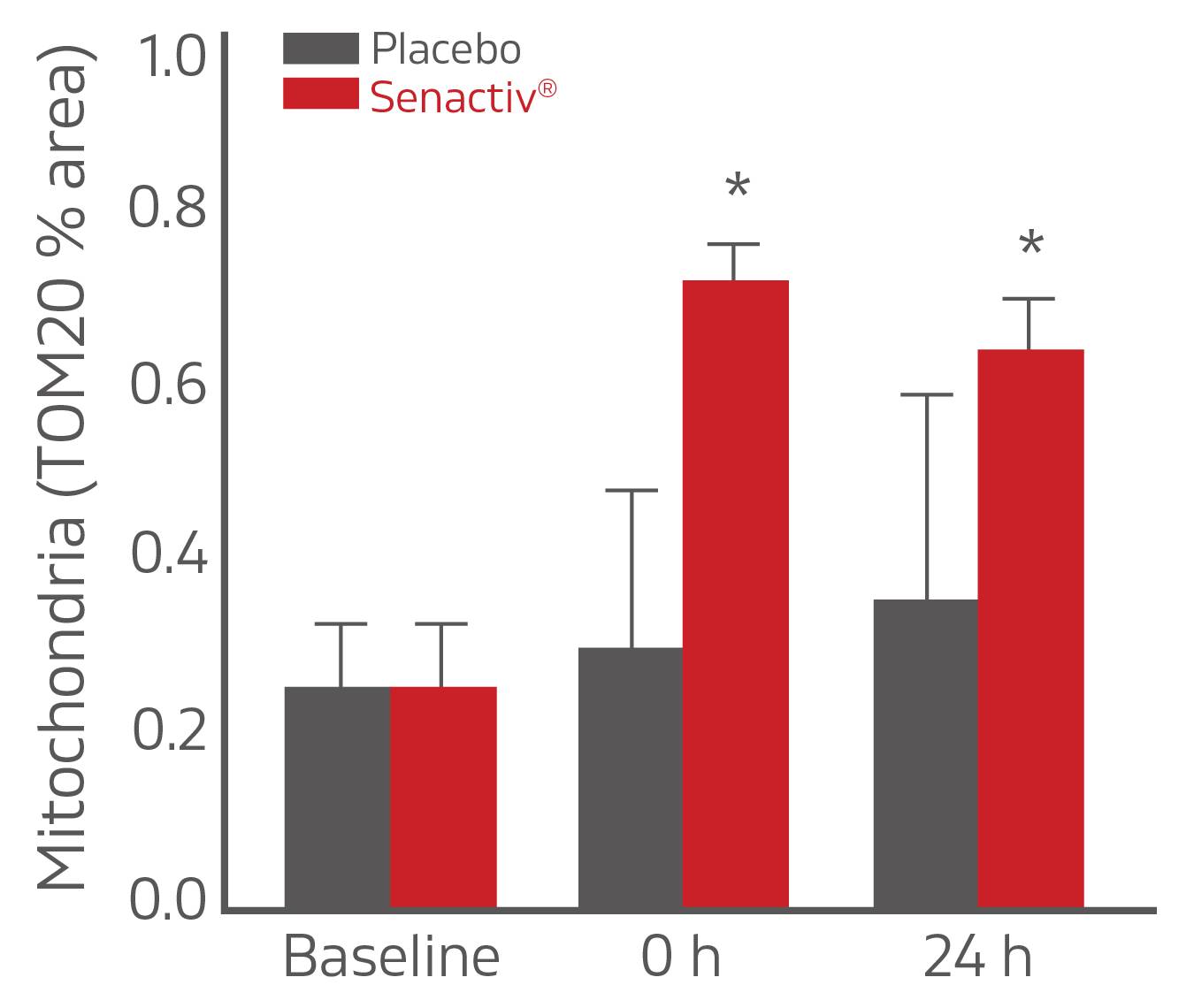
The above results had nothing to do with overall cell counts, though -- it was mitochondria. Resistance exercise alone didn't change total mitochondrial content in the women's muscle tissue, but Rg1 supplementation drove a 173% increase, the result that cleared p < 0.05 significance with real room to spare (p = 0.03).[1]

Senactiv Total Stro-1+ Stem Cell Abundance After Exercise
Trying to understand a mechanism, the researchers have a hypothesis, but the stem cell data behind that number is mixed. This is where Stro-1+ helps us.
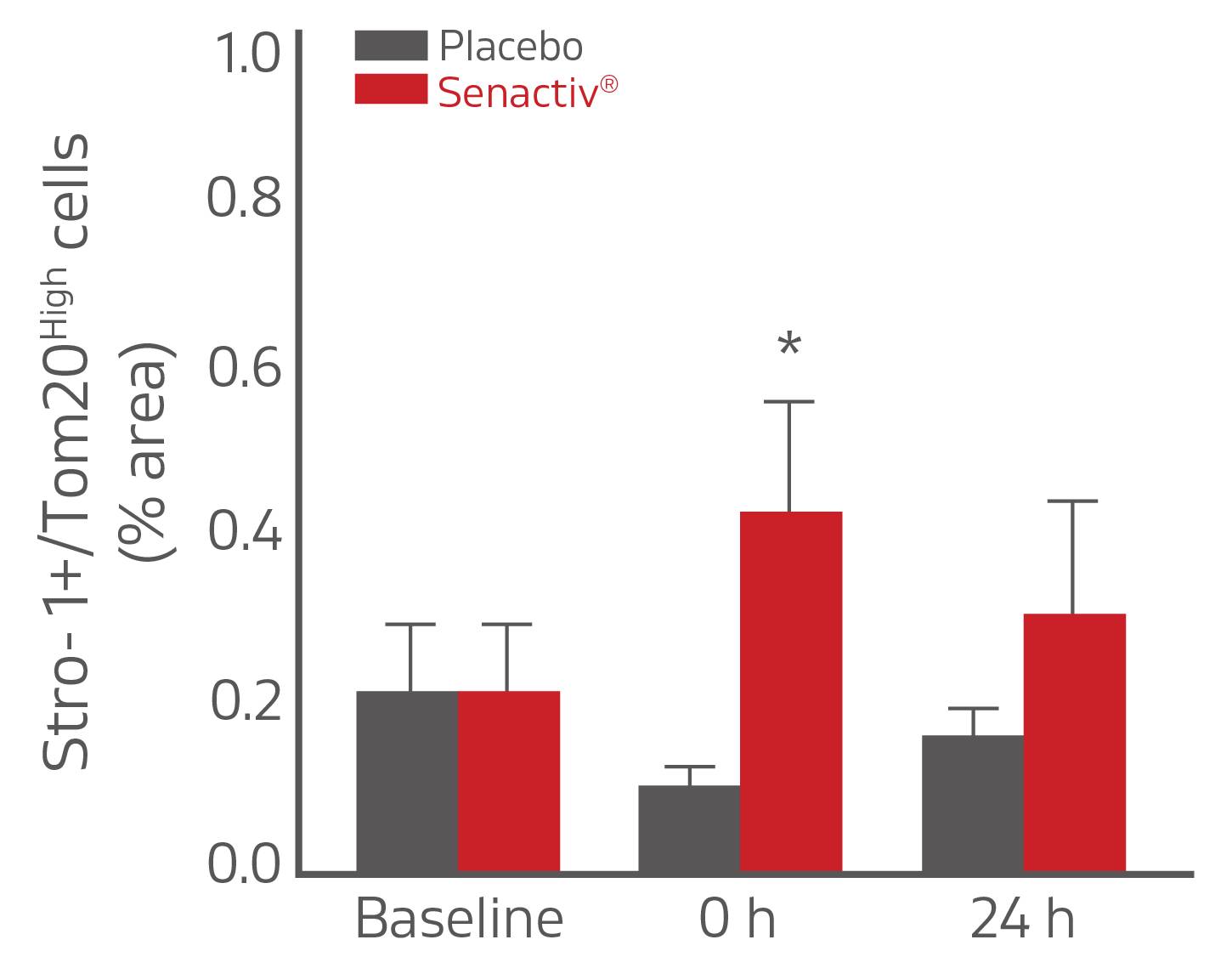
Stro-1+ marks mesenchymal stem cells, a flexible class of bone marrow stem cells that can turn into several different tissue types depending on what the body needs. Pairing that marker with TOM20 (a protein found on mitochondria) lets researchers pinpoint which of those stem cells are unusually energy-rich.

Senactiv Muscle Mitochondrial Content (TOM20) in Postmenopausal Women
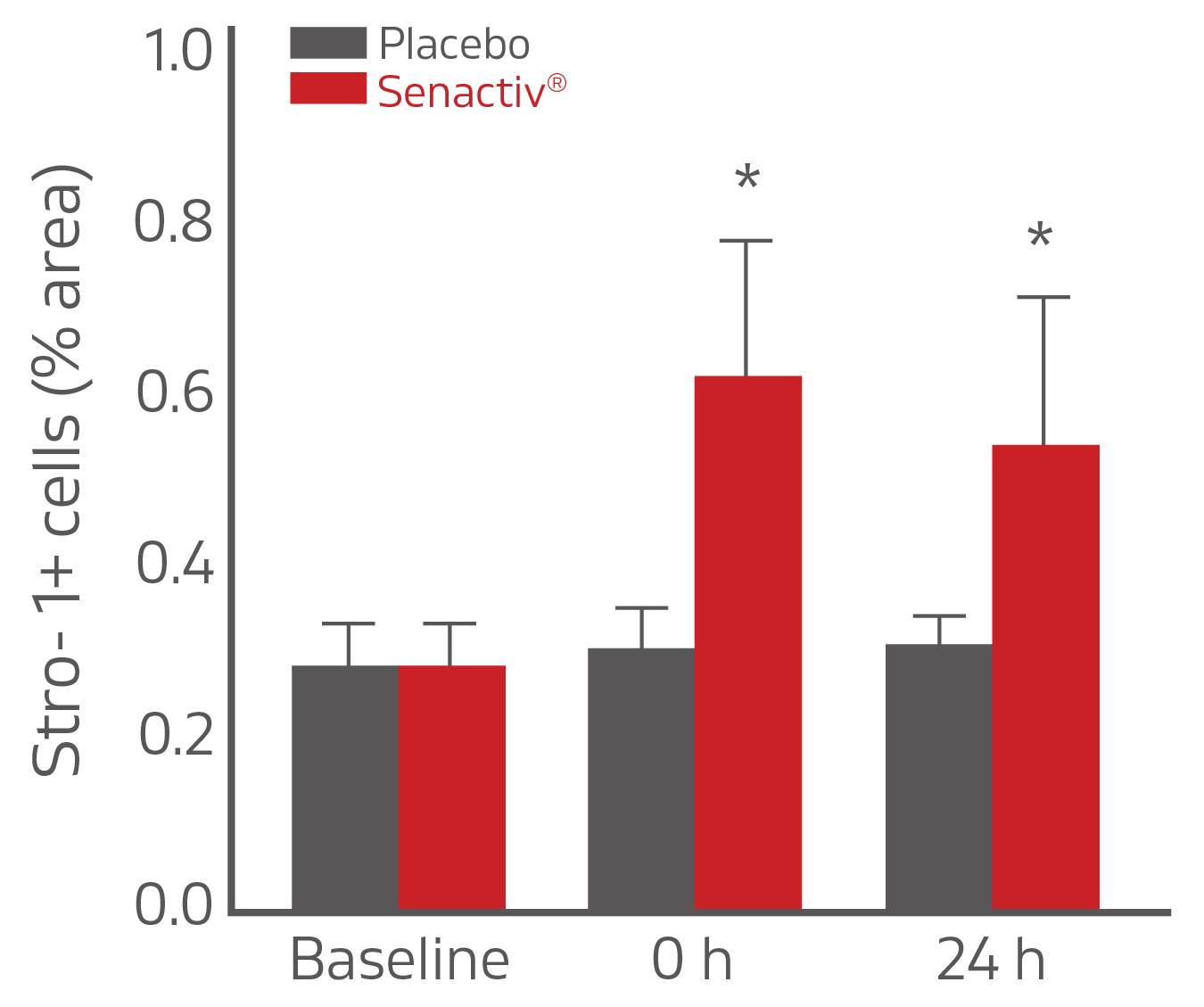
In the study, total Stro-1+ mesenchymal stem cell counts didn't change significantly with exercise alone without Senactiv, but the fraction of those cells with unusually high mitochondrial content (marked by high TOM20 expression) dropped by roughly half immediately after exercise. Rg1 reversed that pattern: total Stro-1+ abundance rose 114% above baseline (p = 0.08), driven mostly by that same high-mitochondria subfraction, though the subfraction increase alone landed at p = 0.14, a trend rather than a confirmed effect.[1]

Senactiv Total Stro-1+ Stem Cell Abundance After Exercise
The mitochondrial content jump is the number worth knowing. The mechanism the authors propose, that bone marrow-derived Stro-1+ cells ferry mitochondria directly into damaged muscle fibers, is a very interesting hypothesis and is backed by some data, albeit data that didn't reach the same statistical confidence.
-
Nestin+ and Vascular Progenitor Cells
Two more progenitor populations shifted under exercise alone, and Rg1 pushed back on both.
Nestin+ marks neural progenitor cells, immature cells that despite the "neural" name also show up in muscle tissue, where they seem to help rebuild the nerve connections that keep repairing muscle fibers working properly.
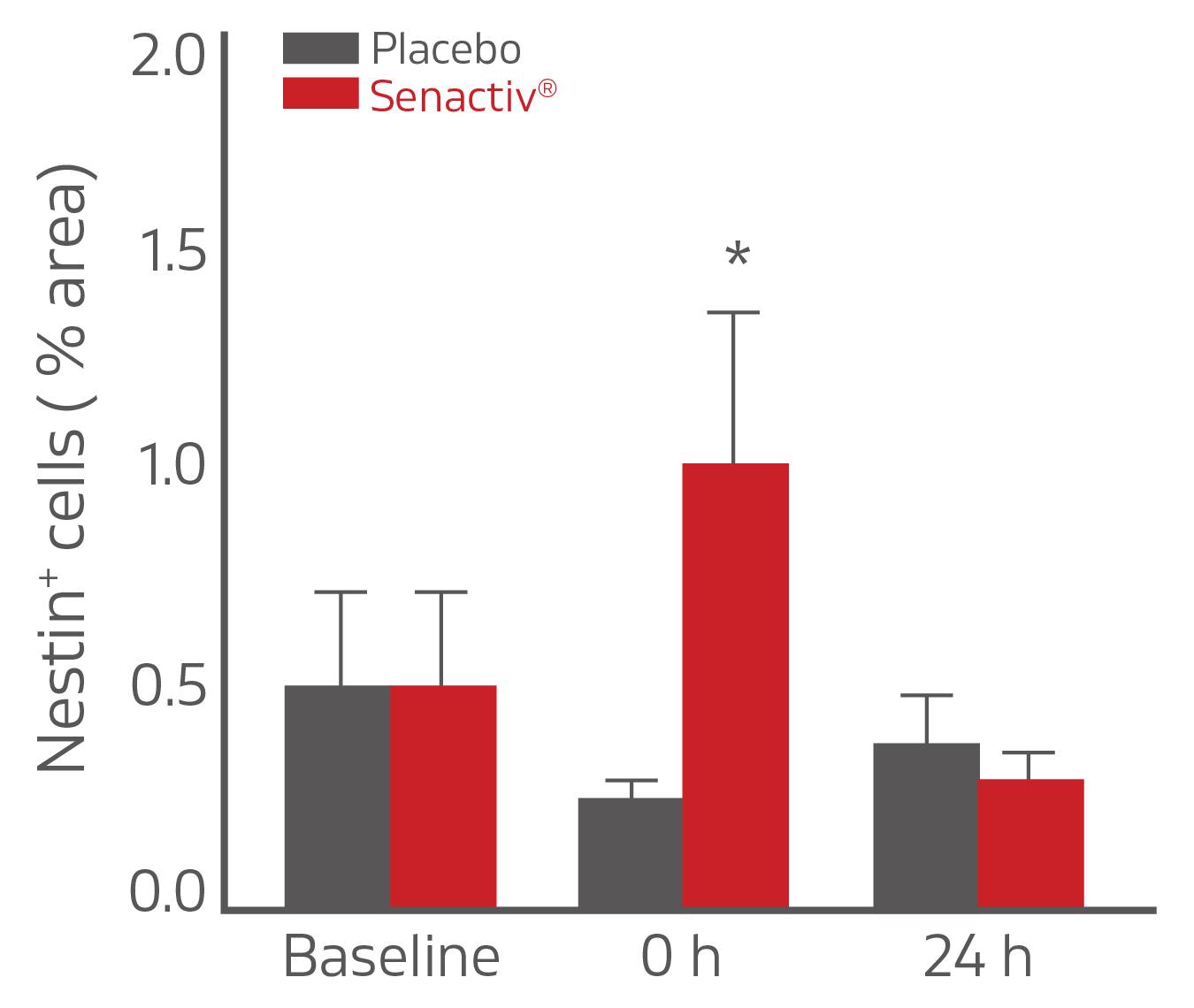
In the study, Nestin+ neural progenitor cells fell after exercise in the placebo condition, while Rg1 produced roughly double the Nestin+ cell levels compared with placebo at the same timepoint (p < 0.05).[1]
Senactiv Nestin+ Neural Progenitor Response After Resistance Exercise
CD34+ marks early-stage stem cells capable of building new blood vessels, while CD31+ marks the more mature cells that actually line those vessels, so tracking both together shows how well the muscle is growing fresh capillaries to feed its own repair.
In the trial, CD34+ vascular progenitor cells dropped a clear 68% at 24 hours post-exercise under placebo, one of the trial's most statistically solid results (p < 0.01). Rg1 reversed the CD34+ depletion entirely and modestly lifted CD31+ cells 33% above baseline, though that increase only reached moderate significance (p = 0.07).[1] The combined CD34+/CD31+ vascular progenitor population stayed flat regardless of condition.

What This Means for Senactiv's Research Arc
Every previous Rg1 trial PricePlow has covered, including the endothelial progenitor rejuvenation study in trained men,[2] came from young, healthy exercisers, mostly men in their twenties. This is the first time the same University of Taipei research group, led by exercise physiologist Chia-Hua Kuo, has tested Rg1 in a population that actually runs low on the sex hormones this mechanism appears to depend on. NuLiv calls this Senactiv's first dedicated women's health study, a notable shift for an ingredient that built its reputation almost entirely on young men's performance data.

The 2021 study in trained men found that exercise alone doubled endothelial progenitor cells within a day, with Rg1 mainly speeding up how quickly senescence markers cleared afterward.[2] In this postmenopausal cohort, exercise alone didn't produce that same rebound. If anything, several progenitor populations dropped and stayed down, which is the gap NuLiv is positioning Rg1 to fill for women managing menopause-related muscle and hormone changes.
If you want to see Senactiv at the dose NuLiv associates with this trial, Ghost Legend carries it at 100mg per scoop. GHOST Hydration Powder uses the ingredient's more common 50mg serving as well, so there are multiple ways to get it from one of the world's most popular brands, who's been formulating with Senactiv even before it had that name (the previous name is ActiGin).
Study Limitations
The authors are upfront about what this trial can and can't tell us. A sample of eleven is small, even with the extra statistical power a crossover design provides, and these women were a self-selected, healthier-than-average subset of postmenopausal women in that age range, since simply reaching 60 to 73 already filters out less healthy peers. The trial also didn't measure resting hemodynamic responses, so the researchers can't fully separate a direct Rg1 effect from a general amplification of the body's normal exercise response. Stem cells aren't the only bone marrow-derived cells known to shuttle mitochondria between tissues either, so the "mitochondrial donor" mechanism proposed here is still just a hypothesis (though one worth testing further), not a settled mechanism.[1]
The authors call the findings exploratory and say they need confirmation in larger trials before anyone draws firm conclusions.
A New Chapter for an Established Ingredient
Senactiv's research arc started with young men chasing better VO2 max numbers. It's now extended into women managing the muscle and hormone shifts that come with menopause, and the strongest result in this trial, a 173% jump in muscle mitochondrial content, is an incredible start. This is a result worth paying attention to regardless of which side of that age range you're on.
We'll keep tracking Senactiv's research as NuLiv expands into this population. Sign up for NuLiv Science alerts below to catch what comes next.


Comments and Discussion (Powered by the PricePlow Forum)