New NNB Nutrition preclinical data on MitoBurn (L-BAIBA) shows 22% endurance and 20% strength gains at ~1,500mg/day HED. Three independent 2025 papers deepen the exercise mimetic story further -- bone health, aging, and muscle protection all in the mix.
When we covered NNB Nutrition's mimetics platform earlier this year, we made the case that MitoBurn (L-BAIBA) is one of exercise's primary molecular messengers, not just a mimic.[1] The research since then hasn't slowed down. New preclinical data from NNB's R&D team directly extends their glycogen supercompensation findings, and a cluster of independent studies is building the kind of mechanistic case that makes formulators take notice.
This article covers the new performance preclinical, then walks through three significant papers published in 2025 that deepen the exercise mimetic story in ways we haven't discussed before.
Before diving in, subscribe to our NNB Nutrition news alerts so you don't miss the next update:
Subscribe to PricePlow's Newsletter and Alerts on These Topics

Quick Recap: The Glycogen Supercompensation Preclinical
If you read our Glycogen Supercompensation Breakthrough article, you'll recall that NNB's internal research showed MitoBurn at a human equivalent dose (HED) of approximately 1,300mg/day could significantly enhance post-exercise glycogen storage (the process of loading more carbohydrate into muscle than normal).
New research shows MitoBurn (L-BAIBA) from NNB Nutrition significantly enhances glycogen storage after exercise. Study found 140-152% higher muscle glycogen and up to 235% higher liver glycogen. Could be a breakthrough for athletes and fitness enthusiasts!
The logical follow-up question was obvious: if the muscles are storing more glycogen, does that actually translate to better performance? That's exactly what the new preclinical set out to answer.
The Performance Preclinical: Strength, Endurance, and Muscle Protection
This new study tested two human-equivalent doses of L-BAIBA against an exercise control group over four weeks. BAIBA-L used a 1,000mg/day HED and BAIBA-H used a 1,500mg/day HED, bracketing that glycogen supercompensation dose and extending the tested range upward.
-
Muscle Strength
By week three, both doses produced meaningful grip strength gains vs. the exercise control. BAIBA-L showed a 5.6% increase (p < 0.05), while BAIBA-H came in at 20% higher and outperformed BAIBA-L by 13.6% (p < 0.0001). These gains arrived without changes in body weight or lean mass, a noteworthy separation between strength signal and tissue growth that cleanly supports a body recomposition positioning.
-
Endurance
The treadmill and forced swimming tests at week four told a consistent story. On the treadmill, BAIBA-H improved endurance by 22.2% vs. control (p < 0.001), with BAIBA-L following at 9.3% (p < 0.05). The dose-response relationship held clearly.

NNB Nutrition's mimetic supplements hack your biology: MitoBurn (L-BAIBA) triggers exercise signals at rest, GlucoVantage (dihydroberberine) activates GLP-1 pathways naturally, and Puremidine (spermidine) mimics fasting's cellular cleanup. The science is wild.
The swimming test produced the strongest numbers: both doses showed roughly 81 to 82% improvements in swimming endurance vs. control (p < 0.05), with no statistically significant difference between doses on that particular test. That kind of improvement in an exhaustive swimming protocol suggests meaningful central and peripheral fatigue resistance, not just a marginal edge.
-
Muscle Protection Markers
The biochemical picture reinforced the performance data. Muscle damage indicators, including superoxide dismutase (SOD), lactate dehydrogenase (LDH), and creatine kinase (CK), all decreased with L-BAIBA supplementation, alongside reduced lactic acid accumulation. Muscle glycogen increased, consistent with the supercompensation findings. The data suggests that L-BAIBA may reduce oxidative stress and accelerate metabolic clearance during exercise, which would directly support the endurance improvements observed.
Putting the Dosage Picture Together
This preclinical, combined with the glycogen supercompensation study, gives NNB a coherent internal data arc. The 1,300mg HED showed metabolic priming (more glycogen storage). The 1,000mg and 1,500mg HEDs now show that priming converts to measurable performance gains. This updates the practical dosing conversation: earlier MitoBurn guidance of 250mg to 500mg per serving reflected what was workable at launch, but the newer research supports a target range of 1,000mg to 1,500mg/day for performance-oriented applications, whether split across one or two servings.

NNB is also moving this toward human data, with clinical trials in progress for weight management, exercise adaptation, and exercise equivalency. A UK study is specifically designed to assess whether L-BAIBA can enhance the effects of low-to-moderate exercise in populations that can't train at higher intensities. We'll cover that when those results land.
The Mimetic Case Grows: Three 2025 Papers Worth Knowing
The performance preclinical is NNB's work. But independent research published in 2025 is building the same story from different angles. Here are three papers that expand the exercise mimetic narrative in meaningful ways.
-
Vallejo et al. 2025: L-BAIBA + Exercise Is Better Than Either Alone
The question of whether L-BAIBA adds to or simply replaces exercise signals matters enormously for positioning MitoBurn. Vallejo et al. published an answer in the journal Aging that's directly relevant.[2]
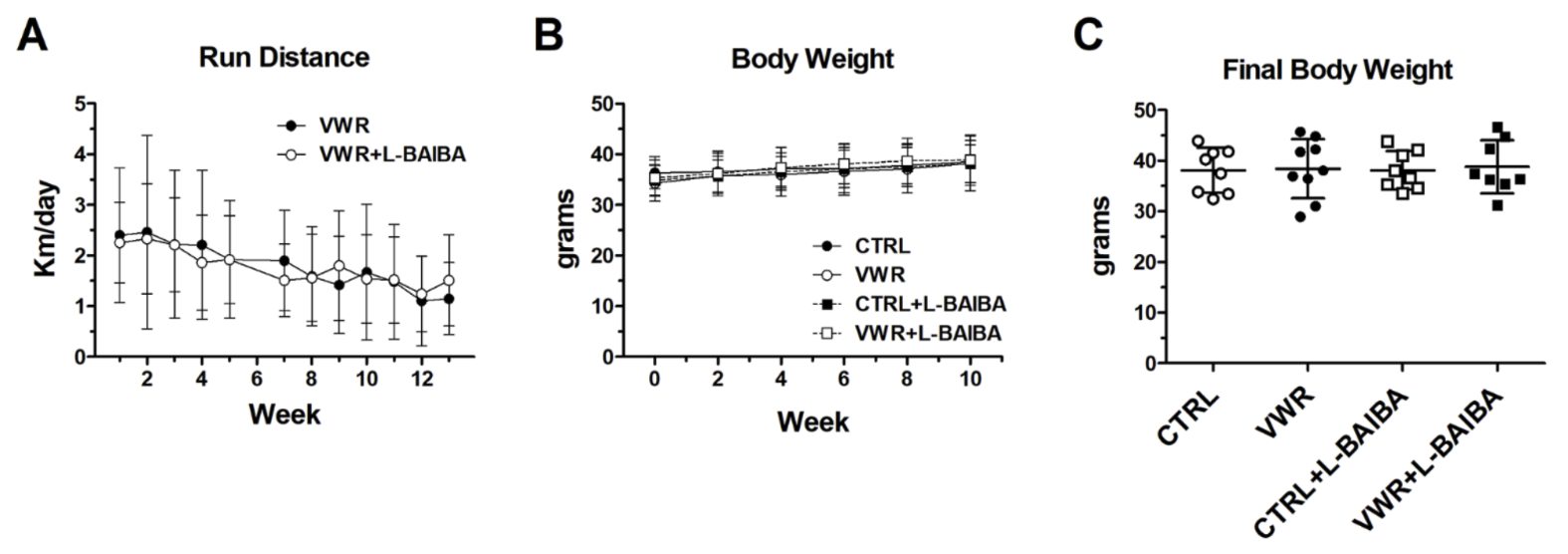
The study used 12-month-old male mice (a middle-age model) and ran four groups for three months: sedentary control, voluntary wheel running (VWR) alone, L-BAIBA alone (100mg/kg/day), and VWR combined with L-BAIBA. The primary finding was that the combination outperformed either intervention independently on the outcomes that mattered most.

Daily running distance declined similarly in both the VWR and VWR+L-BAIBA groups across 12 weeks, while body weight remained stable across all four groups -- confirming that performance and muscle adaptations occurred independent of changes in body mass.[2]
In slow-twitch soleus muscle, VWR alone did not produce statistically significant changes in muscle weight or contractile force compared to sedentary controls. The VWR + L-BAIBA group, however, showed a 17% increase in soleus weight (p = 0.002 vs. control) and marked improvements in contractile output: 15% greater maximal force and 27% greater submaximal force vs. sedentary controls (p < 0.05). Exercise alone didn't reach statistical significance on those measures.[2]
The bone findings were similarly excellent. VWR + L-BAIBA, but not VWR alone, showed lower bone marrow adiposity, higher trabecular thickness, improved trabecular connectivity, and better bone material quality (higher Modulus of Elasticity) compared to controls. The authors conclude that L-BAIBA delays age-related periosteal expansion through improved bone material properties, a mechanism distinct from simple bone mass preservation.
The implication for formulators: L-BAIBA doesn't just mimic exercise, it can amplify the musculoskeletal adaptations that exercise produces. For aging populations, or products designed for moderate-exercise users who won't be doing high-intensity training, that's a meaningful differentiator.
-
Huang et al. 2025: Exercise Uses L-BAIBA as Its Bone-Protective Messenger
While Vallejo showed the combination effect. Huang et al. published work clarifying the mechanism by which exercise itself protects bone, with L-BAIBA as the key signal.[3]

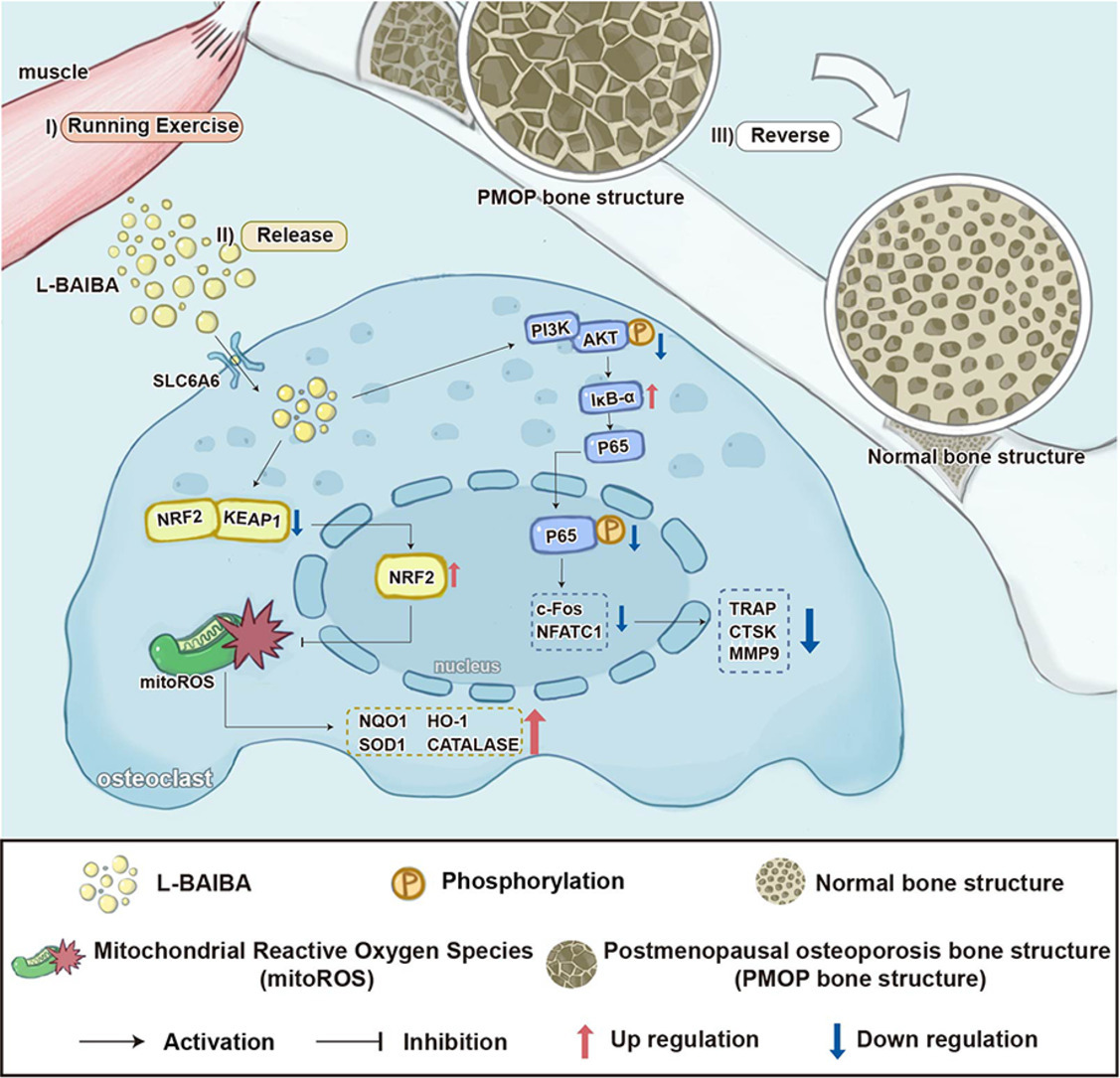
Running exercise triggers muscle release of L-BAIBA, which enters osteoclasts via the SLC6A6 transporter and shuts down the PI3K/AKT/NF-κB pathway -- reducing bone-resorbing activity and shifting degraded postmenopausal bone structure toward a healthier state.[3]
Published in the Journal of Sport and Health Science, the study used an ovariectomized (OVX) mouse model to simulate postmenopausal osteoporosis, then tested both treadmill exercise and direct L-BAIBA supplementation (150mg/kg) against bone loss outcomes.
Eight weeks of exercise increased circulating L-BAIBA, suppressed osteoclastogenesis (bone breakdown), and reduced bone loss in the OVX mice. Crucially, when the researchers supplemented L-BAIBA directly without exercise, they got the same bone-protective effect. The mechanism runs through the SLC6A6 transporter, which downregulates PI3K/AKT/NF-κB signaling and activates the NRF2 antioxidant system, restraining the osteoclasts responsible for bone resorption.[3]
Also note the human-relevance here: L-BAIBA plasma concentrations were significantly reduced in women with postmenopausal osteoporosis compared to healthy controls, and correlated positively with bone mineral density (BMD). The pattern is consistent across mechanisms: exercise increases L-BAIBA secretion, L-BAIBA suppresses the cells that break down bone, and people with lower L-BAIBA have worse bone outcomes.
For MitoBurn, this paper adds a new, independently validated mechanism -- the muscle-to-bone communication pathway that explains why weight-bearing exercise protects skeletal health, with L-BAIBA as the primary messenger in that pathway.
-
Marmondi et al. 2025: BAIBA Gets the "Exerkine" Classification
The third paper worth flagging is a review from Italian researchers covering exercise-induced biomarkers in sarcopenia, published in Sports in December 2025.[4]

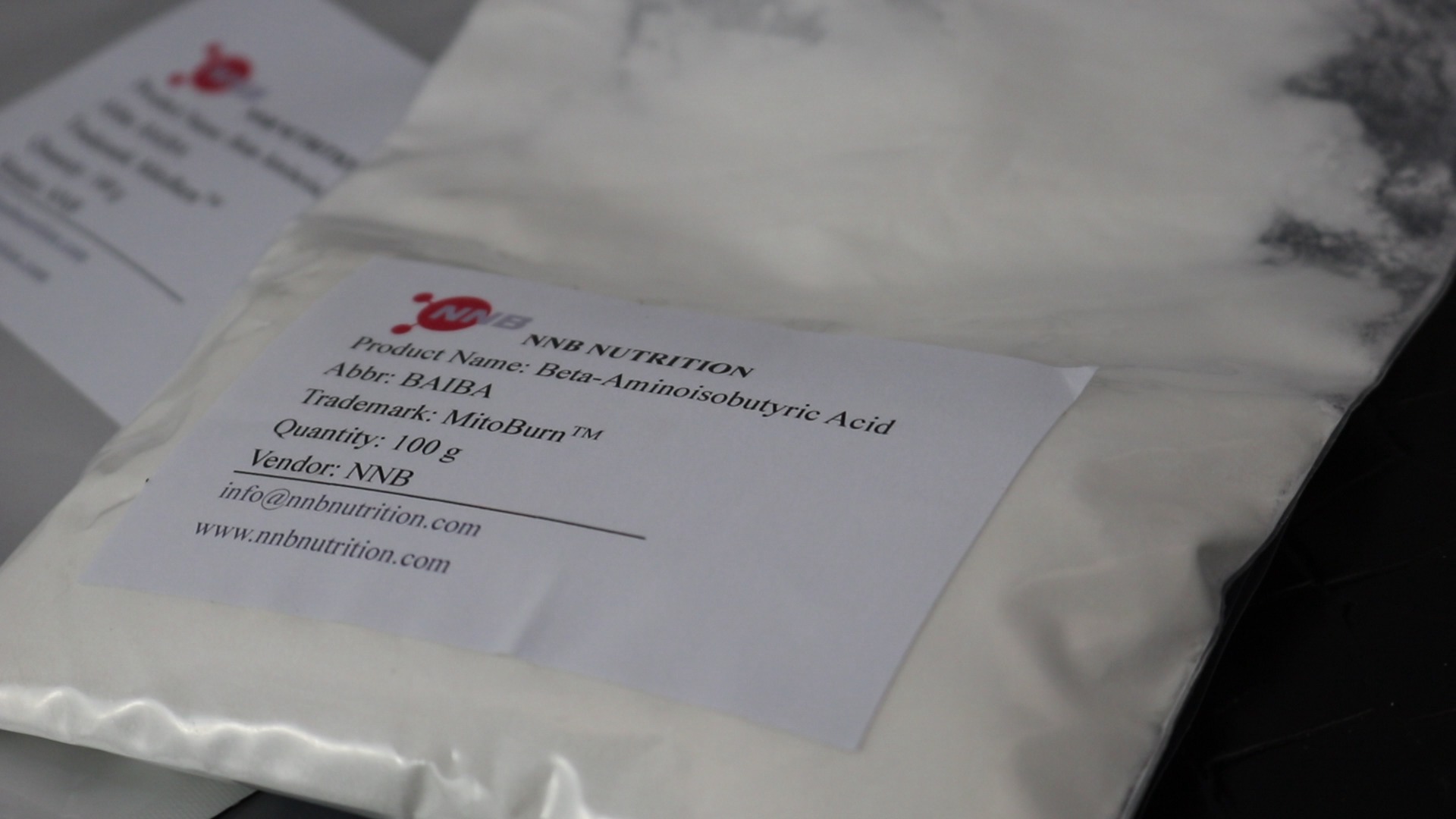
MitoBurn L-BAIBA Powder is nearly tasteless, with just a smidgen of bitterness that's easily covered up.
The significance here is taxonomic as much as mechanistic. The review classifies BAIBA within the emerging class of exerkines, exercise-responsive molecules that exert local and systemic effects regardless of tissue origin, alongside irisin, apelin, BDNF, decorin, and meteorin-like factor (Metrnl). This is the language researchers and clinicians are now using to describe the signaling network that exercise activates, and BAIBA is explicitly named in that group.
The BAIBA section reinforces the L-BAIBA/PGC-1α/AMPK cascade we've covered before, and adds an important clinical nuance: plasma BAIBA tends to decline in older adults, but not because muscle stops producing it. The decline appears to be due to reduced expression of the MRGPRD receptor (L-BAIBA's signaling receptor).[4] The muscle is still sending the signal. The tissue is losing its ability to hear it. That's a distinction with direct implications: supplementing L-BAIBA at higher concentrations may help compensate for reduced receptor sensitivity, restoring a signaling dynamic that aging quietly erodes.
The review calls for research into whether structured exercise can restore BAIBA signaling in older adults and whether BAIBA could serve as a reliable biomarker and therapeutic target for sarcopenia. NNB's clinical pipeline is positioned to answer those questions.
Where MitoBurn Fits Now
Taken together, these four bodies of work shift MitoBurn's application story in a few practical directions.

Walk into any GNC or Vitamin Shoppe and you'll see the supplement revolution in action. NNB Nutrition's ingredients like MitoBurn and CaloriBurn are now in bestselling products across the shelves. The era of fairy dusting is over -– educated consumers demanded better, and they got it.
- Pre-workout and performance formulas are the obvious fit given the new data. The performance preclinical's 22% endurance improvement and 20% strength gain at 1,500mg HED offer numbers that translate directly into copy for stimulant-free or dual-purpose pre-workouts. The three-to-four-week timeline for benefits aligns cleanly with the industry-standard 30-serving supply.
- Healthy aging and mobility products have a stronger case than they did a year ago. Vallejo showed that L-BAIBA + exercise specifically improved slow-twitch (endurance-type) muscle and bone quality in middle-age mice, and the MRGPRD receptor insight from Marmondi gives formulators a mechanistic rationale for positioning MitoBurn in anti-aging blends targeting users who exercise but won't be doing high-intensity training.
- Recovery formulas get a stronger story from the biomarker data. Reduced LDH, CK, and lactic acid are exactly the signals that matter to post-workout recovery positioning.
- Bone health stacks are now a legitimate application. Huang's work, with L-BAIBA suppressing osteoclastogenesis through an identified receptor and pathway while correlating with real-world BMD in humans, gives this category a mechanistic backbone it didn't have before.
The recommended dose range has effectively updated to 1,000mg to 1,500mg/day based on the weight of preclinical evidence. For formulas splitting servings across pre- and post-workout, that's 500mg to 750mg per serving.
What's Next
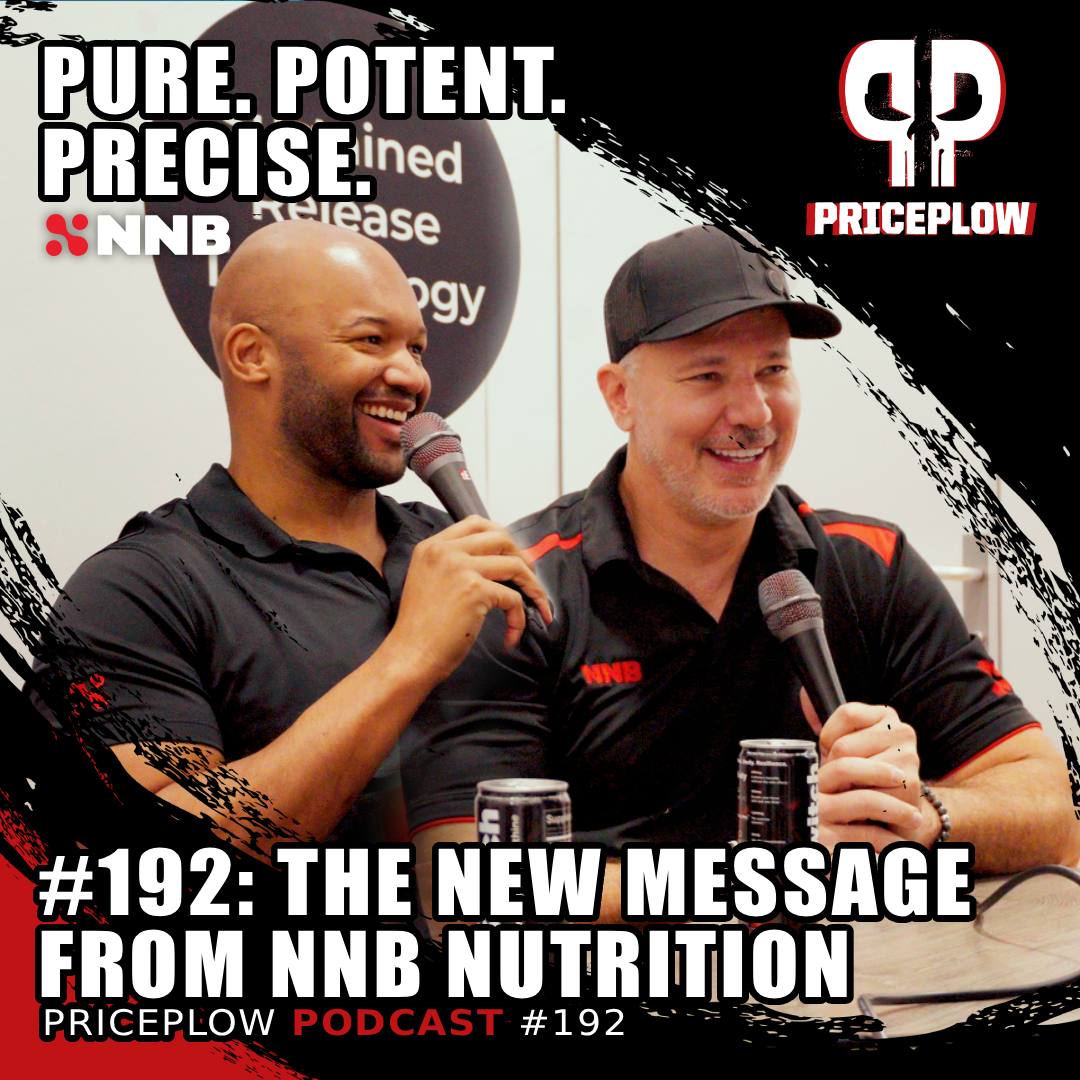
Shawn Wells and Dustin Elliott reveal NNB Nutrition's Pure, Potent, Precise revolution at SupplySide Global 2025, discussing precision fermentation, Pürest Creatine, OnSwitch beverage innovation, and the future of pharmaceutical-grade supplement ingredients on Episode #192 of the PricePlow Podcast
NNB's human clinical pipeline is the obvious next chapter, discussed in detail in our last podcast with Shawn Wells and Dustin Elliott (Episode #192 at SupplySide Global 2025). Trials targeting weight management, exercise adaptation, and exercise equivalency are underway, along with the UK study on low-to-moderate exercise populations and disease states. When human data emerges at these dose levels, it will confirm the translation from preclinical to clinical, or refine the picture further.
For brands and formulators evaluating where MitoBurn fits, the question has shifted. It's no longer whether L-BAIBA does something. It's which application captures the benefit of the research that's already there.
To stay updated on MitoBurn developments and the human clinical results as they arrive, subscribe below:
Subscribe to PricePlow's Newsletter and Alerts on These Topics
For more on NNB's broader mimetics platform, including GlucoVantage (dihydroberberine) and Puremidine (spermidine), check out our NNB Nutrition Mimetics Platform article.


Comments and Discussion (Powered by the PricePlow Forum)