Most whey protein is a cheese byproduct. Native whey skips that process entirely -- filtered from fresh milk with more leucine, intact bioactive fractions, and real digestibility benefits.
Most people shopping for whey protein assume they're comparing versions of the same thing. Same source, different processing grades (ie concentrate, isolate, hydrolysate, etc). Pick your budget, pick your macros, choose a flavor, move on.
Where Your Whey’s Processing Begins Makes a Massive Difference
That assumption misses something important. Not all whey starts from the same place. The majority of whey protein on the market today is a byproduct of cheese manufacturing, and that origin shapes the final product in ways that processing grades alone can't fix. Native whey protein takes a fundamentally different path, one that starts before cheese ever enters the picture.
Native Whey Protein: The Non-Cheese Processing Path
If you've been using protein powder for years without ever asking where the whey actually comes from, this guide is worth reading. And if you want to see what native whey looks like in a well-executed product, check out our full breakdown of Nutristat PÜR NATIVE -- a product we think makes the case as well as any on the market. Its prices are below, check it out and then let's head into our Native Whey guide:
Nutristat PÜR NATIVE – Deals and Price Drop Alerts
Get Price Alerts
No spam, no scams.
Disclosure: PricePlow relies on pricing from stores with which we have a business relationship. We work hard to keep pricing current, but you may find a better offer.
Posts are sponsored in part by the retailers and/or brands listed on this page.
This area is reserved for Team PricePlow's upcoming videos.
Subscribe to our channel and sign up for notifications so you catch it when it goes live!

Where Whey Actually Comes From
To understand native whey, you need to understand the conventional whey supply chain first.
When a dairy producer makes cheese, they curdle milk with heat and acid to separate the solid curds from liquid whey. That liquid is the raw material most whey protein powders come from. It's not spoiled or contaminated -- it's a legitimate food stream -- but it's a byproduct, and it's been through a process that subjects the milk proteins to thermal and acidic stress before they ever reach a filtration step.
That's the first part nobody talks about. You've probably seen "cold-filtered" on protein labels and assumed it meant the whey was handled gently from start to finish. In most cases, that label refers to how the whey was filtered after it came out of the cheese vat -- not how it was treated before. The cold filtration step is real, but it happens downstream of heat and acidification.
Not Native Whey, Though...
Native whey skips the cheese process entirely. It's filtered directly from fresh liquid milk, without acid or heat treatment, before any manufacturing byproduct enters the picture. The result is a protein that's been protected from the processing conditions that alter amino acid profiles, degrade bioactive fractions, and affect digestibility. The term "cold-filtered" actually means something here.
This isn't a processing grade like isolate or concentrate -- it's a source distinction. You can have native whey concentrate or native whey isolate depending on how the protein is further refined. But the "native" label refers to where the whey comes from and what it hasn't been through.
Does it matter? That's where we get into the science next:
The Science: What Native Processing Preserves
-
Leucine Content: The Amino Acid That Pulls the Trigger
Of all the amino acids, leucine has the most direct influence on muscle protein synthesis (MPS). It's the primary activator of the mTORC1 signaling pathway, the upstream switch that tells your muscle cells to start building. But leucine doesn't activate that switch at any dose. Researchers have identified what's called a "leucine threshold", which is a minimum blood concentration that has to be crossed before MPS kicks into high gear.
Native Whey = Fastest and Highest Leucine Rise
This is where native whey's amino acid profile becomes directly relevant. In a five-way crossover study from the Norwegian School of Sport Sciences, researchers gave trained young men 20g of protein from five different dairy sources after a full-body resistance training session, then measured blood amino acid concentrations over two hours. Native whey produced the fastest rise and highest peak blood leucine of all five proteins, significantly outpacing WPC-80 (standard whey concentrate), hydrolysed whey, microparticulated whey, and milk.[1]

Nutristat PÜR NATIVE delivers Native Whey Protein extracted directly from milk, not cheese production. Lab-tested with 3.1g+ leucine per serving and enhanced with NativeZyme technology for superior absorption. Research shows faster recovery and better gains.
The leucine advantage in native whey isn't subtle, either. The amino acid data from that study showed 0.43g leucine per 100g of the native-whey study drink versus 0.34g per 100g of the WPC-80 drink.[1] After accounting for the drinks' slightly different protein concentrations, native whey still provided roughly 18% more leucine per gram of protein.
The hydrolysed whey result is worth noting: this is a form specifically engineered for faster absorption, and it still didn't outperform WPC-80 in that study, let alone native whey! The native advantage isn't a kinetics story though, it's a composition story. Higher leucine content per gram produces higher blood leucine concentrations, and the intact protein structure isn't slowing it down.
-
Cysteine and Glutathione: The Quiet Advantage
Leucine gets most of the attention, but cysteine may be the more underappreciated argument for native whey. Cysteine is a conditionally essential amino acid and the rate-limiting precursor to glutathione, the body's primary intracellular antioxidant. Every cell in your body depends on glutathione to manage oxidative stress, and your muscles are no exception, especially during and after hard training.
The catch is that cysteine's functional integrity depends on its chemical structure. Heat treatment and acid processing can alter the amino acid's form, and there's reason to believe that structurally compromised cysteine isn't as effective a glutathione precursor as intact cysteine. The amino acid profile data from the Hamarsland leucine study puts this in concrete terms: the native-whey study drink contained 0.09g cysteine per 100g versus 0.07g per 100g for the WPC-80 drink.[1] After accounting for the drinks' protein concentrations, that's roughly 20% more cysteine per gram of protein.

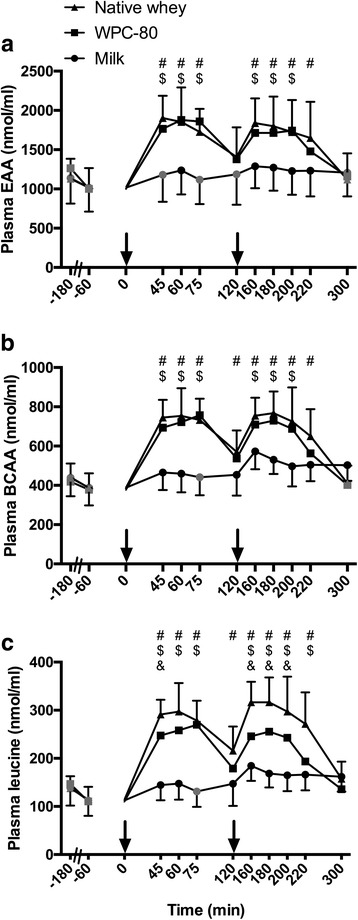
Plasma essential amino acid, BCAA, and leucine concentrations over 300 minutes post-exercise. Both whey proteins produced stronger EAA and BCAA responses than milk, while native whey produced the greatest leucine response.[2]
The Lactalis technical documentation on Prolacta (the raw material's commercial name) notes that cold filtration from raw milk specifically preserves cysteine availability, which they identify as a key differentiator for glutathione synthesis potential. This is still an area of active research, and it's worth being clear that the human data directly measuring glutathione conversion from native versus standard whey cysteine is limited. But the mechanism is sound, and native whey starts from a structurally better position.
-
Bioactive Fractions: More Than Just Protein
Conventional whey processing exposes the liquid protein stream to heat and acidification at the cheese vat stage, before any filtration or refinement occurs. That exposure degrades not just individual amino acids but entire protein fractions with biological activity beyond simple nutrition.
Native whey, filtered directly from cold fresh milk, preserves several of these fractions at higher concentrations. The key ones are lactoferrin, immunoglobulins, and beta-lactoglobulin. Lactalis's documentation on Prolacta specifically identifies higher immunoglobulin and lactoferrin concentrations relative to standard whey proteins as a distinguishing characteristic of cold-filtered native whey.
These aren't inert compounds. Lactoferrin has established roles in immune function and has antimicrobial properties. Immunoglobulins support the mucosal immune system. Neither of these fractions is the primary reason most people buy protein powder, but their preservation is a legitimate marker of product quality. For athletes training at high volumes with elevated infection and illness risk, they're not trivial.
-
Muscle Protein Synthesis: What the Research Actually Shows
This is where you need to read carefully, because the native whey research is genuinely good, but we need to be careful to note that there's still great research on non-native whey too, so it's not to disparage other forms.
The leucine kinetics story from the Hamarsland BMC study is solid and consistent. Native whey reliably delivers more leucine, faster, than standard whey. That part isn't in dispute.[1]
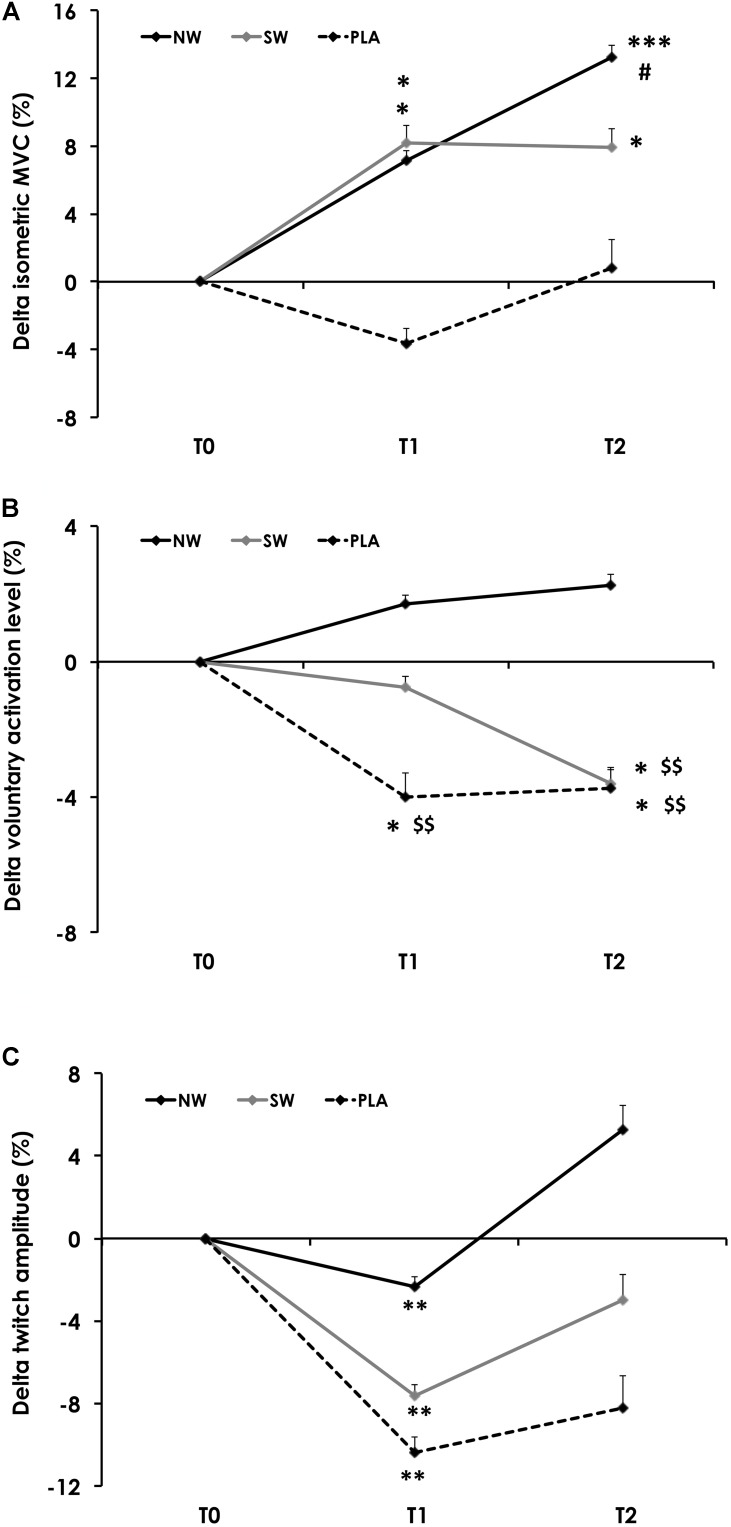
Where the differences become meaningful is in an applied training context. A 12-week study using electrical stimulation and plyometrics found that moderate native whey supplementation promoted better muscle training adaptations and recovery outcomes compared to standard whey.[2] And in a randomized crossover study on rugby sevens players, a recovery drink combining native whey protein and carbohydrates helped maintain sprint performance over a simulated tournament day and attenuated the rise in creatine kinase (a blood marker of muscle damage) compared to placebo.[3]

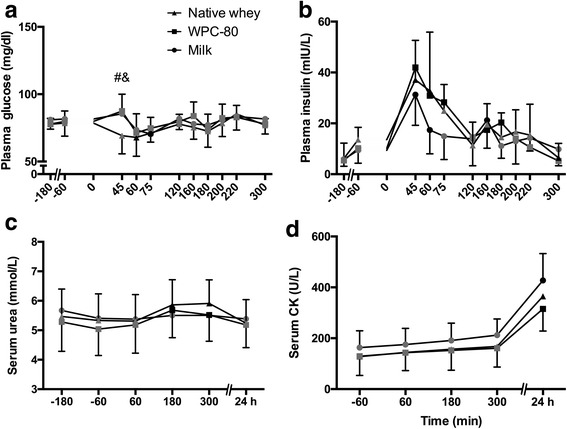
Metabolic and muscle damage markers tracked over 24 hours after protein ingestion. All three sources drove similar insulin and glucose responses, while creatine kinase -- a marker of muscle damage -- rose comparably across groups through the 24-hour window.[2]
These data currently suggest native whey's edge is most visible in recovery and repeated-effort contexts, exactly the situations where protein quality matters most.
The Elderly Population: Where the Leucine Advantage Has the Clearest Case
The leucine threshold isn't fixed. Research indicates it increases with age, meaning older adults require a higher leucine dose per meal to achieve the same MPS response as younger adults. This is a known contributor to age-related muscle loss (sarcopenia), and it makes native whey's amino acid profile directly relevant for older populations.
The Hamarsland elderly data confirms the leucine kinetics advantage holds in older adults: native whey produced significantly higher peak blood leucine than WPC-80 after exercise in adults 70 and older.[4] Interestingly, this didn't translate to statistically significant superior acute MPS versus WPC-80. Native whey was superior to milk for MPS, but WPC-80 was not.[4] The researchers noted this may reflect a leucine saturation effect even at the elevated thresholds seen in elderly individuals. It's definitely tough to achieve significance against standard whey protein.
What the data does clearly support is that for older adults, native whey clears the leucine threshold more reliably per serving than standard whey. Whether they're getting exactly to the same biological ceiling or meaningfully above it may vary by individual protein intake and training status. This matters when you have older individuals simply eating and drinking less overall volume. Native whey's leucine profile is a more comfortable margin for a population that's working against a higher bar.
-
Mechanisms and Protein Quality Markers
A 2023 preclinical study added mechanistic context by comparing native whey protein and commercial whey head-to-head on protein quality metrics. Native whey showed significantly higher biological value and net protein utilization, as well as greater mTOR and p70S6K phosphorylation -- the same downstream signaling proteins studied in the human research.[5] Animal data has obvious limits for extrapolation, but the mechanistic alignment with human studies adds coherence to the overall picture.

Study showing native whey's (NW) superior effects on isometric muscle contraction, voluntary activation, and muscle twitch amplitude compared to standard whey (SW) and placebo (PLA) over multiple time points.[2]
The bottom line: native whey's protein quality advantage is real, grounded in peer-reviewed research, and most pronounced in recovery contexts, high-frequency training, and populations with elevated protein quality requirements. The acute MPS parity with standard whey in young adults isn't a knock on native whey.[6] It reflects how good both options are when leucine thresholds are comfortably met. The native advantage is a larger margin, a better safety net, and a protein that's doing more work per gram across the board.
Who Benefits from Native Whey Protein
The honest answer is most people who use protein powder can gain benefits and need to give a Native Whey product like PÜR NATIVE a shot at least once. But the case is clearest in a few specific situations.
First, if you've had trouble tolerating whey historically (bloating, GI discomfort, poor mixing), native whey is worth trying before writing off the category. The intact protein fractions and lack of acid processing appear to make a real difference for many people who'd otherwise avoid whey entirely.
If you're an athlete focused on maximizing muscle protein synthesis around training, the higher leucine content per gram is a direct advantage. You're clearing the leucine threshold more reliably per serving, which translates to a stronger anabolic signal from the same amount of protein.
Older adults have an even clearer case. The leucine threshold for triggering MPS appears to increase with age, meaning elderly individuals need more leucine per meal to achieve the same anabolic response as younger adults. Native whey's amino acid profile is better suited to clear that elevated threshold, and the research on leucine kinetics in older populations suggests the difference is meaningful and not just a marginal gain.
Finally, if you're the type to read labels and ask questions, native whey gives you a clear, traceable answer to "where does this come from?" That matters if ingredient quality and minimal processing are priorities in how you build your supplement stack.
Nutristat PÜR NATIVE: The Real Cold-Filtered Whey
Nutristat built their reputation on a specific philosophy: use the best available ingredient, dose it correctly, and don't cut corners to hit a price point. You see that pattern in their Creapure creatine choice, their Albion minerals in the wellness line, and their BioATP inclusion in Pre Script. Nutristat PÜR NATIVE fits that same pattern.
The founder's take on native whey is direct: it's the least-processed option available, the amino acids stay intact, and the digestibility difference is real for tons of their customers (including the company leadership). People who've sworn off whey protein because of stomach issues have been able to use PÜR NATIVE without problems. That's what happens when you start with intact protein and skip the cheese vat of heat and acid.
The cysteine-glutathione angle is also one Nutristat takes seriously. The logic is straightforward: when molecules are less denatured, they're more likely to function as nature intended. The data on denatured cysteine and glutathione conversion specifically points toward native-source whey, and it's an area where ongoing research may continue to validate what practitioners in this space have observed for years.
PÜR NATIVE is also where Nutristat's retail growth has been concentrated. Their proteins have driven much of the business, and the native whey product has especially held up because the quality justifies repeat purchases. Flavor and mixability matter, and native whey's solubility profile gives it a real edge: smoother texture, better dispersion, no chalky residue.
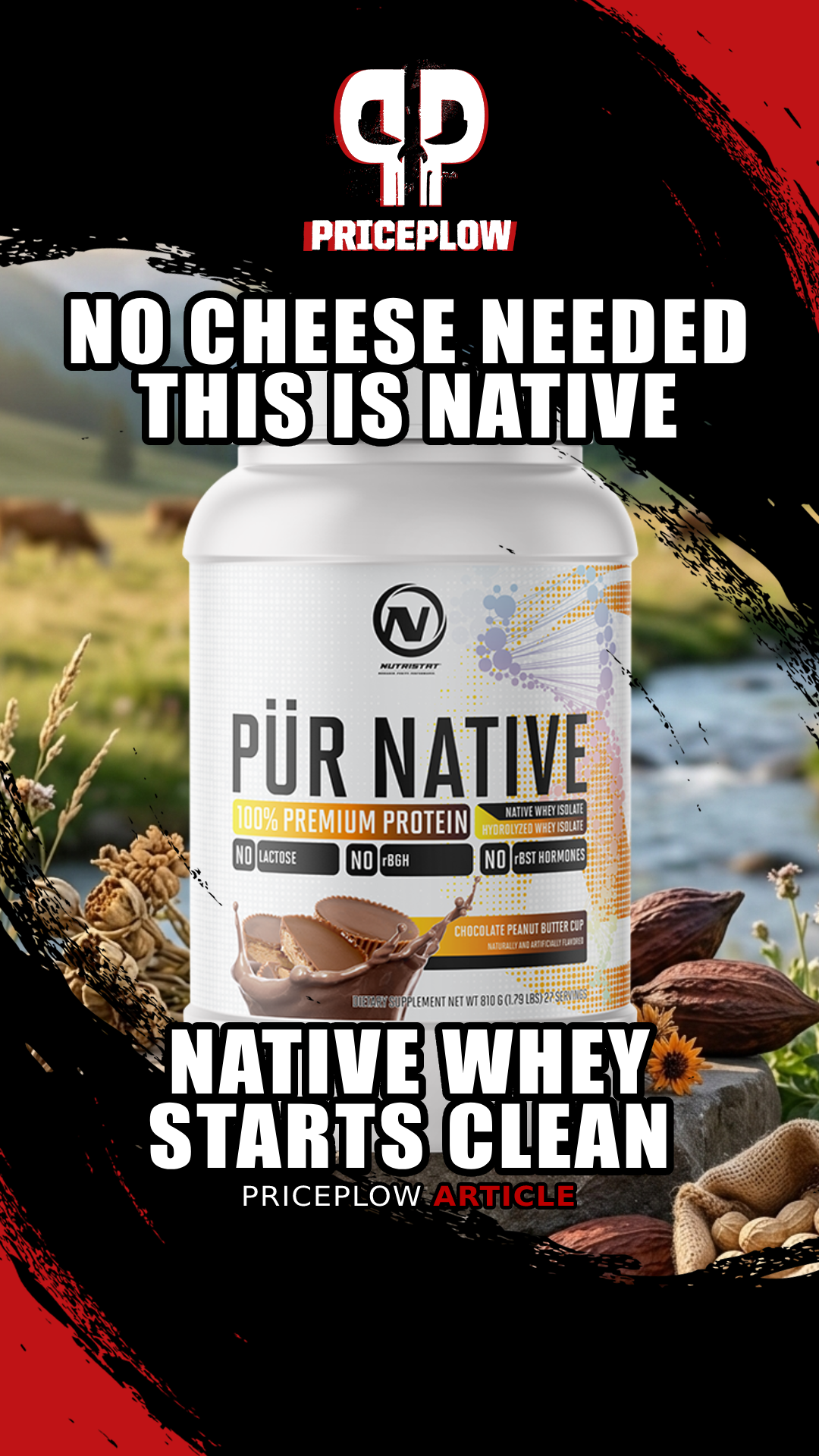
For full formula details, flavor options, and how to stack it with other Nutristat products, see our complete PÜR NATIVE breakdown. You can track pricing and availability below.
Conclusion: Native Whey for Better Digestion
Native whey protein isn't a marketing term someone invented to charge more for the same product. It's a description of a production method -- one that starts in a different place, skips a fundamentally damaging process, and delivers a protein that's been treated more gently from start to finish.
The amino acid profile is better, the bioactive fractions are more intact, and the digestibility is real. But it's the research outcomes (the leucine kinetics, the MPS data, and the implications for older adults) that give those structural differences a practical meaning. For many of Nutristat's users, it simply comes down to better digestion though!
If you've been treating all whey protein as functionally equivalent, native whey is worth a closer look. Check out Nutristat PÜR NATIVE if you want to see what a well-executed native whey product looks like.
Nutristat PÜR NATIVE – Deals and Price Drop Alerts
Get Price Alerts
No spam, no scams.
Disclosure: PricePlow relies on pricing from stores with which we have a business relationship. We work hard to keep pricing current, but you may find a better offer.
Posts are sponsored in part by the retailers and/or brands listed on this page.


Comments and Discussion (Powered by the PricePlow Forum)