You'd think 40g of whey protein would be enough on its own. A 2026 study says otherwise. Adding 3g of myHMB® kept muscle breakdown suppressed longer in older adults, and in older women it pushed protein synthesis even higher.
Something interesting happens when researchers pile on the protein. You'd expect that at some point, a high-quality dose becomes sufficient on its own and any added ingredient becomes redundant. A 2026 study in Nutrients by Smith et al. put exactly that assumption to the test.[1] Researchers gave older adults 40 grams of whey protein (a dose chosen specifically to potentially maximize the muscle protein synthesis response) then added 3g of myHMB® (calcium HMB supplied by TSI Group) and asked whether it still changed anything.
Smith2026: Adding 3g of myHMB® to 40g Protein Supports Muscle Better
For muscle protein breakdown, the answer was yes, across both sexes. For muscle protein synthesis, the answer depended on who was being studied.
Anabolic resistance -- the progressively blunted response to dietary protein that comes with aging -- is the backdrop here. It's why older adults don't build muscle as efficiently as younger people do, and why researchers keep searching for ways to work alongside protein to amplify its capabilities.
We've covered HMB's mechanisms in our HMB deep-dive and in PricePlow Podcast Episode #093 with TSI Group researcher Shawn Baier. This new trial asks a harder question than most: does HMB still add value when you're already eating a research-grade amount of high-quality protein?
Subscribe to PricePlow's Newsletter and Alerts on These Topics

Study Design: Direct Measurements, High Standards
The trial enrolled 24 community-dwelling older adults (mean age 68.5 years; 13 men, 11 evaluable women) in a randomized double-blind crossover design. Each participant completed both conditions (roughly three weeks apart) -- protein only or protein plus HMB -- so every person served as their own control. The supplement was 40g of whey protein alone, or 40g of whey plus 3g of calcium HMB from TSI Group, consumed all at once.[1]
Creatine + HMB aren't just for athletes. A 2025 study found active adults over 60 gained 25–46% functional strength improvements -- with little to no change in muscle mass. Better muscles, not just bigger ones.
The 40g whey dose was based on known science. Research indicates that older adults need higher relative protein doses than younger people to stimulate muscle protein synthesis, and the authors explicitly selected this amount to represent a potentially maximal protein stimulus in aging muscle. That framing matters for interpreting these results: HMB was being tested against a very favorable protein condition, not against a modest meal.
What distinguishes this study methodologically is the measurement approach. Rather than relying on blood amino acid levels as a proxy, the team used stable isotope tracer infusion (¹³C₆ phenylalanine) to directly measure muscle protein synthesis (MPS, via tracer incorporation into myofibrils) and muscle protein breakdown (MPB, via arterio-venous dilution across the leg). These direct measurements confirm what's specifically happening in muscle, not just what's circulating in plasma. Measurements were taken at baseline (fasted) and across two post-feeding windows: early-fed (45–90 minutes) and late-fed (135–180 minutes).[1]
The calcium-HMB form used here is the same one the Nottingham research group previously showed independently increases MPS and suppresses MPB in younger adults.[2][3] So Smith et al. investigated whether those effects survive when 40g of whey is already doing most of the anabolic work.
What the Researchers Found
-
Muscle Protein Breakdown: An Extended Window
Both conditions reduced MPB in the early-fed window. That's expected: dietary protein triggers insulin release, which is acutely anti-catabolic. But the divergence came later.
In the late-fed window (135–180 minutes), only the HMB arm maintained significant MPB suppression -- both across all 24 subjects (p = 0.0298) and when participants were separated by sex.[1] The protein-only arm's breakdown suppression had faded by then.
In women, the late-fed MPB result for the HMB arm reached p = 0.0012 but the control arm didn't reach significance at all during that window. Men showed a similar pattern: the HMB arm maintained significant late-fed MPB suppression (p = 0.0037), while the control arm did not.

Afraid of getting bulky? Women produce 15-20x less testosterone than men. Research shows myHMB helps you build lean muscle and preserve strength during fat loss and menopause without bulking up.
This aligns with what's known about HMB's anti-catabolic mechanism. Protein's early MPB suppression runs largely through insulin. HMB suppresses breakdown via an insulin-independent pathway (attenuation of the ubiquitin-proteasome degradation system) which keeps working after insulin levels have receded.[3] That mechanistic independence is why HMB extended the suppression window while protein alone did not.
-
Muscle Protein Synthesis: A Sex-Dependent Story
Both conditions significantly raised MPS above fasted baseline, which is what 40g of quality whey does. When all 24 subjects were analyzed together, there was no significant treatment difference for MPS overall.
The data split when separated by sex. In older women, adding HMB produced a significantly greater MPS response than whey protein alone -- both the FSR change (p = 0.0495) and the 3-hour area under the curve (p = 0.0364) were higher in the HMB arm.[1] The MPS change for women was +0.023%/h with protein alone versus +0.038%/h with HMB. In older men, there was no significant difference between treatments.
The context for the women's finding is notable. The authors had chosen 40g whey to potentially maximize MPS in older adults, yet women still responded meaningfully to HMB on top of it. As the paper notes, the protein bolus alone "did not maximize the anabolic response in older women", but HMB did!
The authors point to possible sex differences in anabolic signaling (including eIF4E-related pathways and potentially phospholipase D2 activation) as directions for further study, but those mechanisms need to be confirmed and aren't important to our readers for real-world use anyway. More trials are needed before drawing firm conclusions about why women responded to HMB differently than men. For a deeper look at the women-specific HMB research base, see our myHMB for Women article.
Both Sides of the Equation
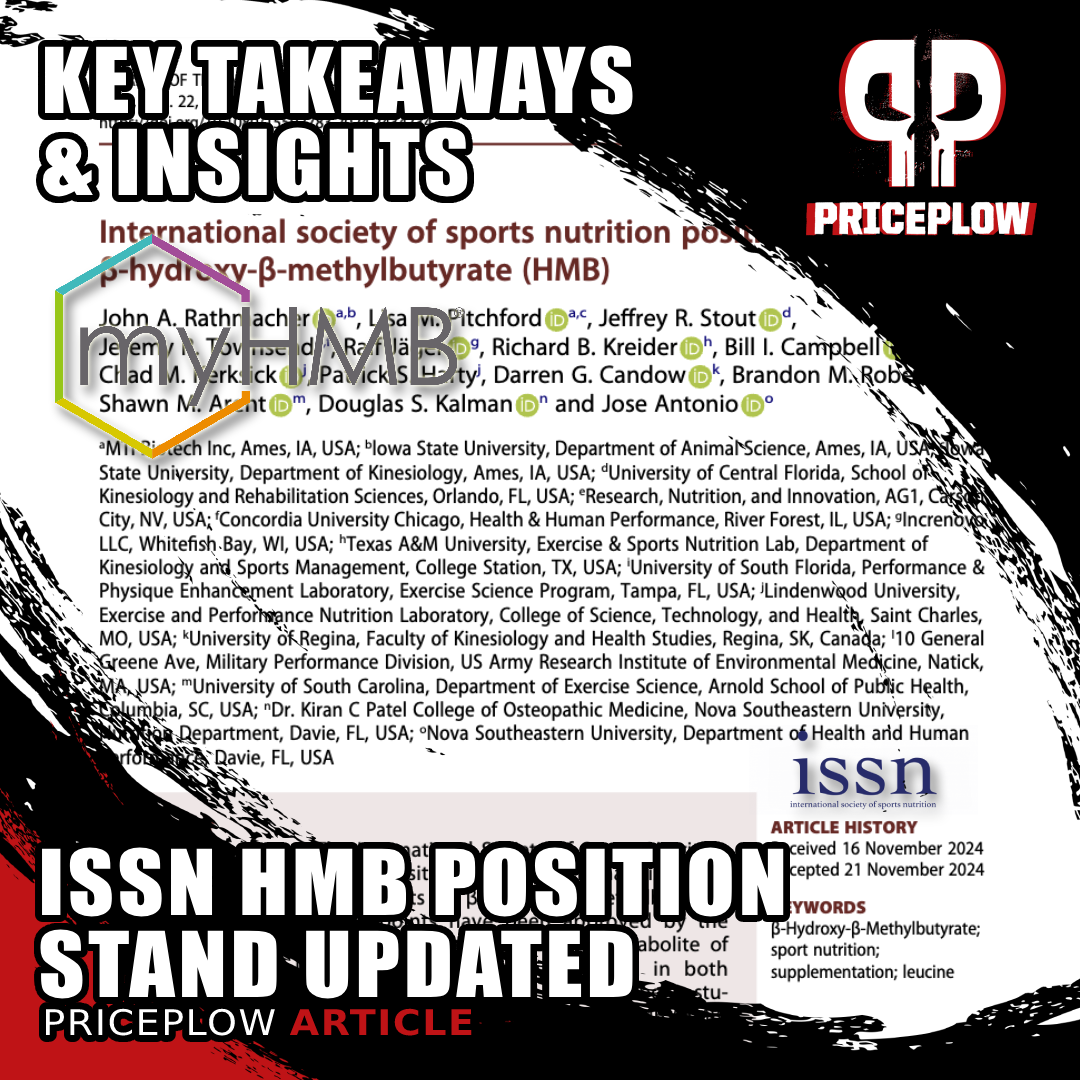
The ISSN's updated position stand on HMB reinforces its role in muscle health and performance. Key findings show it's safe, effective for muscle growth and recovery, and works best when timed around training. Best part? Benefits seen across all ages and fitness levels![4]
Muscle mass is governed by the balance between synthesis and breakdown. Tilting that balance positively towards more synthesis and less breakdown is how muscle is maintained or built over time. What this study shows is that HMB may push on both sides of that balance even when substantial dietary protein is already present.
The MPB finding was the most broadly applicable: HMB extended the period of breakdown suppression beyond what protein alone achieved, in both sexes. The MPS finding was more specific, applying to women at this dose. Together, they support the framing the ISSN's updated position stand articulates: HMB operates via dual mechanisms, with mTORC1 activation running through a pathway independent of leucine sensing, which helps explain why it can contribute even when whey protein is already saturating the leucine-mediated route.[5]
For formulators building protein products aimed at older adults, that's a solid signal. Calcium HMB alongside a high-quality protein source may extend the anti-catabolic window beyond what protein can achieve on its own. The effect is additive in a part of the metabolic timeline that protein alone doesn't cover. For the broader science case, see our coverage of the updated ISSN HMB position stand.
Limitations and Next Steps
This study is hypothesis-generating. Sample sizes were small overall, and the 11 evaluable women weren't sufficient to power sex-stratified comparisons reliably. The authors didn't adjust for multiple testing, which increases false-positive risk among secondary and exploratory outcomes. The design measured acute responses over a 3-hour window -- it says nothing directly about chronic body composition outcomes. The investigators explicitly call for larger, sex-stratified trials to confirm or refute what they found here.
A Backup Plan That Isn't Backup

Even at a large 40 gram dose of whey protein, HMB still had something to offer. The most consistent finding was the extended muscle protein breakdown suppression: HMB kept MPB down into the late-fed period in both men and women, while protein alone did not. In older women, HMB also drove a significantly greater MPS response, suggesting that a high-protein bolus doesn't fully capture the available anabolic capacity in aging female muscle.
The practical takeaway is that pairing myHMB® with protein products targeting older adults isn't redundant. It may address a part of the muscle turnover equation that protein alone leaves on the table... and the research here suggests both sides of that equation are in play.


Comments and Discussion (Powered by the PricePlow Forum)