Everyone talks about dopamine. Almost nobody has a mechanism. A new 2026 study found salidroside, the compound behind NNB Nutrition's SalidroPure, binds the dopamine D2 receptor directly and switches on signaling inside neurons.
The topic of dopamine is having quite a moment, if you haven't been around for the past decade or so. Podcasts break down "dopamine detox" protocols, productivity coaches warn about "dopamine hacking" your phone, and half the wellness internet is convinced modern life has wrecked everyone's baseline. Screen time trackers, "brain rot" jokes, and an entire cottage industry of dopamine-menu content have basically turned one neurotransmitter into a lifestyle brand. The advice tends to stay vague: put the phone down, get some sunlight, and stop doomscrolling. (You're reading this on a screen right now, so no judgment!)
What's been missing is a specific, testable connection between a supplement ingredient and the dopamine system itself. Not just a mood claim, but an actual mechanism. A new 2026 study on salidroside, the compound behind NNB Nutrition's SalidroPure, gives researchers exactly that: the first direct evidence that salidroside and its main metabolite bind a dopamine receptor and switch on a real signal inside neurons.
Can a Feel-Good Adaptogen Supplement Properly Modulate Dopamine?
We'll walk through that study first, then zoom out to the rest of salidroside's dopamine-related research, since the new paper connects to older findings that didn't have a clear mechanism until now.

Quick background for anyone new here: Rhodiola rosea's active compound is salidroside, but standard extracts run about 1% salidroside, or roughly 3mg per serving. Wild Rhodiola crenulata has far more salidroside, but it landed on the CITES endangered species list in 2022, which is why NNB Nutrition moved to a fermentation-based, nature-identical version instead of harvesting the plant directly. SalidroPure replaced RhodioPrime 6X, and delivers 20mg to 60mg of pure salidroside per serving. We've already covered some of salidroside's recent cognitive research in a recent analysis. But this time, the story is on dopamine specifically.
Sign up for PricePlow's news alerts covering NNB Nutrition and salidroside research to stay ahead of what's next, and check current SalidroPure formulas below.
Subscribe to PricePlow's Newsletter and Alerts on These Topics

New Research: Salidroside Binds the Dopamine D2 Receptor Directly
Researchers set out to find the specific molecular target of salidroside. Rather than guessing based on chemical structure, they took a data-first approach: they exposed cells to salidroside, sequenced the resulting gene expression changes, and ran those signatures through the Connectivity Map (CMap), a database that matches gene expression patterns to thousands of compounds with known mechanisms. Both compounds' signatures matched up strongly with known modulators of DRD2, the dopamine D2 receptor.[1]
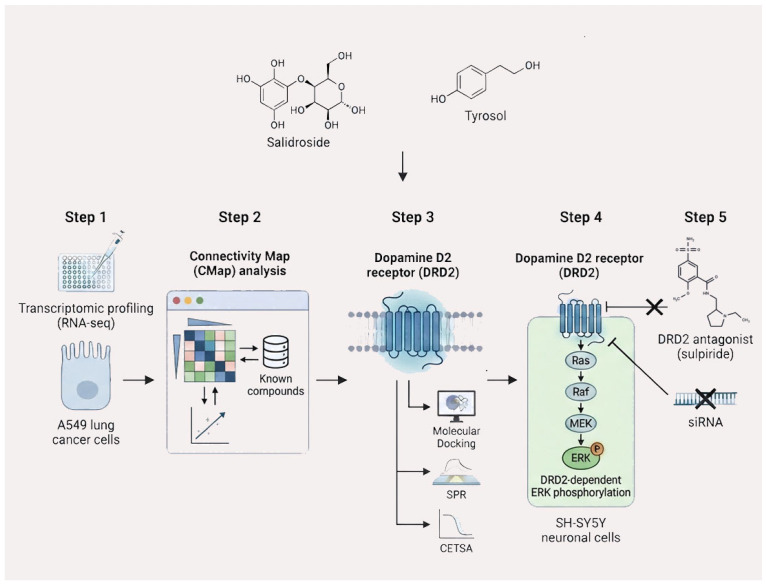
Five steps take the research from gene sequencing to CMap matching, three binding tests, and finally ERK signaling in neuronal cells.[1]
But a gene expression match is a lead, not proof. So the team ran three more tests to confirm it. Molecular docking showed salidroside settles into the same binding pocket on DRD2 as dopamine itself. In this situation, it forms a hydrogen bond with the same two amino acid residues, Asp114 and Ser193, that prior research has identified as the switches controlling the receptor's high-affinity and low-affinity states. Binding at those specific spots is what makes receptor activation possible in the first place, so a shared binding pattern with dopamine itself is an important result.
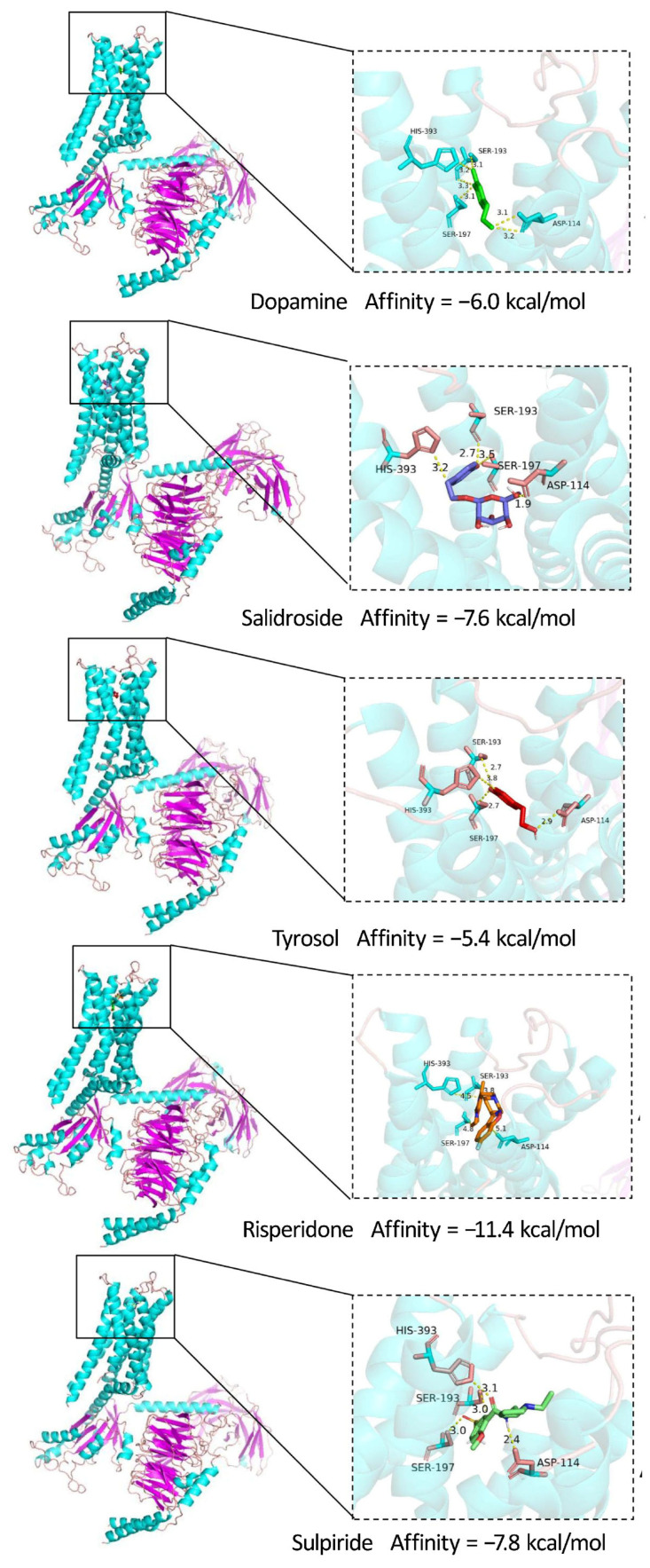
Docking scores put salidroside at -7.6 kcal/mol against dopamine's -6.0, with both sitting on the same Asp114 and Ser193 contacts.[1]
Surface plasmon resonance, a technique that measures real-time binding between molecules, confirmed the compound physically attaches to the receptor. The binding came in weaker than dopamine's own affinity for DRD2, of course. A cellular thermal shift assay added a separate line of evidence, showing the receptor became measurably more heat-stable once salidroside was bound inside living cells, which is what direct target engagement looks like outside of a test tube.
The last piece was function. The researchers ran this stage in neuroblastoma cells, since those already carry the dopamine signaling machinery that real neurons use. Salidroside triggered a fast increase in ERK phosphorylation, a signaling step downstream of DRD2 activation. Blocking the receptor with a DRD2 antagonist, or silencing the DRD2 gene entirely, wiped out that signal in both cases.[1]
That's about as strong as cellular evidence gets, since it shows the effect depends entirely on DRD2 being present and active, not some indirect side effect.
As a reminder, this is cell-based and biophysical research, not a human trial. It establishes a mechanism, so we can't make massive claims on humans. The researchers themselves note that dose-response work and in vivo follow-up still need to happen before anyone can say how this translates outside a lab.
An Old Finding Gets Its Mechanism
This isn't the first time salidroside has been connected to dopamine. The same research group previously used a model of temporarily reduced blood flow to the brain and found that salidroside raised dopamine and its breakdown products, HVA and DOPAC, in the striatum during the recovery window, measured directly through microdialysis. The same study recorded improvements in coordinated movement, along with a rise in tyrosine hydroxylase, the enzyme that converts the amino acid tyrosine into dopamine's direct precursor.[2] At the time, none of this had a clear explanation. A rise in dopamine, its metabolites, and the enzyme that makes it could come from a dozen different upstream causes.
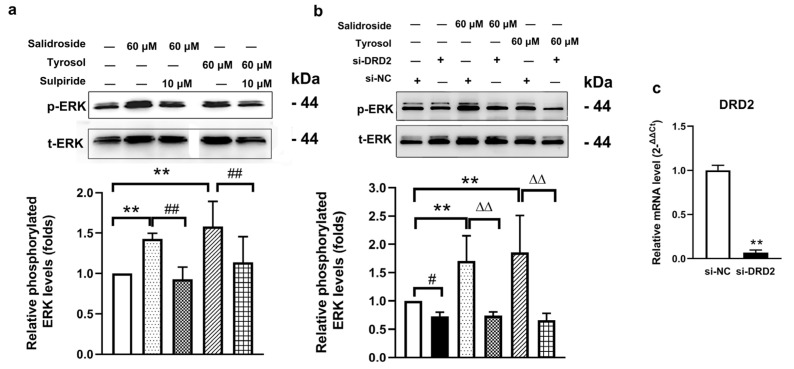
Salidroside at 60 µM raised ERK phosphorylation about 1.4 fold in SH-SY5Y cells, and both blocking the receptor with sulpiride and silencing the DRD2 gene erased that response.[1]
This new 2026 receptor study gives that older result a specific mechanism, which is what the research team was hoping to find. If salidroside binds DRD2 directly, a downstream rise in dopamine signaling stops looking like a coincidence and starts looking like a predictable effect. It also means this research base already touches both ends of the dopamine pathway independently and years apart: the supply side (the enzyme that builds it) and the receptor side (DRD2, the target it acts on). That connection comes back up in the formula discussion below.
Taking Advantage of the Tyrosine Connection
This also leads us to wonder if we should be stacking Salidropure with L-tyrosine (commonly used in pre-workouts and nootropics) more often. If salidroside can support tyrosine hydroxylase, then it reasons to stand that there's some added ingredient synergy here that formulators could be taking advantage of.
SalidroPure's Broader Dopamine-Related Research
The 2026 paper doesn't stand alone. Several other studies in salidroside's research base point the same direction, even though none of them set out to study dopamine receptors specifically.
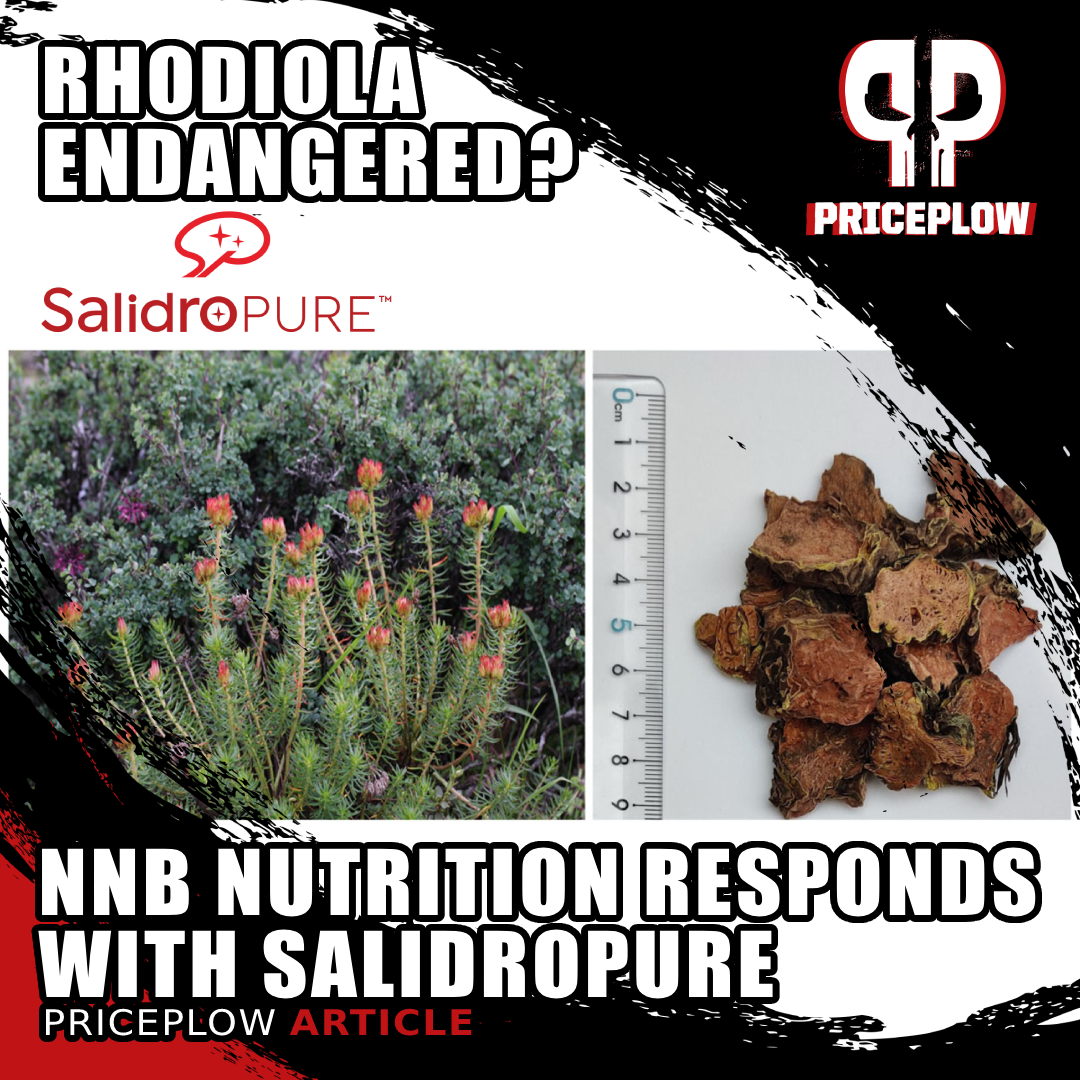
Wild Rhodiola now protected by CITES - NNB Nutrition launches SalidroPURE as sustainable alternative, delivering pure salidroside through precision fermentation. The future of adaptogenic supplementation has arrived.
-
Three studies leading to the same outcome
Separate research using neurotoxin-challenge models, the kind scientists use in the lab to study the loss of dopamine-producing neurons, found that salidroside preserved those neurons and maintained dopamine transporter expression along with striatal dopamine and its metabolites, working in part through PI3K/Akt signaling.[3][4] A third, independent study found a similar protective effect through a different pathway entirely, preserving mitochondrial Complex I activity and antioxidant enzyme levels in that same kind of model.[5]
This means we have three separate research teams landing on the same outcome: dopamine-producing neurons staying intact, through three distinct mechanisms (mitophagy, kinase signaling, and antioxidant defense), giving a far stronger signal than just the one study.
-
Checking the Brain's Dopamine Circuitry
Further research on the ventral tegmental area, a central hub of the brain's dopamine circuitry, found salidroside supported healthy synaptic structure and function in the dopamine-producing neurons there, again through PI3K-Akt signaling.[6] Separate network pharmacology research adds a systems-level view: mapping salidroside's gene targets against those tied to cognitive performance under low-oxygen conditions pointed to core targets including VEGFA and MAPK1, funneling mainly through the same PI3K-Akt pathway alongside MAPK and VEGF signaling.[7] Seeing the same pathway again and again across independent studies using vastly different models makes this credible and not just a coincidence.
-
Salidroside Doing the Heavy Lifting

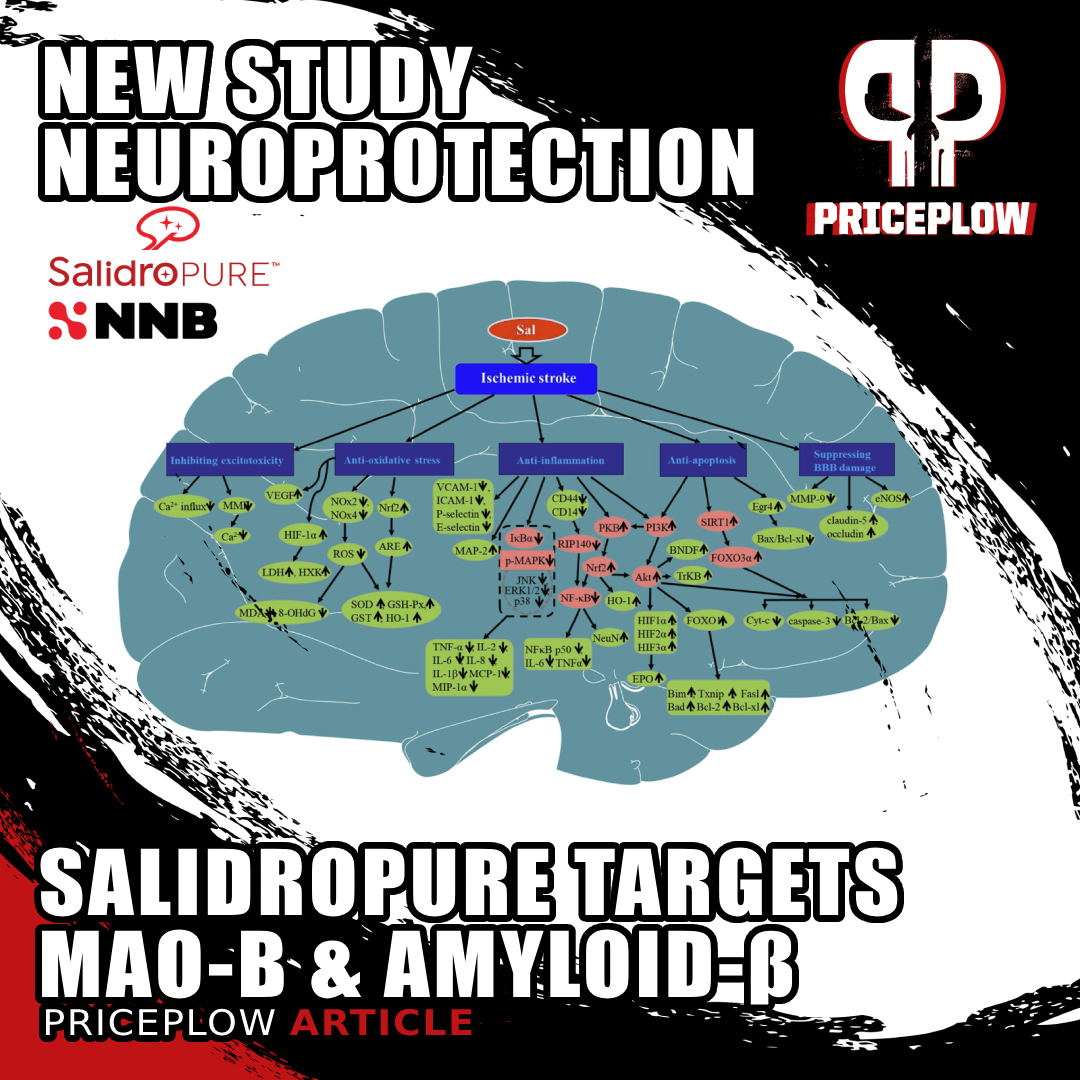
Research shows salidroside inhibits both MAO-B and amyloid-beta aggregation, supporting cognitive health. With Rhodiola rosea now endangered, NNB Nutrition's SalidroPure offers the same benefits through sustainable fermentation technology.
Earlier, when researchers tested Rhodiola's individual isolated compounds side by side in a standard rodent resilience test, salidroside came out as the active pair, while several other Rhodiola compounds showed no effect at all.[8] Note that that study calls it rhodioside, but that's another (older and less commonly used) name for the salidroside molecule. Separate mouse research backs this up on the memory and stress-response side, where a single dose of salidroside supported fear memory retention along with a calmer stress response.[9]
Human data on Rhodiola rosea extract, not isolated salidroside, adds a bit more context. A 12-week monitoring study in adults ages 50 to 89 found meaningful improvements in energy, motivation, and mental clarity using a Rhodiola extract combined with vitamins and minerals, with both physicians and patients rating the results as good or very good in the large majority of cases.[10] Separate lab testing on commercial Rhodiola extracts found that salidroside content varied significantly from product to product, and that potency in a validated synaptic transmission model tracked directly with how much salidroside each extract actually contained![11]
That's the exact standardization problem SalidroPure's precision fermentation process is built to solve in the first place -- you get a fixed amount of salidroside instead of a variable trace amount.
Three theories, one name. Shawn Wells' "GLP-1 Drag" ties together muscle loss, mitochondrial fatigue, and dopamine flattening on weight loss drugs.
The strongest evidence to support this is done in humans on isolated salidroside itself. It comes from a 2024 randomized, double-blind, placebo-controlled trial where fifty healthy, active young adults took 60mg of salidroside daily for 16 days. The placebo group's mood scores worsened under exercise stress, with a significant drop in reported friendliness and a rise in fatigue on standardized mood testing. But the salidroside group held steady on both measures, alongside improved oxygen uptake during high-intensity exercise and lower markers of exercise-induced muscle damage.[12] Note that this wasn't using Salidropure, but it was with the same exact chemical molecule.
Where This Fits in a Formula
NNB Nutrition's own team has been circling this territory in public, too. On a recent episode of the PricePlow Podcast, NNB Nutrition Chief Science Officer Shawn Wells made the case for "shift in state" beverages built around dopamine and mood-active compounds like PEA (phenylethylamine) and anandamide, aimed at a generation drinking less alcohol but still wanting to feel something. Shawn was talking about other ingredients in that specific conversation, but a receptor-level dopamine mechanism gives SalidroPure a legitimate case for the same category.
If the goal is supporting the dopamine system from multiple angles, the receptor side (SalidroPure) pairs logically with the supply side: TyroPure, NNB Nutrition's L-tyrosine, the amino acid the body uses to build dopamine in the first place. GeniusPure Alpha-GPC adds acetylcholine support for the focus side of the equation, which is one reason all three already show up together in some of NNB's beverage concepts.
The Bigger Picture
Shawn Wells, Chief Science Officer at NNB Nutrition, breaks down GLP-1 Drag, precision fermentation, and NNB's next wave of buccal delivery ingredients on Episode #227 of the PricePlow Podcast.
Back to the phone in your hand. The cultural conversation about dopamine mostly stays at the behavior level: put down the device, get outside, stop chasing quick hits. That conversation isn't wrong, but it's also not where the science currently lives. Under the hood, it's really in receptor binding assays, cell signaling cascades, and striatal microdialysis data... topics that just aren't as great for headlines. But for those of us who care (or are formulating supplements) salidroside just became one of the few supplement ingredients with a documented, receptor-level connection to back up its place in that conversation.
What makes this research base so cool is how it built up over time without anyone planning it that way. A 2019 study measured dopamine directly in an animal model, then separate papers found protective effects on dopamine-producing neurons, then a human trial documented steadier mood during exercise stress. Now a 2026 receptor study goes backwards and ties all of it together. Given that it wasn't all funded by the same team or even in the same country, that's a far better story than you could ask for, since it's not all coming from one place that has certain incentives. The bigger story is also easy to miss if you only read the studies in isolation.
For the other side of NNB Nutrition's dopamine research this year, our GLP-1 Drag deep dive covers what happens when the dopamine system gets flattened by weight-loss medications, a different mechanism than the one covered here, but the same neurotransmitter.
Sign up for PricePlow's news alerts covering NNB Nutrition and salidroside research to stay on top of what comes next.

Comments and Discussion (Powered by the PricePlow Forum)