New preclinical data from NNB Nutrition. A combo of DL185® dileucine, leucine, and hydrolyzed pea protein out-protected a full 25g whey serving against soleus muscle loss in a mouse immobilization model. Smaller plant dose, stronger anabolic signal, lower cost.
Continuing with their rapid pace of innovation and research, NNB Nutrition has shared new internal preclinical data showing that a combination of their DL185® dileucine peptide, leucine, and hydrolyzed pea protein outperformed a full 25g serving of whey protein in a mouse limb immobilization atrophy model. The data is internal and has not been peer-reviewed or submitted for publication yet. However, it offers is the clearest preclinical support yet for the thesis the company has been building through PeptiClear™ and the Clean & Clear Series: a smaller dose of plant protein, amplified by dileucine's anabolic signal, can outperform a full whey serving at comparable or lower cost.
This is Study 2 of a broader DL185® preclinical program NNB's been running. Study 1 is on the effects of dileucine on GLP-1-induced muscle loss in obese mice. That story is coming separately, but it's already been completed and confirmed that DL185® effectively prevented muscle loss caused by a GLP-1 receptor agonist. This article covers the immobilization model.
PricePlow has tracked dileucine since Dr. Ralf Jaeger first teased it on Episode #078 of the PricePlow Podcast in January 2023, noting that the body doesn't synthesize something without a strong biological reason. We've covered every milestone since, from the MuscleTech Peptide 185 exclusivity period through the NNB Nutrition DL185 distribution launch and into the PeptiClear™ concept debut at Expo West 2026. This immobilization study is the data behind that concept.
NNB's Chief Brand Officer Dustin Elliott walked through the study slides on that call and flagged the soleus muscle finding directly:
"The most statistically significant movement was the pea protein plus dileucine."
-- Dustin Elliott, NNB Nutrition
Why the soleus and not the gastrocnemius is the crux of the story.

Study Design
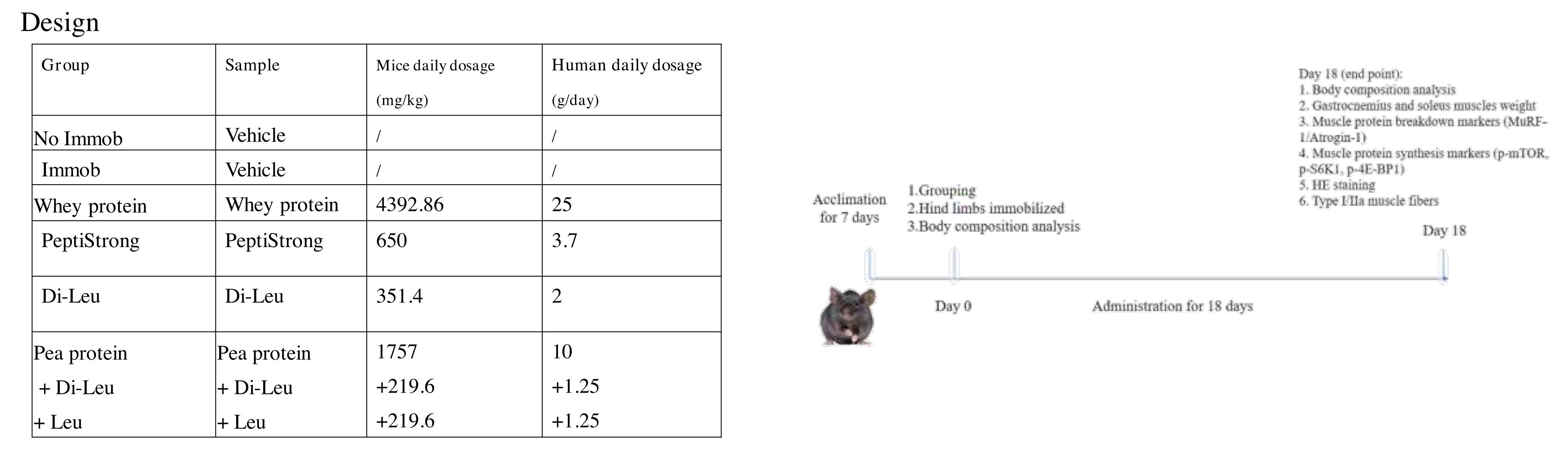
Study design showing the six groups, their mice and human equivalent doses, and the 18-day immobilization timeline.[1]
This was an 18-day preclinical mouse study using hind limb immobilization to simulate disuse atrophy, with a 7-day acclimation period before the intervention.[1] Treatment groups were:
- An unimmobilized control
- An immobilized group receiving vehicle (no supplementation)
- Whey protein at 25g human equivalent dose (HED)
- Another anabolic peptide at its published research dose of 3.7g HED
- DL185® alone at 2g HED, and
- A pea protein combination at pea protein 10g HED plus DL185® 1.25g HED plus leucine 1.25g HED
Sarcopenia isn't just about losing muscle. It's about losing the strength to live independently. DL185® research shows dileucine addresses what standard supplements can't.
The combination group is the PeptiClear™ concept in formula form: pea protein as the general protein matrix, DL185® for direct mTOR signaling, and leucine to supplement pea's naturally lower leucine content. The DL185 dose was set below the commercially validated 2g because that's how most brands would actually deploy this combination at commercial price points. The point of this formula is that it can be cheaper than whey, yet more effective.
The anabolic peptide comparison used that ingredient's published research dose, which is notably higher than its standard commercial serving. NNB matched it to hold the comparison to its competition's best available data.
Day 18 endpoints included gastrocnemius and soleus muscle weights, muscle protein breakdown markers (MuRF-1/Atrogin-1), mTOR gene expression via q-PCR, HE staining, and muscle cross-sectional area with fiber type distribution.[1] The molecular analyses are still being completed, but the current data covers the muscle weight outcomes.
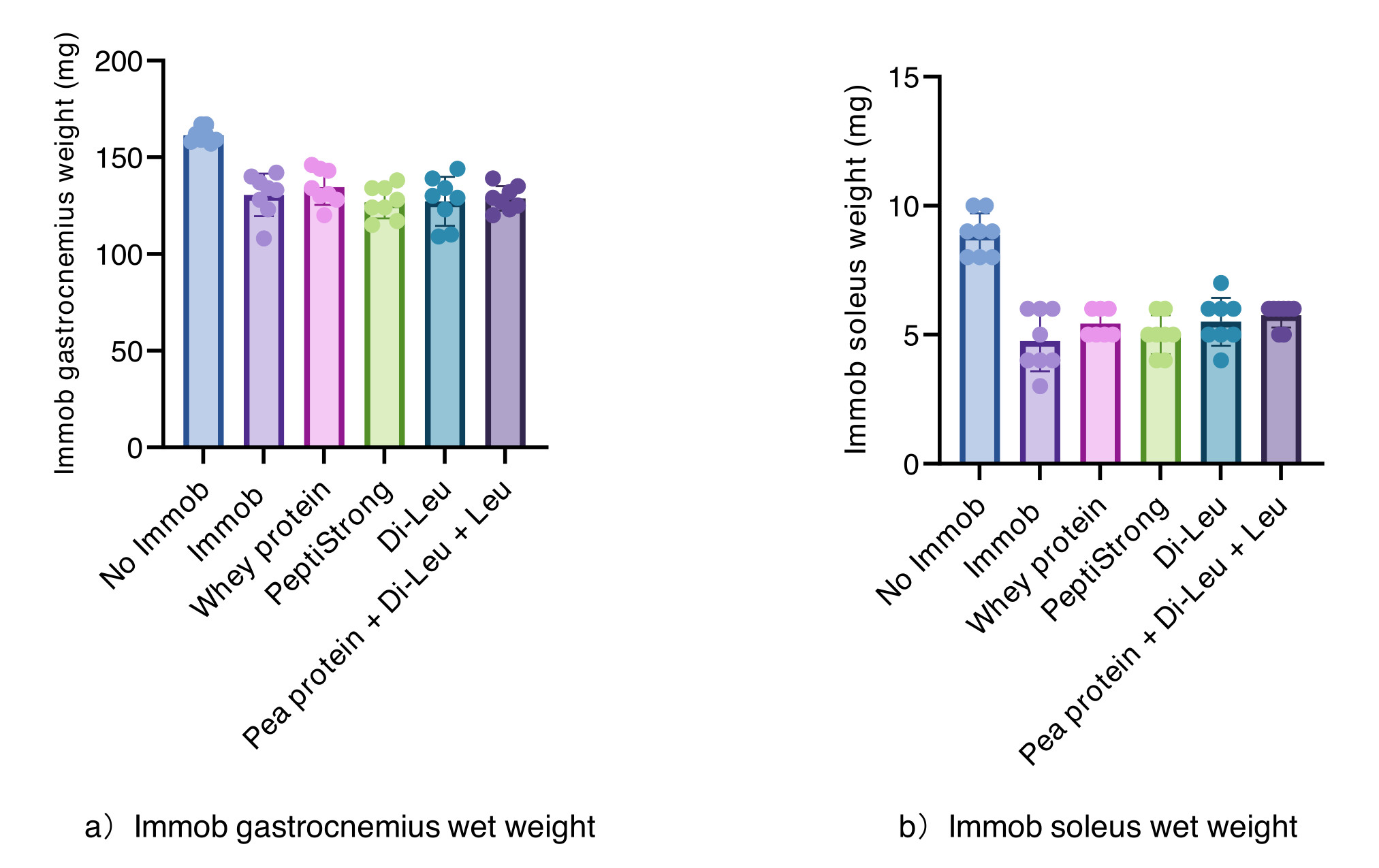
Raw gastrocnemius and soleus wet weights across all six groups, where no intervention separated from the immobilized control on absolute mass.[1]
Two Muscles, Two Stories
The study examined two muscle groups with different fiber compositions: the gastrocnemius (primarily type 2 fast-twitch fiber, most relevant to anaerobic performance) and the soleus (primarily type 1 slow-twitch fiber, most representative of whole-body everyday function). The results split along exactly those lines.
-
The Gastrocnemius: Whey Takes It.

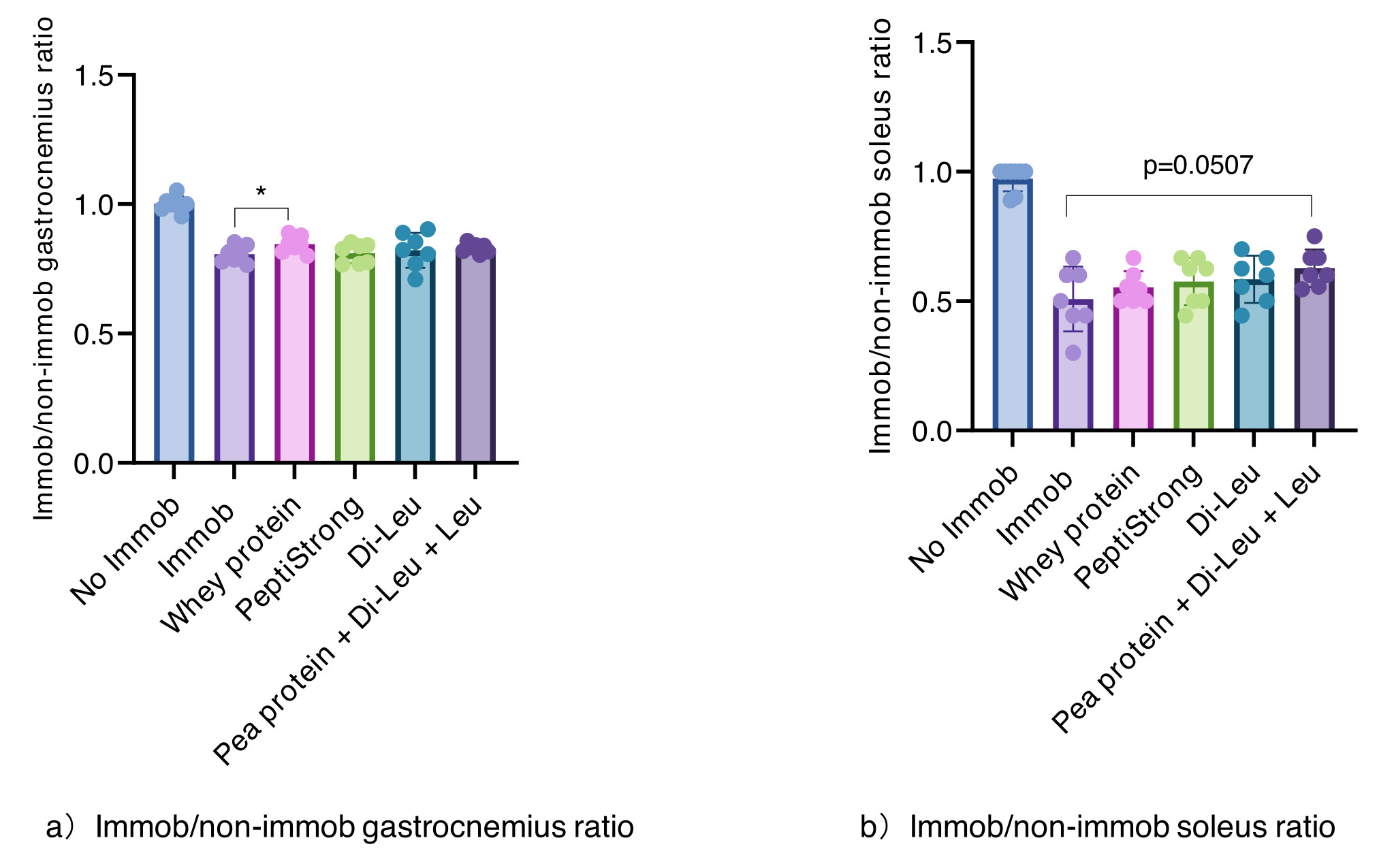
Within-animal muscle ratios, where whey reached significance in the gastrocnemius while the pea protein plus dileucine plus leucine group trended in the soleus at p=0.0507.[1]
In the gastrocnemius, whey protein was the standout. The immob/non-immob gastrocnemius ratio showed statistically significant protection for the whey group (p<0.05) versus the immobilized control.[1] The pea protein + DL185® + leucine combination and the other groups did not reach significance in the gastrocnemius by this metric.[1] This is a genuine whey win in fast-twitch muscle, worth stating honestly.
-
The Soleus: Pea Protein + DL185® + Leucine Separates.
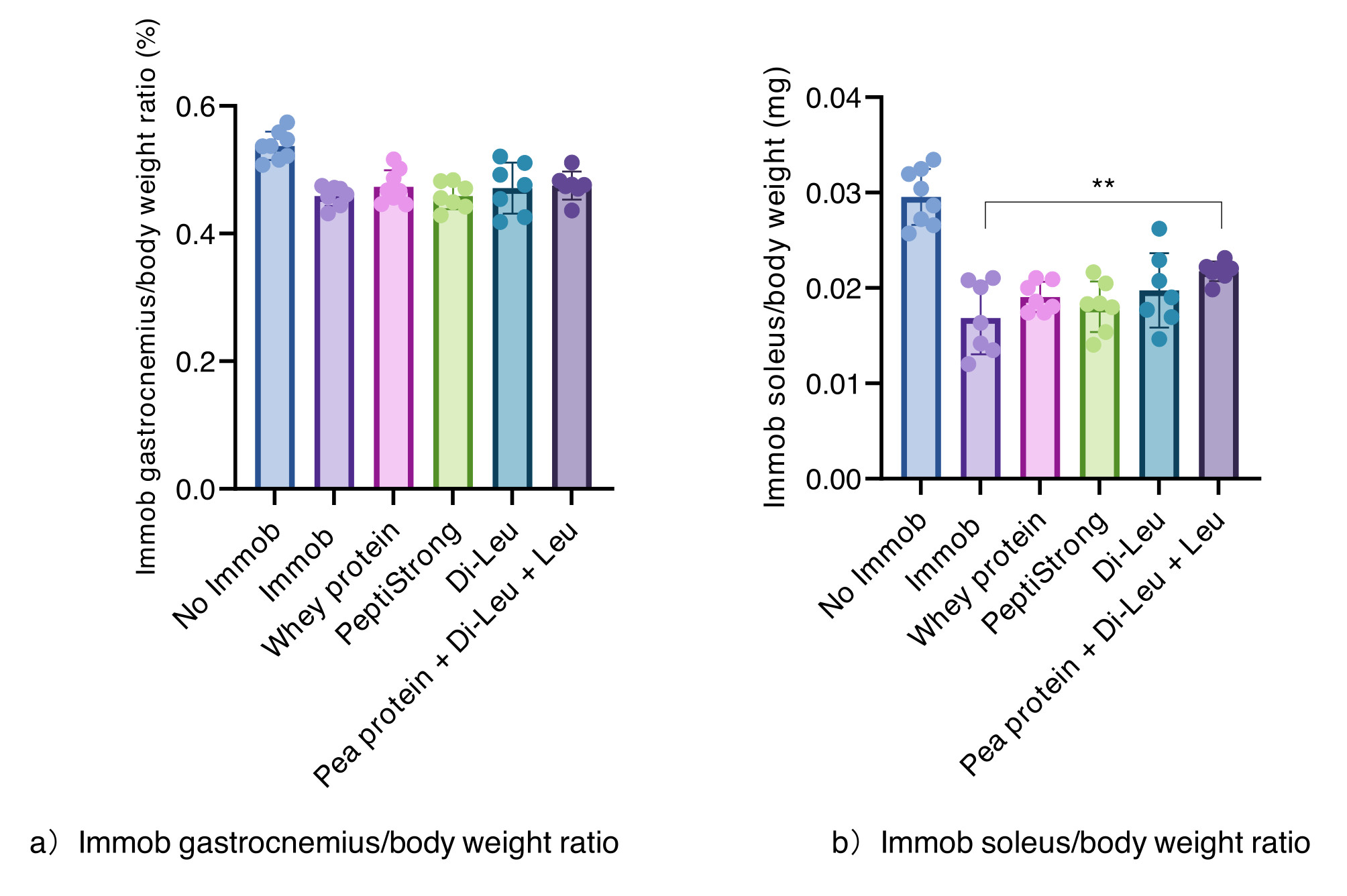
The soleus showed a different picture, and a more striking one. Immobilization cut soleus muscle mass to roughly half of the non-immobilized control, making for a steep drop that gave the recovery signal room to be read clearly. Across all intervention groups in the soleus, the pea protein + DL185® + leucine combination produced the most significant protection. The soleus/body weight ratio reached p<0.01 versus the immobilized control.[1] The within-animal immob/non-immob soleus ratio showed a strong trend (p=0.0507 vs. immob), just missing the conventional significance threshold.[1]

Muscle to body weight ratios, where the pea protein plus dileucine plus leucine combination hit p<0.01 soleus protection (**) versus immobilized.[1]
Whey protein, by comparison, landed near the immobilized baseline in the soleus without reaching significance. NNB's own slide puts it plainly: "The combination of pea protein, Di-Leu and Leu significantly protects against muscle atrophy in the soleus muscle."[1]
One additional observation: some animals in the DL185® alone group showed notably strong individual responses, with soleus muscle mass approaching the unimmobilized control. The combination's mean was the highest across all groups, but the DL185®-only hyper responders are worth noting as a signal for future investigation.
The Signal vs. Total Protein
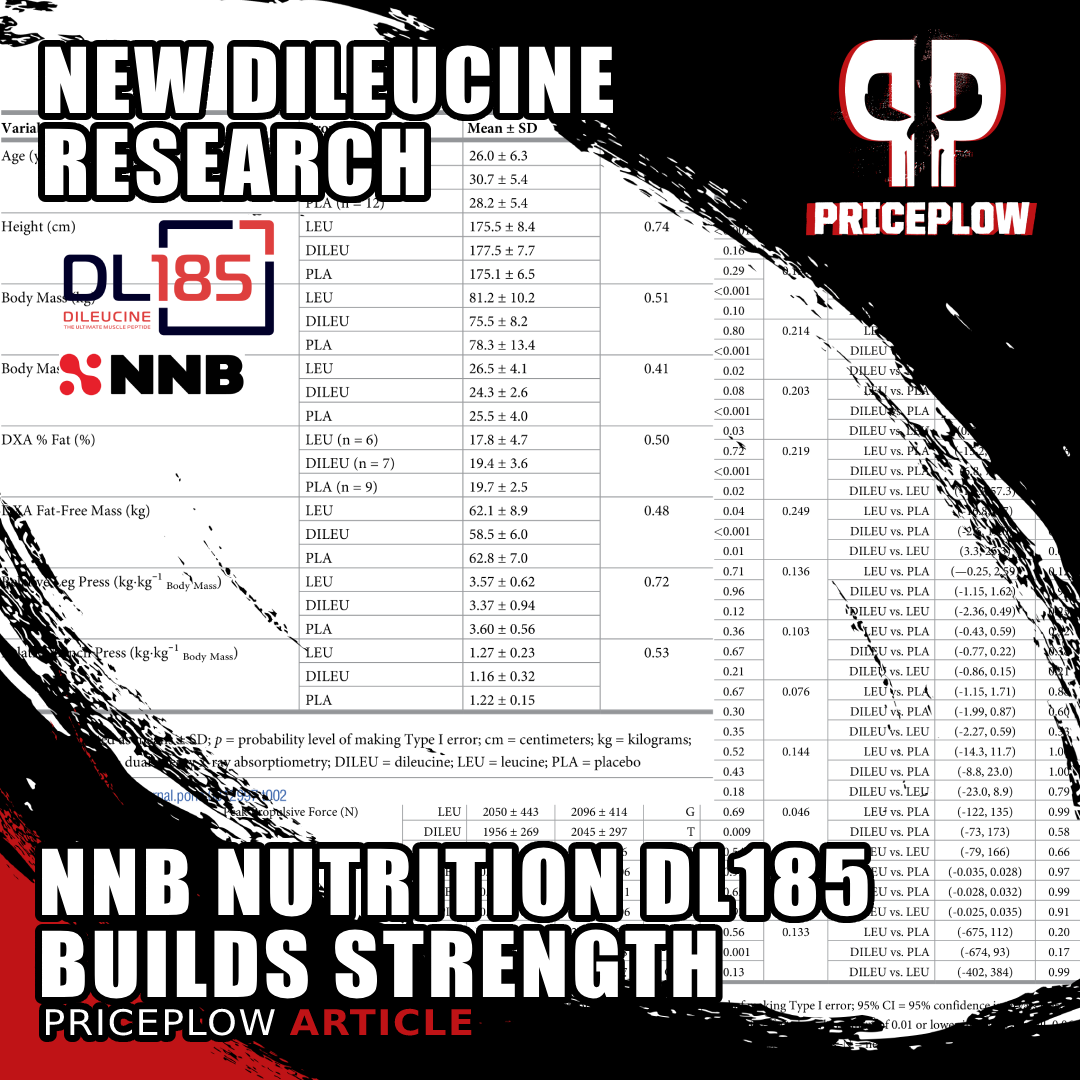
Groundbreaking research published in PLOS ONE demonstrates NNB Nutrition's DL185 dileucine boosts lower body strength more effectively than leucine. 2g daily improved leg press strength and muscular endurance in 10-week study. Science continues supporting this novel ingredient.
The gastrocnemius/soleus split is interesting from a mechanistic point of view. Whey is a fast-digesting, leucine-dense protein well matched to the acute anabolic demands of type 2 fiber. The pea + DL185® + leucine combination counters with a different approach: a lower protein dose, paired with concentrated signaling from DL185® via the PEPT1 dipeptide transporter pathway.
Prior human research gives context for why that signal is so effective. The 2021 Paulussen crossover trial showed dileucine produced 60% greater myofibrillar fractional synthetic rate activation than free leucine at the same 2g dose in young males at rest.[2] The 2024 Hagele PLOS ONE trial found DL185® supplementation generated 25.8% leg press strength gains over 10 weeks versus 15.2% for leucine and 7.3% for placebo in resistance-trained males.[3] The immobilization data adds a third context -- disuse atrophy recovery -- to that growing research picture.
"The goal was to have the cost be similar -- but also could be cheaper."
-- Dustin Elliott, NNB Nutrition
That framing was Dustin's explanation for the 10g pea protein dose: the combination was designed to cost-compare to a full 25g whey serving, not to match it in volume. If the soleus finding holds in future research, the economics favor the combination, especially as whey prices are trending higher with no relief in sight. Pea protein quality is improving, and DL185® fills the anabolic signal gap.
What's Still Coming, and What to Watch
This is early-stage internal data with important limitations. The molecular analyses of mTOR gene expression (q-PCR), atrophy markers (MuRF-1/Atrogin-1), muscle fiber cross-sectional area, and fiber type distribution are still being completed.
Shawn Wells and Dustin Elliott reveal NNB Nutrition's Pure, Potent, Precise revolution at SupplySide Global 2025, discussing precision fermentation, Pürest Creatine, OnSwitch beverage innovation, and the future of pharmaceutical-grade supplement ingredients on Episode #192 of the PricePlow Podcast
Read this data as a directional signal from a well-designed preclinical model, with molecular confirmation pending and full publication ahead.
Our Other DL185® Coverage
For the full science background on DL185®, the DL185® main ingredient article and the DL185® for sarcopenia deep dive cover mechanism and prior research pretty thoroughly, while 2024 strength study coverage covers the Hagele PLOS ONE trial in depth.
The PeptiClear™ article and the Expo West 2026 recap show how this data fits NNB's commercial thesis. And of course, Episode #152 and Episode #192 of the PricePlow Podcast with Shawn Wells and Dustin Elliott are the best video/audio entry point for NNB Nutrition's full research vision.
We'll cover the DL185® research program as molecular data and future studies publish. Sign up below so you don't miss any new results:


Comments and Discussion (Powered by the PricePlow Forum)