How a single San Diego law practice built a five-year protein-labeling legal campaign, and why no judge has ever decided whether the challenged protein labels were actually right or wrong.
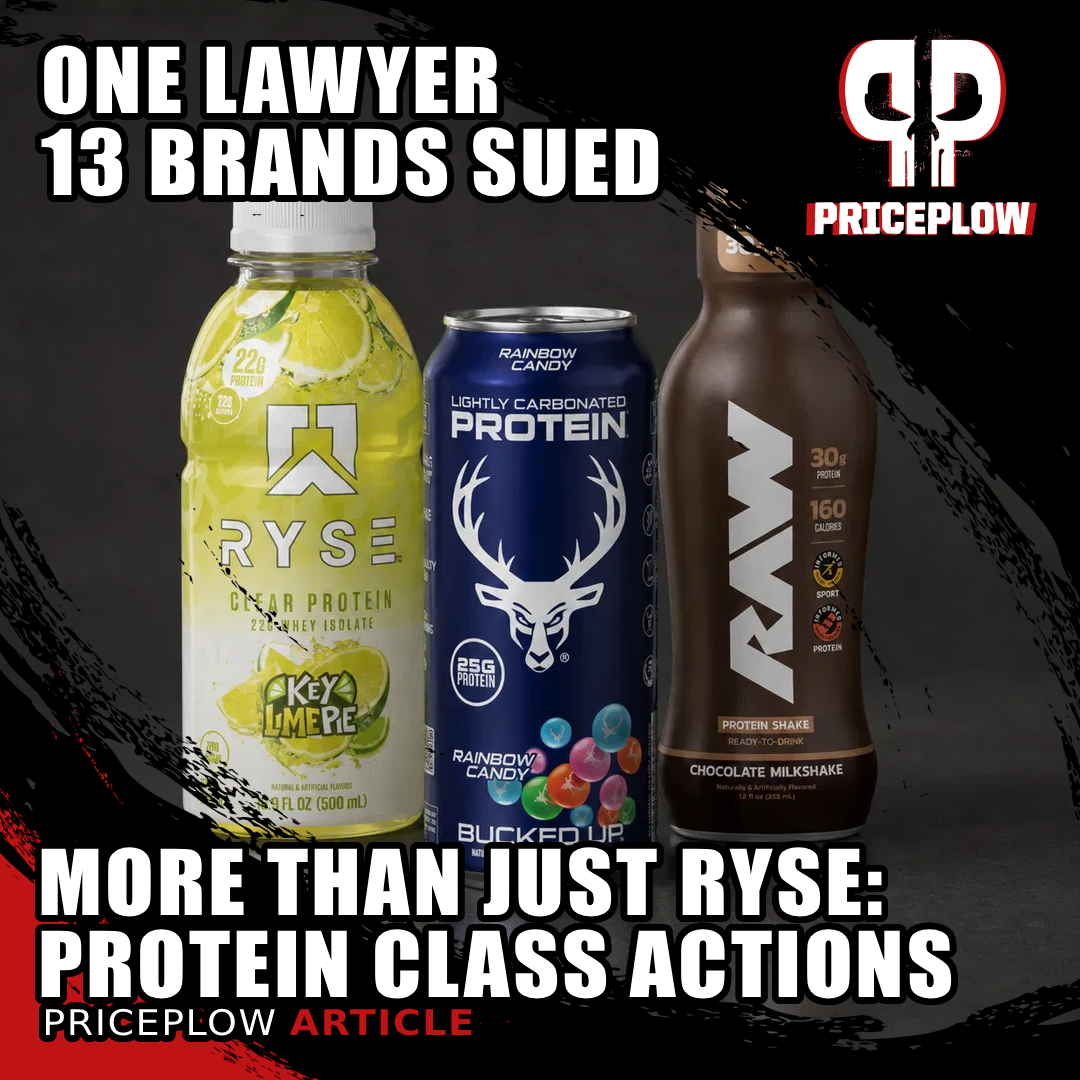
On August 4th and 6th of 2026, two industry media outlets published paywalled articles about a proposed class action lawsuit against RYSE Up Sports Nutrition (RYSE Supps), alleging that the brand's Clear Protein RTD comes up short on label claims.
That didn't sound too good, so we found the complaint, looked at the allegations, and noticed something amiss.
Paragraph 18 of the complaint says Daniel Ruchman bought "the chocolate flavor" at a Vitamin Shoppe in Thousand Oaks, California, on January 8, 2026.
There's only one small problem:
RYSE doesn't sell a chocolate flavor in that product!
After all, how can chocolate be clear?
Then, on the next line, paragraph 19 then lists what RYSE's Clear Protein Drinks actually come in: Kool-Aid, Jell-O, Key Lime Pie, Strawberry Banana, and Country Time Lemonade.(Ruchman v. Ryse Up Sports Nutrition, No. 2:26-cv-05434, Doc. 1)[1]
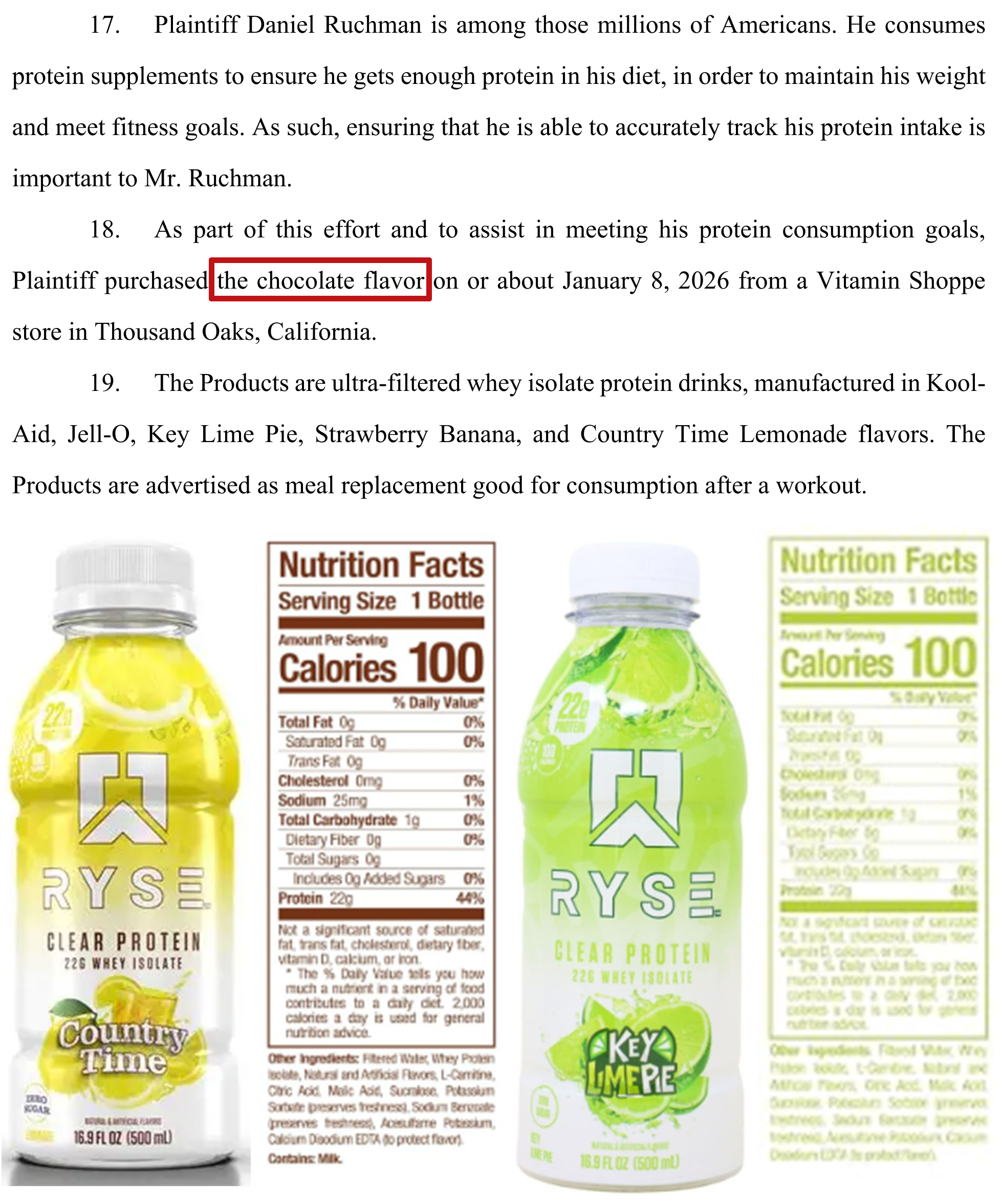
The initial lawsuit says Ruchman bought "the chocolate flavor", but immediately below lists what RYSE Clear Protein actually comes in: Kool-Aid, Jell-O, Key Lime Pie, Strawberry Banana, Country Time Lemonade. This sent us down a rabbit hole that became this entire article.
So where did this clear chocolate come from?
It turns out that the sentence in paragraph 18 wasn't exactly a typo... it just appears to have been carried over from an earlier complaint that wasn't about RYSE in the first place. An identical sentence -- same date, same store, same paragraph number -- appears in a complaint filed six weeks earlier against a different company, where chocolate is a real product.(Doc. 1., ¶18)[2] That company is none other than RAW Nutrition, who makes a decidedly unclear protein RTD.
The Apparent Copy-Paste Error That Opened a Much Bigger Story
That single copy-paste error is just a small piece of a much bigger story, and it opens onto a much larger body of supplement-industry litigation.
Since 2021, attorney Charles C. Weller, a solo practitioner working out of a San Diego office, has filed a sustained series of protein-labeling class actions against nutrition and food brands, using multiple named plaintiffs (one repeatedly used) and two recurring protein-labeling theories shaped by three Ninth Circuit decisions.
RYSE is Not Alone... Not By a Longshot
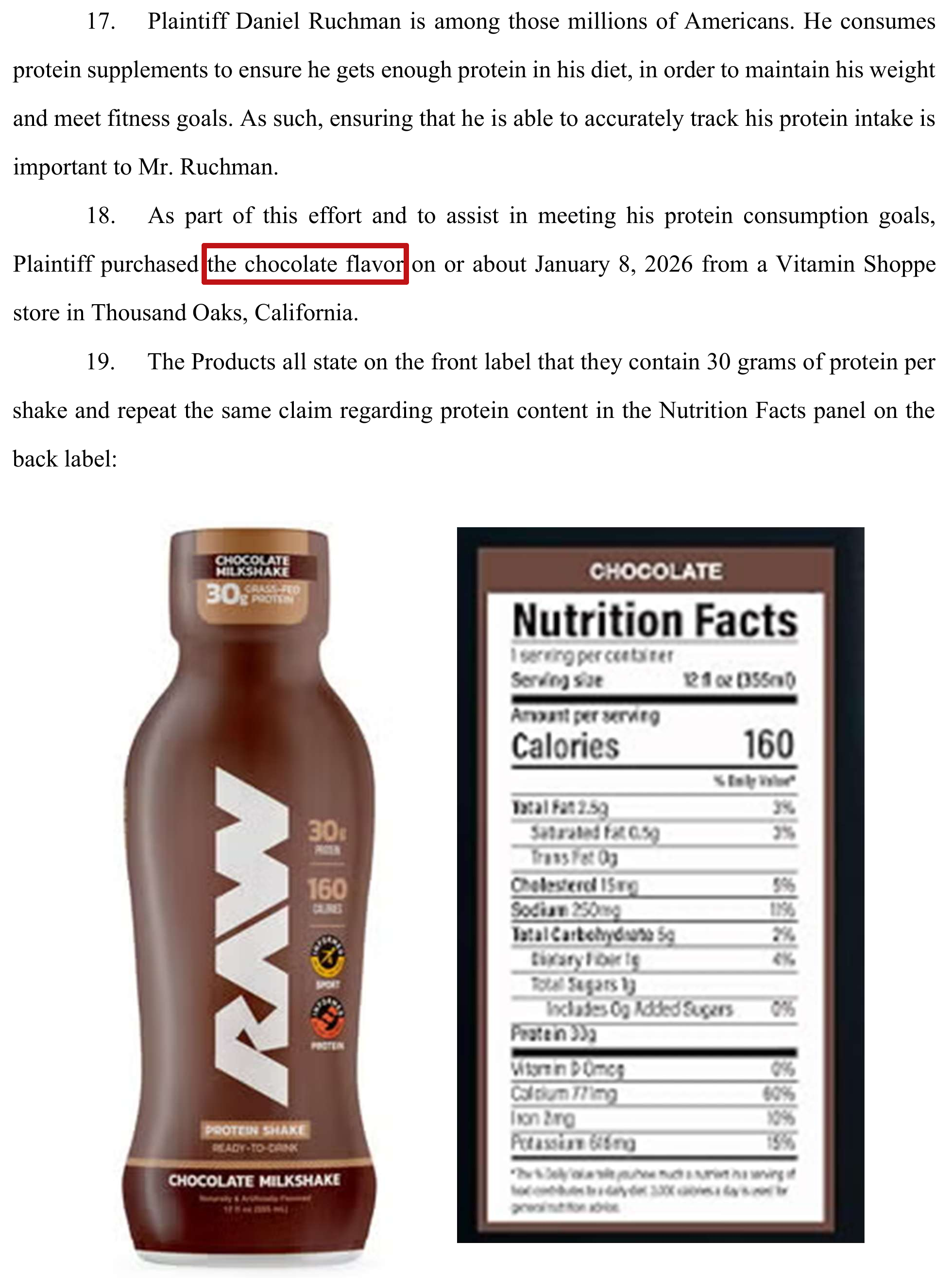
The same sentence, word for word, from a complaint filed six weeks earlier against RAW Nutrition, where a chocolate flavor does exist.
RYSE is one of thirteen brands we identified across seventeen federal docket numbers we could find. Note that a few of them are re-filings, so it's not seventeen independent disputes.
They're not an isolated target, and after digging through dozens of court filings, which include the two Ninth Circuit opinions that made the newer wave possible, as well as a third opinion from 2018 that explains why the whole thing is shaped the way it is, one wild fact stands out above the rest: No court in this corpus has adjudicated, on the merits, whether a challenged finished product actually contained less protein than its label represented -- or whether a challenged protein-quality disclosure was wrong. Plenty happened in court, but nobody ever ruled on the underlying protein question!
This article traces how that happened, in chronological order. And it brings us back to a time and company we've been trying our best to forget.
2018: The Rule That Shaped Everything After It
Our dear old friends at MusclePharm are, as ever, the gift that keeps giving.
Long before Weller's first protein complaint, MusclePharm was the defendant in the case that built the legal architecture that this entire campaign runs on. PricePlow covered the original allegations when they surfaced in the mid-2010s, when a wave of suits accused the brand of "nitrogen spiking" -- padding the amino-acid content of products like its Arnold Schwarzenegger Series line with cheap, incomplete amino acids that inflate a lab's nitrogen-based protein reading without adding usable dietary protein.
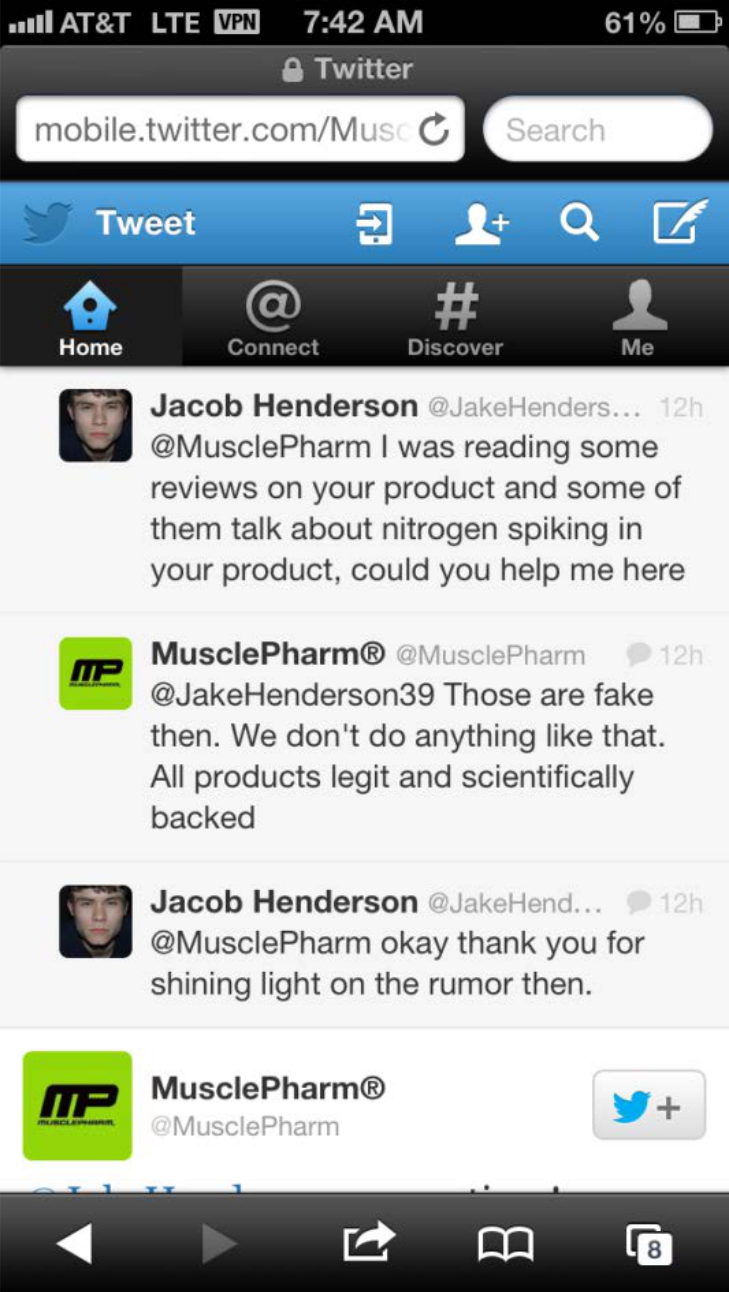
Remember this fiasco? This is the Twitter correspondence taken from the lawsuit against MusclePharm, which rears its ugly head once again.
One of the earliest complaints against MusclePharm's Arnold Iron Mass weight gainer lab testing allegedly found only about 19 grams of bound amino acids where the label claimed 40 (see PricePlow's original coverage and our broader explainer on amino acid spiking). One of those cases, brought by plaintiff Tucker Durnford, made it to the Ninth Circuit.
Durnford v. MusclePharm Corp
Durnford v. MusclePharm Corp (9th Cir. 2018), drew an "amount-versus-composition" line that remains a key precedent for the protein-labeling theories discussed in this article.[3]
The Ninth Circuit said that the FDCA (Food, Drug, and Cosmetic Act) preempts a state-law claim regarding the amount of protein measured, since federal rules permit manufacturers to calculate protein using the nitrogen method Congress and the FDA already settled on. This means that you can't use a state law to attack a protein number just because it was calculated using a method the FDA allows.
But the court left room for a different kind of claim: challenging what the label says or implies about what the protein actually is (composition) or where it comes from (source).
So while the Ninth Circuit said that you can't use state law to attack a protein number calculated using a method the FDA allows, you can still challenge what the label implies.
In short, federal law tightly constrains some amount-based theories, while certain source- or composition-based theories remain available.
Nearly every case that follows is framed in a way that tries to stay inside that line.
You can thank Musclepharm for getting us this far. Now let's begin.
2021: The Only Underlying Protein Lab Reports We Found Filed as Exhibits
Five years before Ruchman's name appears anywhere, plaintiff Deana Lozano sued Bowmar Nutrition, with Weller as her counsel, alleging its nut butter spreads, frostings, and whey powders "provide substantially less protein than is stated on the federally mandated nutritional label."(Lozano v. Bowmar Nutrition, No. 2:21-cv-04296, Doc. 1)[4] The complaint also alleged false calorie, fat, and nutrient figures, a broader set of claims than anything filed since.
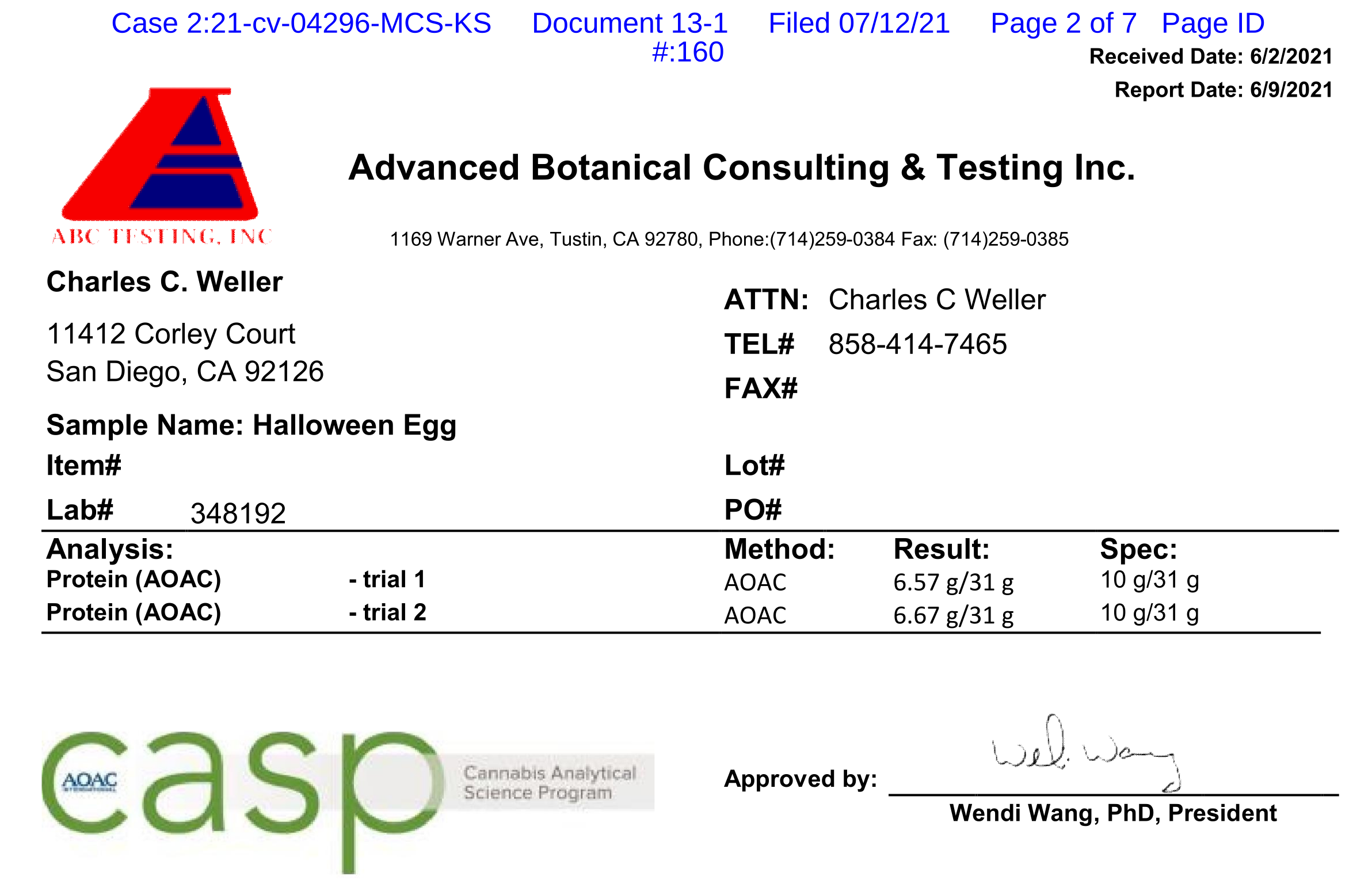
The only actual lab report filed on any docket in this five-year campaign that we've found. Advanced Botanical Consulting & Testing of Tustin, California, addressed directly to Charles C. Weller, dated June 2021. Halloween Egg measured 6.57 and 6.67 grams against a 10-gram spec... roughly two thirds of the claim.
Bowmar is the only protein case in our corpus where the underlying laboratory reports themselves were filed as exhibits, and as of this writing, still the only one. The reports, from Advanced Botanical Consulting & Testing in Tustin, California, were addressed directly to Weller and disclosed lot numbers(Doc. 13-1[5] and Doc. 28-1[6]) -- something no complaint matched again until RYSE's amended complaint, five years later (more on that below).
The alleged shortfalls also dwarf anything in the current wave: a Halloween Egg bar measured at 66% to 67% of its 10-gram claim across two trials, and the Pumpkin Spice whey powder, claiming 22 grams of protein, measured at roughly a third of that, 7.45 and 7.62 grams across two separate tests.
Note that this is an allegation, not an established fact. As the rest of this piece shows, no court ever decided whether those reported measurements established that Bowmar's products were actually mislabeled.
Bowmar's case went through three rounds of amendment, each one changing enough to read like a fresh draft rather than a light edit. The version that mattered most, the Second Amended Complaint, named eleven purchased products and tried to represent buyers of Bowmar's entire protein-fortified lineup, spreads, powders, frostings, and bars alike.
Judge Mark C. Scarsi's ruling on Bowmar's motion to dismiss, issued August 19, 2021, cut that down hard. He dismissed the claims tied to any state but California for lack of standing, dismissed the claims covering products Lozano hadn't actually bought, and dismissed the claims on ten of her eleven purchased products for failing to plead fraud with enough specificity under Rule 9(b), which is defined in the sidebar of this section.
Only one product's claim survived intact, Pumpkin Spice Protein Powder. But on the argument with the most future impact, Scarsi sided with the plaintiffs. Bowmar argued that the complaint never said the testing followed the FDA's 12-sample protocol.[7] Scarsi rejected that argument at this early stage, citing a footnote in Durnford v. MusclePharm, stating that plaintiffs didn't have to prove their testing methodology just to keep the case alive.(Doc. 27)[8]
That's the same reasoning we'll see formalized at the Ninth Circuit level four years later (Scheibe case). A district court got there first, on the same footnote, on the same kind of claim.
Lozano filed a third amended complaint narrowing her allegations, and Bowmar answered rather than moving to dismiss again. Five weeks later, on October 26, 2021, the parties jointly stipulated to dismiss the case without prejudice, with each side bearing its own costs. The joint filing shows that both sides agreed to the dismissal, but the public docket doesn't establish whether the case settled or on what terms. The case ended, five months after it was filed, with one product's claim still technically alive when it did.
Looking back at it now, what's interesting is that Bowmar's complaint cited an actual named lab, disclosed lot numbers, and attached the underlying report. As far as this reporting can find on PACER, none of the post-2021 analytical complaints combined all three features until RYSE's amended complaint disclosed lot numbers for its second round of testing (more on that below). The RYSE case now discloses lot numbers, but Bowmar still stands alone in one important respect: it actually put the underlying lab reports on the docket.
2023: A Defeat That Became a Blueprint
Two years after Bowmar, a different legal theory got its founding case, and it's a case where the plaintiffs (who were not represented by Weller) actually lost.
Nacarino v. Kashi Co., 77 F.4th 1201 (9th Cir. 2023), consolidated two appeals against Kashi and Kellogg cereal products, brought by different plaintiffs (Elena Nacarino and Megan Taylor against Kashi and Molly Brown and two others against Kellogg), arguing their protein claims were misleading because the protein came from lower-quality sources than the label implied.[9]
The Ninth Circuit affirmed dismissal of both. Why, however, is the interesting part: the panel did not actually find that Kashi and Kellogg's labels were accurate. Maybe they were, but that's not where the case led.
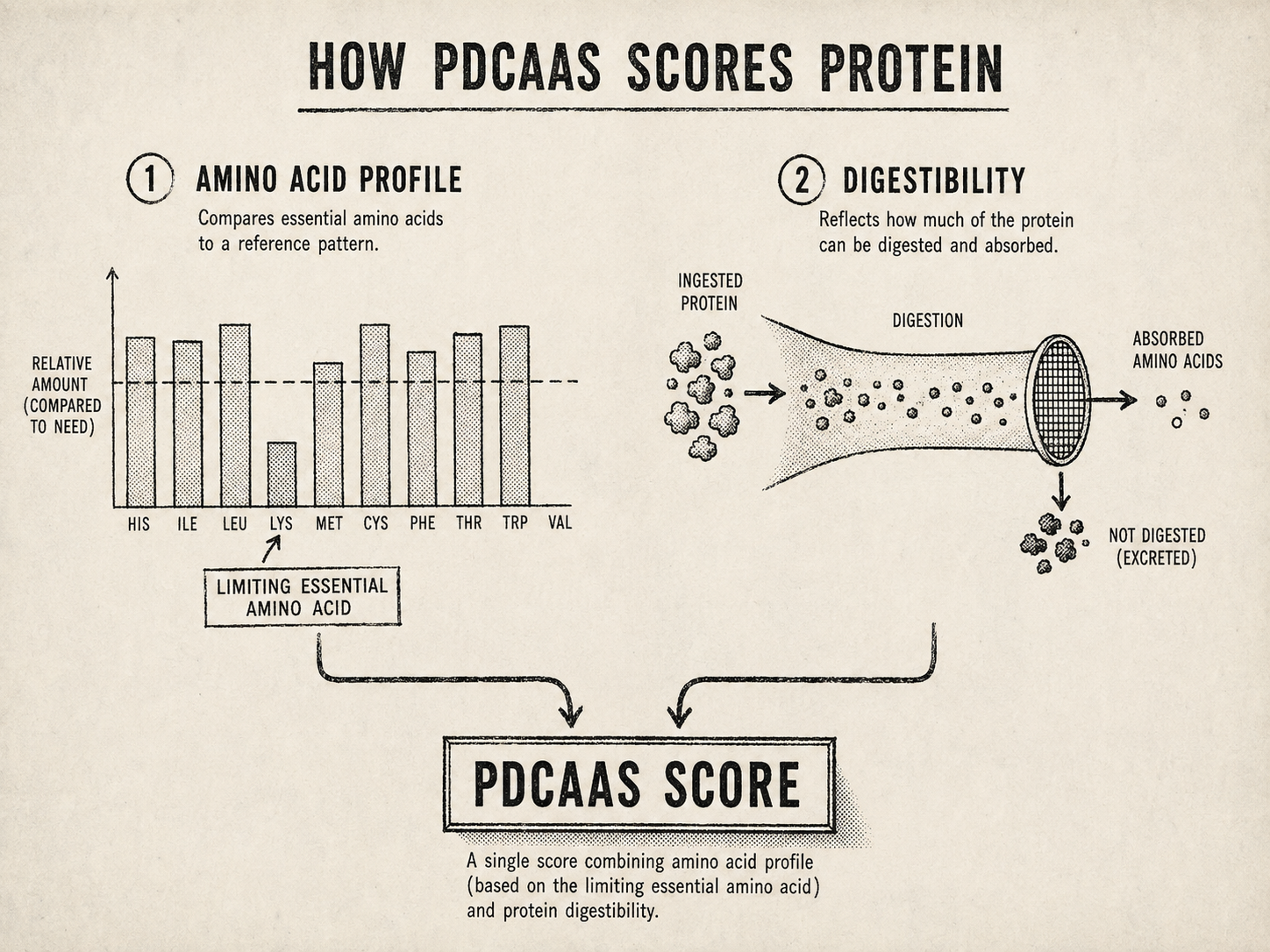
How PDCAAS Scores Protein -- It's not just weighing nitrogen, and certain labeling tactics can trigger its requirement in the %DV area.
It instead found that the plaintiffs hadn't pled the right thing: neither complaint alleged that the labels' Nutrition Facts panels omitted the protein quality-adjusted percent daily value that federal regulations require. Whether the panels actually included it or not was never the question the court answered. The cases were dismissed because the complaints left out a required allegation -- not because the court ever found the labels accurate.
Learning from Loss: What the Regulations Require
The panel did, however, explain in some detail what federal regulations actually require: when a label promotes protein quantity outside the Nutrition Facts panel, the panel itself has to disclose a percent daily value that's been corrected for protein quality using PDCAAS, the Protein Digestibility Corrected Amino Acid Score.[7] The court explained that a protein claim outside the Nutrition Facts Panel can trigger a requirement to display a PDCAAS-adjusted percent daily value inside the panel. The plaintiffs still lost because their complaints had not alleged that the required figure was omitted. The Nacarino and Brown plaintiffs simply hadn't properly pleaded that omission.
Weller was not counsel in Nacarino. But the Ninth Circuit's published opinion supplied a public roadmap for later complaints: plead the omission the Nacarino and Brown plaintiffs had failed to allege.
Every PDCAAS complaint we've seen since then cites Nacarino and includes the exact allegation those earlier complaints left out. So the founding case of an entire legal campaign is a loss that doubled as an instruction manual for winning next time.
2024: The Campaign Finds Its Shape with Alpha Prime and IQBAR
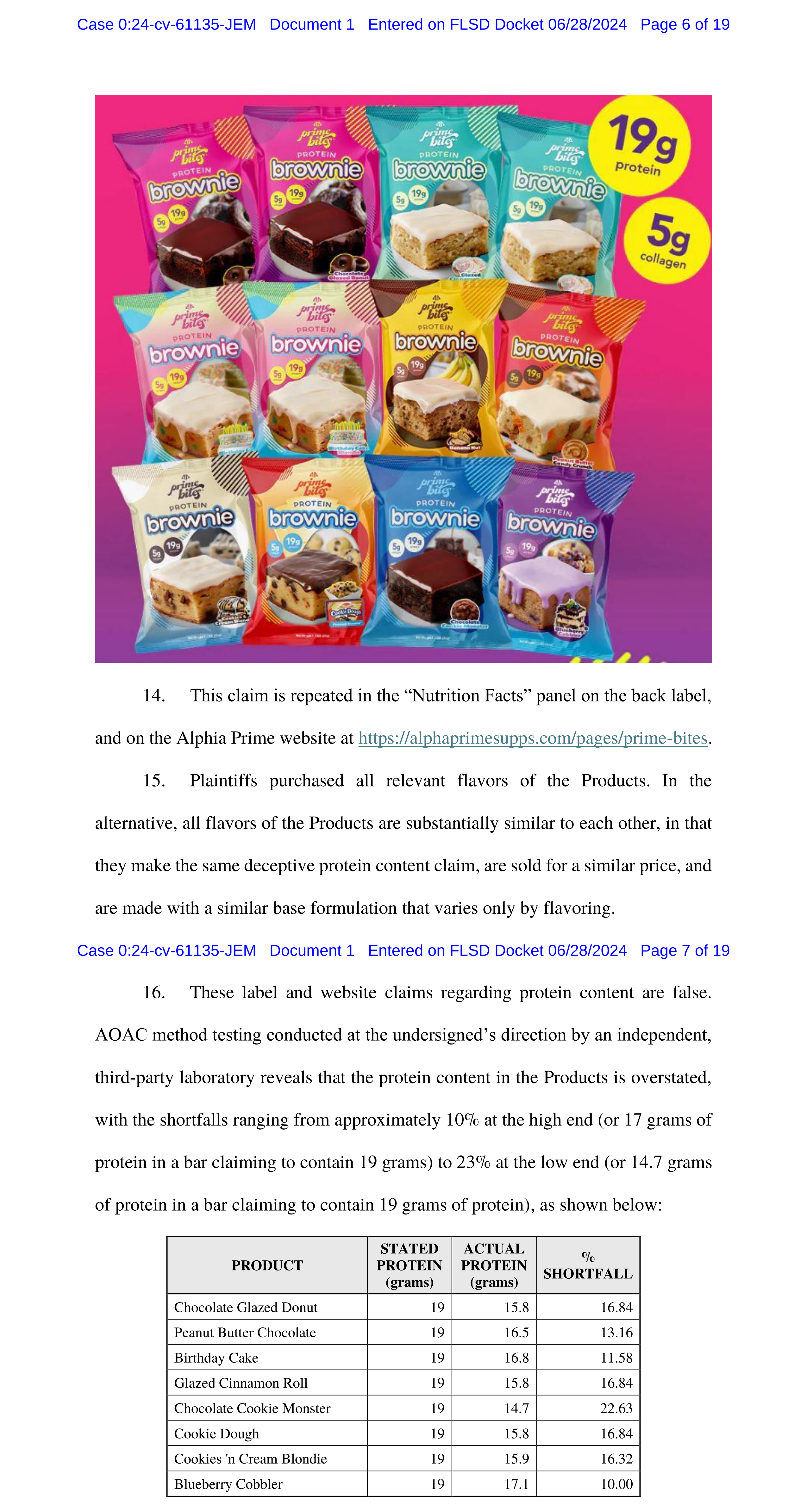
Alpha Prime's Prime Bites Protein Brownies: 19 grams claimed per bar (including 5 grams of collagen). The 2024 complaint alleges shortfalls from 10% to 23%, and three of the eight tested flavors report the exact same result: 15.8 grams, a 16.84% shortfall.[10]
The first suit involving a plaintiff who would go on to dominate this campaign was filed June 28, 2024: Melancon v. Alpha Prime Supps, in the Southern District of Florida, over Prime Bites Protein Brownies claiming 19 grams of protein.(Doc. 1, No. 0:24-cv-61135)[10] One of the three named plaintiffs was Daniel Ruchman, a Ventura, California consumer who would go on to be the named plaintiff in every related sports nutrition suit filed (that we can find) so far in 2026.
The complaint alleged testing by an unnamed independent third-party laboratory and reported shortfalls ranging from about 10% (17 grams measured against the 19-gram claim) to about 23% (14.7 grams), across eight of the line's nine flavors.
One flavor, banana nut, never appears in the results table. Three of the eight rows report the same rounded figures: 15.8 grams and a 16.84% shortfall. The public pleading doesn't provide enough underlying sample or laboratory information to explain why. That could be coincidence, rounding, or something worth asking the lab about. A similar situation shows up again later in this piece, in a completely different case.
Quietly, in the background, a different case was already gathering its own evidence. In August 2024, Weller's office had IQBAR's protein bars tested by EMSL Analytical using AOAC Method 992.15. The complaint that followed would become the only one in this campaign to plead both of his legal theories at once, ten months before the analytical theory would get its own appellate blessing.
2025: Two Campaigns Running in Parallel
Alpha Prime's Florida case was dismissed January 13, 2025. The bigger question is how, as it sets a pattern that repeats twice more in this story.
Judge José E. Martínez never got to the protein testing. He threw the case out because the plaintiffs hadn't shown a real financial injury -- their claim that they paid more because of the allegedly bad label was too speculative. Alpha Prime had also attacked the testing method and raised FDA preemption, but the judge didn't need to decide any of that. So this was a standing loss, not a ruling that the protein allegations were wrong.(Doc. 17)[11]
An appeal to the Eleventh Circuit was dismissed, reinstated, and then voluntarily dropped by the appellants themselves in June 2025, so no appeals court ever reached the protein issues either.
The PDCAAS Wave
With that case stalled, 2025 became the year of Weller's other theory. Between February and July, PDCAAS-based suits went out against PEScience (February 5)[12], Huel (March 10),[13] IQBAR (May 23, pleading PDCAAS alongside its EMSL testing),[14] EHPLabs (May 28, refiled June 3 after a wrong-district filing),[15] Naked Nutrition (June 17),[16] Upnourish (June 18),[17] Tru-Nut (July 23),[18] and Olympian Labs (July 25).[19]
These are Regulatory in Fashion
With one important exception (IQBAR), the PDCAAS suits were about regulatory labeling rules, not finished-product lab testing! In these allegations, the label states a percent daily value for protein that isn't corrected for the protein's actual digestibility, exactly the gap Nacarino described two years earlier.
Not Limited to Protein Cases
Two days after the PEScience suit, Weller also filed against Nature's Path, though this one's more of a footnote: it alleges Organic Toaster Pastries are marketed as "healthy" despite carrying 33 to 38 grams of added sugar per serving, with no PDCAAS or protein allegation anywhere in it. It's worth knowing about mainly because it shows the practice isn't just limited to protein specifically, it's aimed at whatever a label claims that testing or math can call into question. And to be fair, 33g is a lot of sugar.
Then, on June 23, 2025, the analytical theory got its own case, and what's interesting is that it wasn't a protein case at all, yet is the one that gave future testing-based cases an even stronger argument:
Scheibe v. ProSupps: Do You Need 12 Lab Tests to File a Suit?
Scheibe v. ProSupps USA, LLC, No. 23-3300 (9th Cir. 2025), which Weller argued personally, concerned ProSupps' Hydro BCAA product and its zero-carbohydrate, zero-calorie label claim.[20] Plaintiff Jacob Scheibe had one sample independently tested and found carbohydrate and calorie levels far above what a zero-carb, zero-calorie label allows.
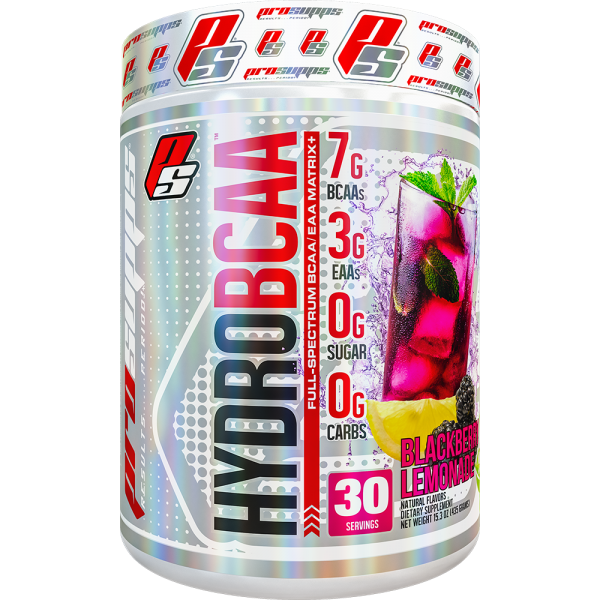
We raved about the flavor of this product. But it landed in a bit of hot water in a case that was used to move other cases forward as well.
However, he hadn't followed the FDA's twelve-sample composite testing protocol, described above. The district court dismissed on preemption grounds. But not so fast -- the Ninth Circuit reversed, holding that one preliminary lab test could be enough to keep a mislabeling case alive at the start, even without the FDA's full 12-sample process. The Ninth Circuit expressly left open whether discovery might show whether the first result was an outlier or not.
Protein was never even mentioned in that case. But the reasoning is more general: a plaintiff doesn't need FDA's full sampling protocol to get a plausible mislabeling case started under the same federal rules that govern protein labels.
Recall, preemption is the rule that federal law overrides conflicting state law. Food labeling is federally governed, so a state-law suit can't demand something different from what the FDA already requires. That's why preemption keeps coming up in these cases.
The Scheibe appeal decided a real but narrow question: how much testing a plaintiff needs before filing... not whether any product was actually mislabeled. And the product was a BCAA drink, where the dispute was carbohydrates and calories. The ruling wasn't about protein, but its logic can still be used in protein cases.
Scheibe wasn't the case that invented testing-based protein suits -- IQBAR had already been quietly running that theory for almost a year. But what Scheibe did was strengthen a testing theory Weller had already used in Bowmar and IQBAR. And now the ball is rolling.
By December 2025, that strategy was already in motion. EMSL tested RAW Nutrition's products on December 10 and RYSE's and Bucked Up's on December 16, roughly a month before Ruchman's alleged January 8, 2026 shopping trip that all three complaints would later describe.
This brings us to the modern era of lawsuits, which we're now only covering.
2026: The Sports-Nutrition Wave
Four suits across three sports-nutrition disputes went out in quick succession: RAW Nutrition (April 7), RYSE (May 21), Bucked Up / DAS Labs (June 1). The RAW matter was later dismissed and refiled against Raw Sport Supplement Company, a differently named corporate defendant, using the same test table.
All three drop the PDCAAS theory entirely and lead with EMSL/AOAC testing:
| Brand | Claim | Flavors Tested | Complaint-Reported Result vs. Label |
| RYSE | 22 g | 4 of 5 across two rounds | 89%-94% (Dec. 2025); 93-96% (July 2026) |
| RAW Nutrition / Raw Sport | 30 g | 6 of 6 | 88%-93% |
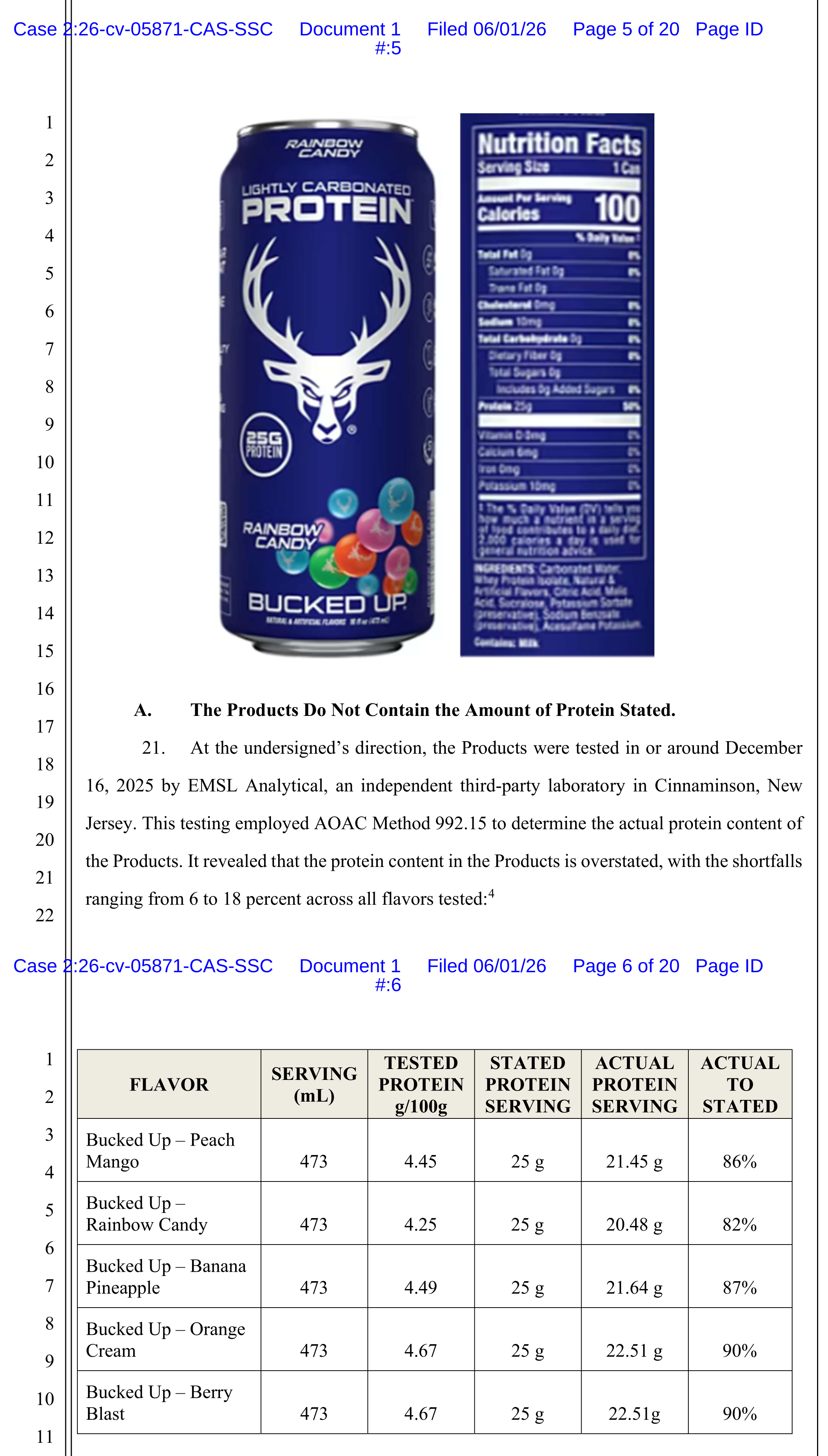
| Bucked Up | 25 g | 5 of 5 | 82%-90% |
| Note: These figures are allegations taken from the complaints' testing tables, not judicial findings. | |||
Three details in this table are as important as the numbers themselves:
-

Bucked Up's Rainbow Candy protein soda claims 25 grams. The complaint's table alleges 82% to 90% across five flavors, and interestingly reports Orange Cream and Berry Blast at identical figures down to the decimal: 4.67 g/100g, 22.51 grams, 90%.
First, every complaint attributes a density correction, applied to convert a lab's grams-per-100-grams reading into grams per serving, to a source other than the lab itself. The RYSE and RAW complaints attribute the density testing to "the undersigned", while Bucked Up attributes it to "Plaintiff", but none attributes that density measurement to EMSL. Because the underlying EMSL reports are not attached, the public filings do not tell us whether EMSL reviewed the conversion.
Since each reported density factor is greater than 1.0, applying it increases the calculated grams of protein per serving and therefore narrows the alleged shortfall. Removing the factor would make the reported shortfall larger, not smaller. The unresolved question is who performed the density measurement, how it was performed, and whether EMSL reviewed or relied on that conversion.
- Second, the testing dates precede Ruchman's alleged January 8 purchase. That establishes the sequence: the lab work was not commissioned in response to that specific purchase. The complaints do not explain in the pleading how the tested samples were selected or acquired.
- Third, the table in the Bucked Up complaint reports identical values, 4.67 grams per 100 grams, a 22.51-gram result, and a 90% figure, for two different flavors, Orange Cream and Berry Blast.
The Alpha Prime complaint two years earlier likewise reported the same rounded result for three flavors, where each reported 15.8 grams and a 16.84% shortfall. The pleadings do not disclose enough underlying test or lot information to explain the identical rounded values. Rounding or coincidence are of course possible.
The Elusive RYSE Clear Chocolate
RYSE's complaint is also where the chocolate paragraph from this article's intro comes from, and once you compare it against RAW's original complaint, the picture is pretty clear: the "chocolate flavor purchased on January 8, 2026 at a Vitamin Shoppe in Thousand Oaks" paragraph is the one in question. RAW's original complaint contains the same paragraph first, where chocolate is an actual flavor. That strongly suggests the RYSE sentence was carried over from the earlier pleading.
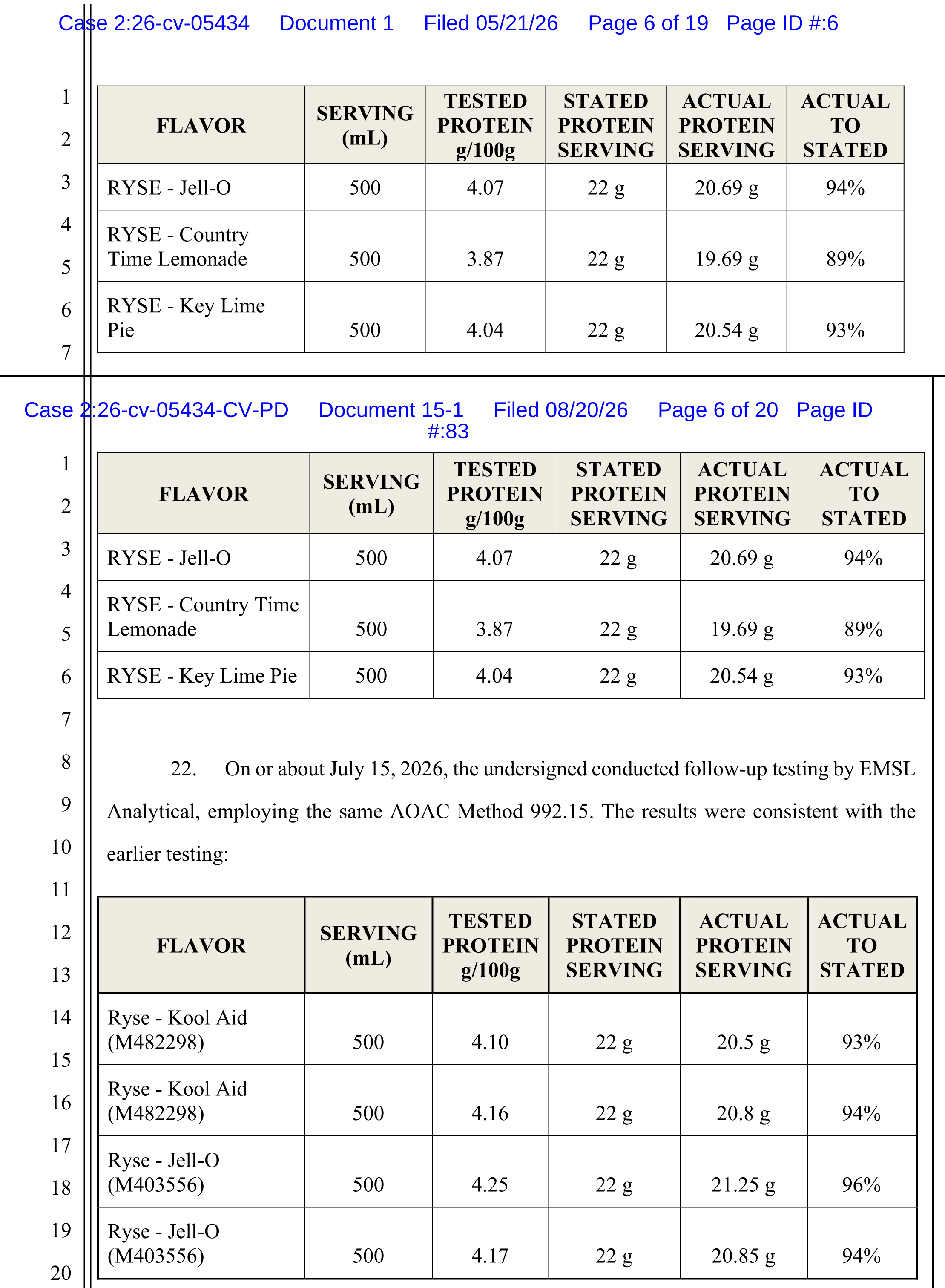
RYSE's testing, before and after. The original complaint tested three flavors at 89% to 94% of the 22-gram claim. The amended complaint adds a July 2026 round -- and for the first time anywhere in this campaign, discloses lot numbers. The new results are milder though: 93% to 96%.
Bucked Up's parallel paragraph correctly substitutes "rainbow candy", an actual Bucked Up flavor, which is consistent with reuse of a common pleading template. This gives us a clue as to how these complaints get assembled.
Of course, it says nothing about whether the underlying testing is right or wrong, which is what we as consumers actually care about.
RYSE Enters the Ring
RYSE was personally served through founder and owner Nicholas Stella at the company's Prosper, Texas office on June 15, 2026, and when no answer followed, Weller filed a request for the clerk to enter default on July 27. On August 6, the parties filed a stipulation before Judge Cynthia Valenzuela to set that request aside, with RYSE's newly retained counsel agreeing to a response deadline of August 27, 2026.(Doc. 13, Doc. 13-1)[21,22] That counsel is Amin Wasserman Gurnani, the same firm defending IQBAR, Upnourish, and Bucked Up.
With RYSE now on board, two of the three currently active 2026 sports nutrition defendants, RYSE and Bucked Up, share the same law firm. Business is certainly booming.
That August 27 deadline never arrived. Instead, RYSE stipulated to let Ruchman file a First Amended Complaint, filed August 20, 2026,(Doc. 15-1)[23] which reset RYSE's response deadline to 21 days later.(Doc. 15-3)[24] The stipulation describes the amendment as one that "adds allegations relating to additional testing and corrects certain clerical errors in the original Complaint."(Doc. 15)[25]
Amendment Fixes Chocolate Error: Now Alleged Kool-Aid Cherry Limeade
The amendment also fixes the chocolate paragraph: Ruchman is now alleged to have purchased "the Kool-Aid (cherry limeade) flavor", which is an actual product. It also adds a second round of EMSL testing, conducted July 15, 2026, and this time the complaint discloses lot numbers, two Kool-Aid samples from lot M482298 and two Jell-O samples from lot M403556.

The fix, in Weller's own redline: "chocolate" struck, "Kool-Aid (cherry limeade)" inserted. Filed August 20, 2026 (the day before this article was completed). The stipulation calls it correcting "certain clerical errors."
The updated complaint calls the new results "consistent with the earlier testing". The numbers now run a little closer to the label than the original round did (93%-96%, versus 89%-94% the first time), which is a decent difference, given that no number is over a 10% shortfall now.
Still, this is the first time since Bowmar that any complaint in this campaign has put a lot number on the record.
What the Courts Have Actually Decided
Long story short: only two cases were thrown out, and both were dismissed because of standing, not because a judge decided either protein theory was wrong.
IQBAR: Two Rounds of Testing, No Merits Ruling
IQBAR is the clearest illustration of how far a plaintiff can get without ever losing on the substance, and its own numbers are worth seeing before getting into how the case played out. IQBAR ran two rounds of testing at EMSL on its 12-gram protein bars, one in August 2024 and a second in March 2025:
| Flavor | Round 1 (Aug. 2024) | Round 2 (Mar. 2025) |
| Wild Blueberry | 10.5 g (13% short) | not retested |
| Toasted Coconut Chip | 12.0 g (0% short) | 11.9 g (1% short) |
| Peanut Butter Chip | 11.2 g (7% short) | 11.3 g (6% short) |
| Chocolate Sea Salt | 10.9 g (10% short) | 9.8 g (18% short) |
| Banana Nut | 11.4 g (5% short) | 11.5 g (4% short) |
| Lemon Blueberry | 11.6 g (4% short) | 10.4 g (13% short) |
| Almond Butter Chip | 11.9 g (1% short) | not retested |
Toasted Coconut Chip measured right at the label claim in round one and slipped slightly in round two. Chocolate Sea Salt went the other way, from a 10% shortfall to 18%. Lemon Blueberry more than tripled its shortfall between the two rounds. Same lab, same method, roughly seven months apart, moving in both directions depending on the flavor.
Whether those rounds tested the same production lot is impossible to say, because the complaint doesn't disclose one! It gives no lot numbers, no batch codes, and no purchase dates for the tested bars. That matters, because FDA's own compliance procedure is built around a lot: twelve subsamples drawn to be "representative of a lot."
Different production lots are one possible explanation for changed results, but the complaint gives no lot numbers, so the two testing rounds cannot be matched to production runs from the public pleading. Without knowing whether these were the same run, a reader can't tell whether Chocolate Sea Salt got worse or whether two rounds simply caught two different batches. Keep that in mind before treating any single percentage in this article (on any brand) as a fixed number.
IQBAR moved to dismiss arguing that five of its seven tested flavors had at least one result rounding to the labeled 12 grams, making a shortfall claim implausible on its face. Judge Josephine L. Staton never reached that argument. IQBAR's motion failed for a technical reason: it attacked only part of a claim, not the whole thing.(Doc. 18)[26] The only claim actually dismissed was unjust enrichment, with leave to amend. The amended complaint fixed that, IQBAR's second motion to dismiss was denied outright two months later,(Doc. 23)[27] and the company answered the complaint in January 2026.
Bottom line: both protein theories stayed alive, but the judge never ruled that either one was correct. IQBAR eventually had to formally answer the complaint and keep defending the case.
The plaintiff eventually voluntarily dismissed in June 2026, with no terms disclosed on the docket. The public docket doesn't say why the plaintiff voluntarily dismissed the case. A private resolution is a plausible inference, though it's not established by any documents we can find.
Huel: A Wild Ride Worth Its Own Story
Huel is probably the most complex case discussed in this article, but it's worth going through since the full story is better than the simple one.
Huel moved to dismiss under Rule 12(b)(1), arguing that Sarayli hadn't shown a real injury, and backed that argument with a sworn declaration from Product Director Lee Boakes.(Doc. 49-2)[28] Boakes stated that pea and rice protein, while individually limited on certain amino acids, complement each other when combined at the right ratio: approximately 1.0 PDCAAS, which, if accepted, supported Huel's position that the advertised percent daily value was accurate.
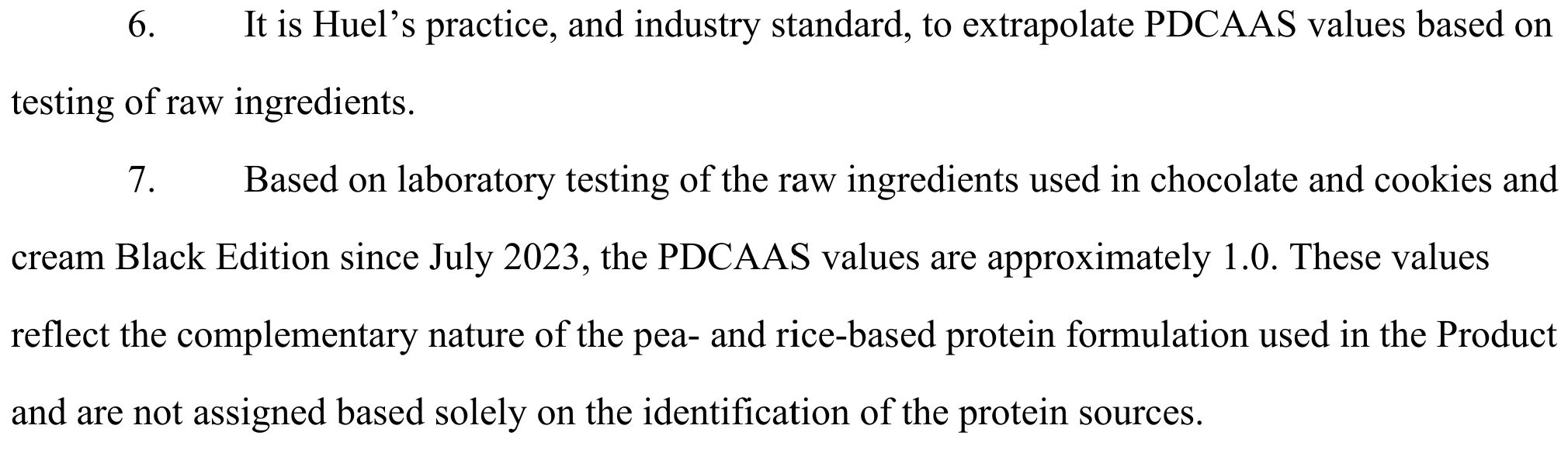
The declaration that won the Huel case. Huel's Product Director states it is "industry standard, to extrapolate PDCAAS values based on testing of raw ingredients" -- not the finished product. Yet no laboratory named, no report attached, two flavors covered.
But read that declaration closely and it's thinner than the outcome suggests. It names no laboratory, attaches no test report, gives no methodology, and only covers the two flavors (chocolate and cookies and cream) that the named plaintiff had actually purchased. The value itself is described as "approximately 1.0", extrapolated from testing of raw ingredients rather than measured on the finished product.
Weller, attorney for plaintiff Aykut Sarayli, contested the declaration hard in his opposition.(Doc. 52)[29] He argued the motion was "a Rule 12(b)(6) motion masquerading as a jurisdictional attack", pointed out that "approximately" was doing a great deal of unexplained work, and noted (accurately) that Huel's entire defense amounted to accusing the plaintiff of not testing the product, while also attaching no test of its own.
Weller attacked the declaration in his brief, but didn't file competing evidence or ask for more time to get it. With Huel's declaration unanswered by other evidence, Judge Pitts concluded Sarayli hadn't shown an injury and dismissed the case in March 2026, without prejudice but without leave to amend.(Doc. 63)[30]
Huel won the standing fight because it put evidence in the record and Sarayli didn't. But the judge never decided whether the PDCAAS theory itself was right.
This doesn't mean Weller's theory here "failed", though. We are this far along, and still, nobody has yet put finished-product PDCAAS testing before a court, on either side of this campaign!
Not the Only Go at Huel - Enter the Heavy Metals Case
That's not all, though.
Weller has actually sued Huel twice, and the second case did get a judge to rule on whether the complaint was properly written... just about heavy metals rather than protein. Filed in October 2025 in the Northern District of California, Sarayli and a co-plaintiff alleged Huel's Black Edition powder, the same product from the protein case, contained excessive lead and cadmium, citing an October 2025 Consumer Reports investigation. (Doc. 12, No. 5:25-cv-08878)[31]
The two cases moved on identical schedules: motions to dismiss, oppositions, and replies were all filed the same day in both. But Huel defended them completely differently. In the heavy-metals case, it filed no fact declaration of its own, only an attorney declaration authenticating government publications on lead exposure limits.
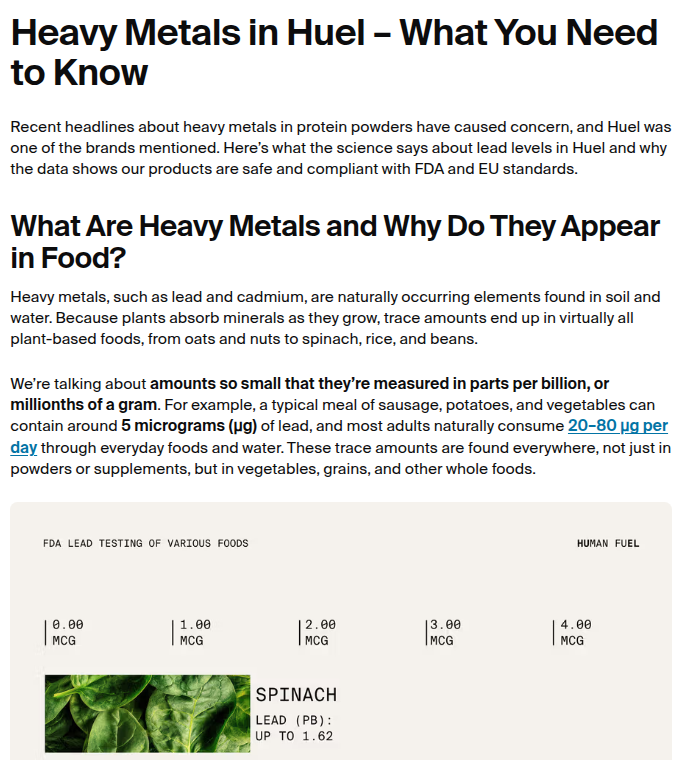
Huel's website now maintains a public heavy metals statement (archive)
Judge Eumi K. Lee's order found the plaintiffs' economic-injury theory adequate for standing, citing Bowen v. Energizer Holdings, then dismissed the complaint under Rule 9(b) for failing to identify which specific statements were misleading and, notably, for failing to plead reliance at all.(Doc. 44)[32] The court granted leave to amend. Rather than file the amended complaint the judge had expressly allowed, the plaintiffs voluntarily dismissed on July 10, 2026.
The difference was in how the case was pleaded, not the science. The judge said the heavy-metals plaintiffs had shown enough injury to be in court, but the complaint still failed because it didn't clearly identify the misleading statements or say the plaintiffs relied on them.
But note now that the RYSE's protein complaint does include that reliance allegation. It states that "Plaintiff reviewed the front label and Nutrition Facts panel on the Products prior to his purchase."
Two Law Firms Duke It Out Again and Again
Now set those two dismissals against Bucked Up, the fourth case in the current wave, and add a new client for a firm that's been on Weller's opposition from the start. William P. Cole and Matthew Orr defended Bowmar in 2021 under their firm's earlier name, Amin Talati Wasserman. As Amin Wasserman Gurnani, the same two lawyers have since defended IQBAR, Upnourish, Bucked Up, and, as of August, RYSE. Five cases across five years, against the same opposing counsel each time. A legal rivalry is formed.
Bucked Up's motion argues only that Ruchman can't seek equitable restitution because he hasn't explained why ordinary money damages wouldn't be enough.(Doc. 12-1)[33] It never mentions preemption, Scheibe, Nacarino, AOAC, EMSL, or sampling methodology. Whatever Judge Snyder decides here, it won't be a ruling on whether the protein numbers are right, as the motion itself doesn't ask the court to decide protein accuracy, AOAC methodology, sampling, or the density correction.
A hearing is set for mid September, 2026, before Judge Christina A. Snyder, roughly a month after this article is to be published, and this piece will be updated once that hearing happens.
But wildly, as of this writing, five years in, no judge has actually ruled whether any protein testing itself was right or wrong!
Where These Cases Actually Get Filed (Take a Guess)
This should come as no surprise to anyone in the industry. California.
The overwhelming majority of the district-court filings in this corpus, protein and non-protein alike, sit in California federal courts: twelve in the Central District, two in the Northern, one each in the Eastern and Southern, plus the one Ninth Circuit appeal. Every California complaint we found uses some combination of the state's Consumer Legal Remedies Act, its Unfair Competition Law, and its False Advertising Law, on top of breach of express warranty and unjust enrichment.
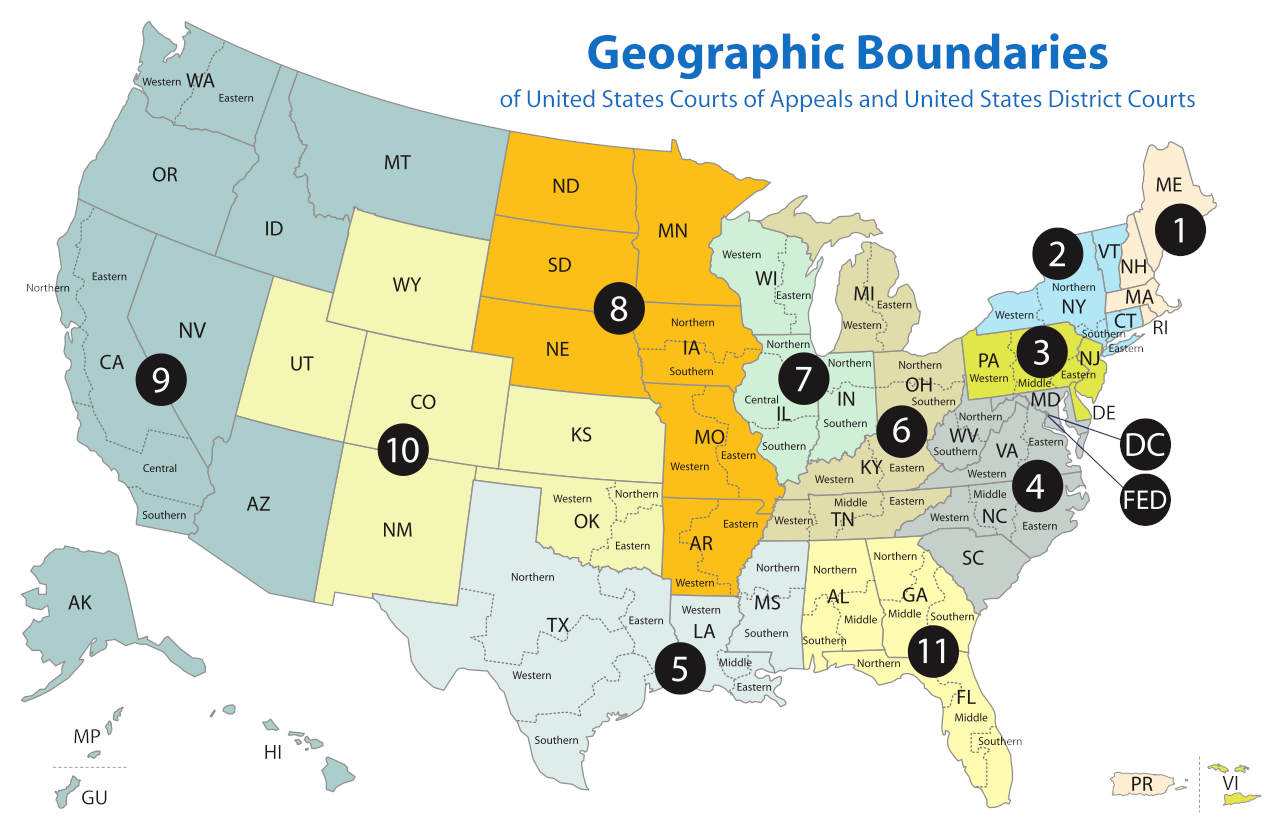
The United States District Court Map. Many cases discussed today hinged on decisions advanced out of the 9th District
The classes themselves are drawn identically, in wording that shows up verbatim in complaints filed years apart: "on behalf of all others similarly situated in the state of California", limited to consumers "of California who purchased the Products within four years prior to the filing of this Complaint". That exact phrase appears in RYSE's complaint, Huel's, and PEScience's, filed in 2026, 2025, and 2025 respectively. Bowmar's 2021 complaint pleads a "California Class" in different words but the same general shape. Most of the later California complaints are framed as California classes and rely heavily on California's consumer-protection statutes.
The Lone Out-of-State Protein Filing Was Dismissed on Standing
Interestingly, the single case filed outside California is also one of only two ever dismissed. The Florida suit against Alpha Prime pled Florida's Deceptive and Unfair Trade Practices Act instead of the California statutes, and lost on standing. That correlation lines up with what one industry contact described to us: that this campaign often leans on gaps specific to how California's consumer-protection statutes work, in a way that similar suits filed elsewhere don't get the same benefit from. However, that's one case, not a full pattern. Huel also lost on standing, and Huel was filed in California.
There's a closer comparison: Alpha Prime's Eleventh Circuit case and Huel's Ninth Circuit heavy-metals case both were decided on whether a price-premium injury (paying more for a product than it was actually worth) is concrete enough to establish standing. In Florida, in January 2025, that theory was too speculative. In California, in June 2026, the same basic theory was adequate. The same kind of claim in two completely different circuits yielded opposite results.
That doesn't prove California is a friendlier forum across the board, but it's a pretty solid data point that venue does some of the work in these cases.
A Copypasta Accusation Already on the Record
The idea that these complaints are heavily templated isn't something we're discovering here for the first time. Huel's counsel, BraunHagey & Borden, said it to a federal judge themselves in January 2026: "Plaintiff's lawyer has filed dozens of nearly identical copies of the same complaint on behalf of various professional plaintiffs", and that Sarayli was a "captive litigant" whose complaint had been "copy and pasted just like dozens of other cases brought by his lawyer".(Doc. 49-1)[34]

Huel's lawyers made the templating accusation to a federal judge in January 2026, months before anyone measured it: a "professional litigant" whose counsel "filed dozens of nearly identical copies of the same complaint."
Using 8-word shingle Jaccard similarity after stripping PACER header stamps, you can measure whole-complaint textual overlap across the pleadings. The 2026 sports-nutrition complaints ranged from roughly 63% to 86% overlap with one another, while Bowmar's 2021 complaint was under 10% against the later filings.
Lawsuits naturally reuse standard legal language, so those percentages alone don't prove "improper" copying. The RYSE clear-chocolate carryover is much more telling, because it's a product-specific factual detail that simply doesn't fit that product.
Weller answered the "professional litigant" half of the accusation in his opposition, and on this specific point, he's right. Sarayli appears in two matters in our corpus, both against Huel: the protein case and the later heavy-metals case. Weller's narrower statement that Sarayli "has never sued any company but Huel" is therefore literally true. Daniel Ruchman appears as a named plaintiff in seven matters in our corpus. The label just doesn't fit the person Huel applied it to.
Weller Replies for Comment: Lawyers Don’t Reinvent the Applicable Law Every Time They File
Asked directly about the pattern, Weller didn't dispute that the language repeats: "Cases involving similar products, regulatory requirements, and legal theories will necessarily contain overlapping allegations and legal language. Lawyers don't reinvent the applicable law and regulatory framework every time they file a related case." And asked specifically about the RYSE chocolate paragraph, he confirmed what this piece inferred rather than contesting it: "The 'chocolate' reference was an inadvertent drafting carryover and has no bearing on the testing or substantive allegations in the case."
So a few things are true at once: the complaints show substantial text reuse, Weller doesn't deny it and has a standard explanation for why, Huel's lawyers put a sharper "copy and pasted" accusation on the record than the reuse itself supports, and the specific "professional litigant" label they chose to hang on their plaintiff doesn't hold up.
Four Ways These Cases End
"Voluntarily dismissed" appears constantly in this campaign's dockets, and it hides at least four genuinely different outcomes.
- Settled. Upnourish's case followed the cleanest version of this path: a settlement notice, a stay, then dismissal, with prejudice as to the individual claim and without prejudice as to the class. Terms were never disclosed on the docket.
Out of seventeen protein cases in this campaign, Upnourish is the only one with an actual settlement notice sitting on the docket.
- Voluntarily dismissed after surviving motions to dismiss. Here the plaintiff was the one ahead. IQBAR tried twice to get the case thrown out and failed both times, then had to file an answer -- the point where a defendant stops arguing the case shouldn't exist and starts actually defending it.

Naked Nutrition moved to dismiss the case against it, and in November 2025 the court threw out part of the complaint but let the rest proceed. Six weeks later the plaintiff dismissed the case anyway. In both instances the plaintiff had already cleared the hurdle that kills most of these suits, leaving them up ahead.
The public dockets don't establish why either case was dismissed, but readers can likely make a proper assumption. Our read? These probably settled. Neither docket actually says that, so we can't report settlement as a fact, but given the circumstances, a private resolution is an obvious possibility.
- A judge had to ask twice. PEScience's case sat for over two months without any response from the defendant. Judge Mónica Ramírez Almadani eventually stepped in on her own initiative, ordering the plaintiff to either file an answer, request a default, or dismiss the case entirely, and citing the 90-day service deadline under Rule 4(m). No motion to dismiss was ever filed. Nobody contested anything. The plaintiff dismissed on the deadline itself.
Alpha Prime's California case followed an almost identical shape five months later: the defendant never answered, its response having come due back in August, and the plaintiff never moved for a default judgment despite having every right to. Judge Jesus G. Bernal ordered the plaintiff to seek that default or explain himself within a week. The plaintiff dismissed one day early instead of taking a default judgment against a company that had never once shown up.
Our take is that something probably got worked out off docket. There's no settlement filing, so we can't state that as fact, of course.
Huel's heavy-metals case arguably belongs in this category too: given a second amended complaint the court had expressly invited, the plaintiffs let the extended deadline pass and dismissed rather than file it.
- A filing error, unwound. EHPLabs' case was filed in the wrong district, voluntarily dismissed the same day a corrected version was filed elsewhere, and the filing fee was later refunded. This one gets confused with a strategic maneuver because it looks similar on paper to the RAW-to-Raw-Sport refiling, but the RAW situation involved a genuine change of corporate defendant. The EHPLabs situation was a clerical correction.
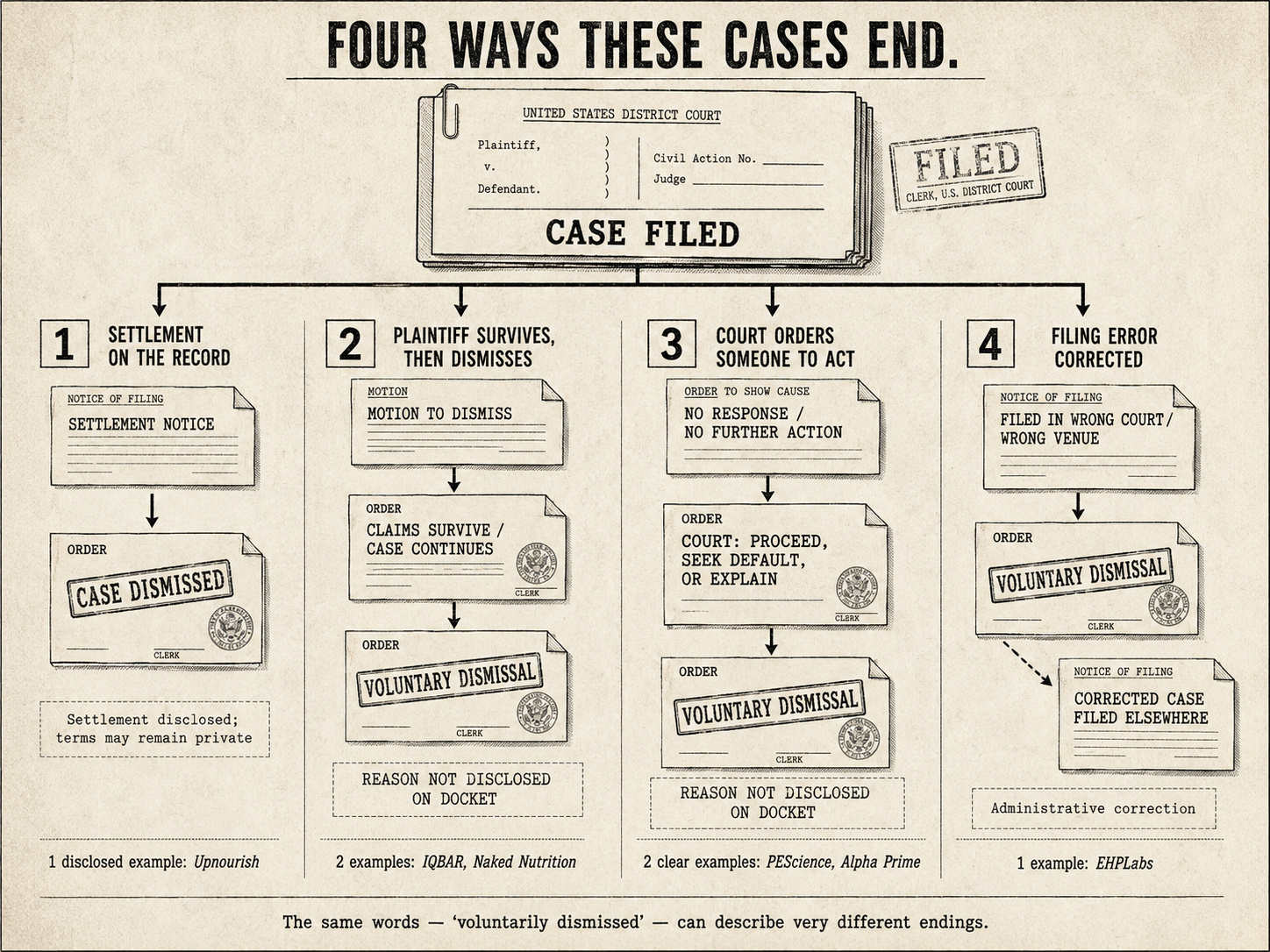
Two protein cases (PEScience and Alpha Prime California) ended after judges issued orders to show cause for lack or failure to prosecute. Meanwhile, IQBAR and Huel were litigated hard, on both sides. But it's different from "the plaintiff dropped the case".
What the Brands Say When You Ask Them
Three brands in this piece responded to outreach, with three different postures.
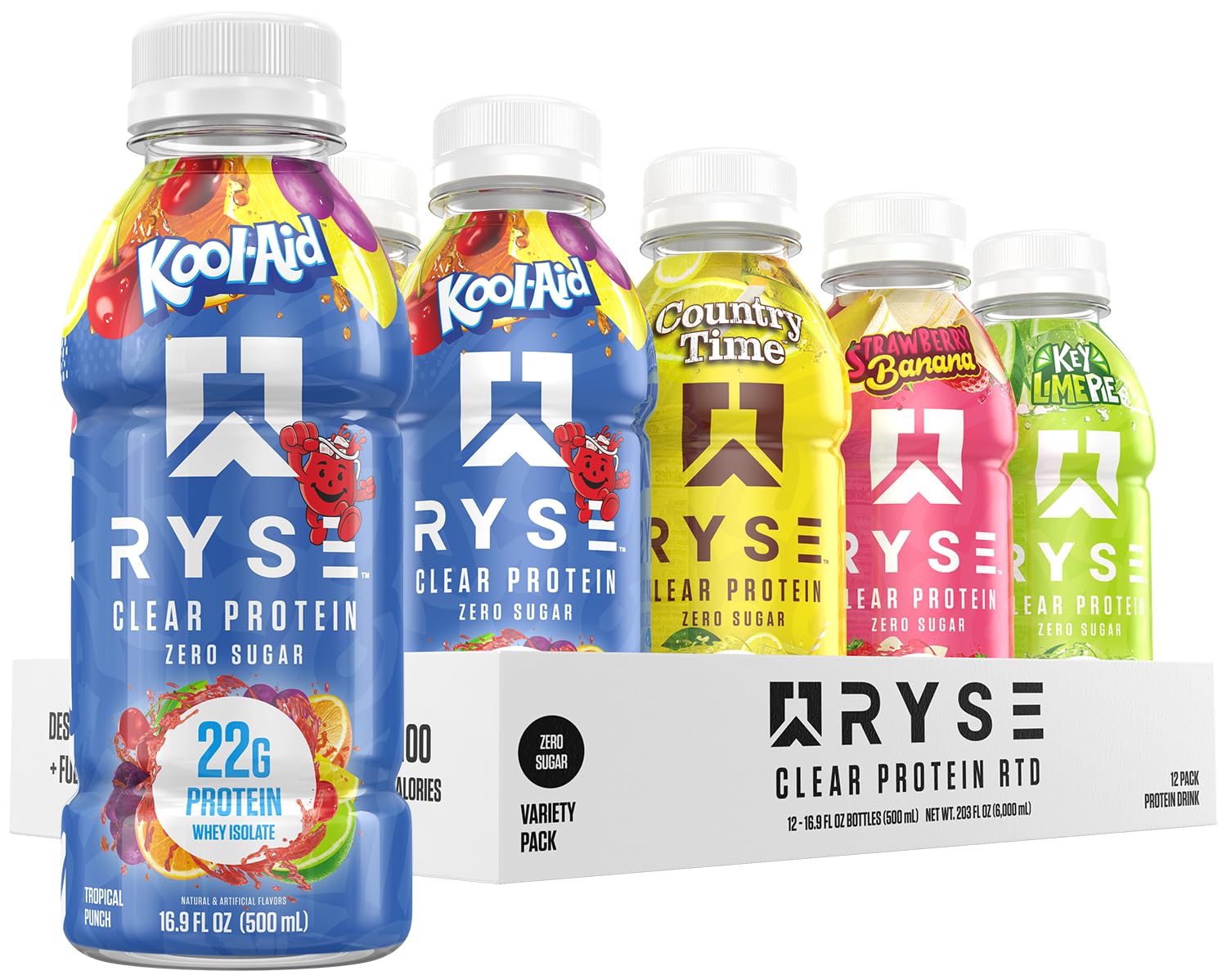
Some of the popular RYSE Clear Protein RTD flavors
RYSE's founder, Nic Stella, engaged directly during reporting and has gone on the record to other media outlets, calling the allegations "baseless". What can also be said is what this entire article turned into: that RYSE is not an isolated target, and no, they have not invented a clear chocolate flavor.
Bucked Up's Ryan Gardner told PricePlow that the company's own testing produced different results from the complaint's table, but the company did not provide that testing for publication, and can't share specifics while the case is active. Note that this isn't evidence, just a position, so we'll monitor the case as it goes.
RAW Nutrition: Informed Sport, Informed Protein
RAW Nutrition's Dom Iacovone was more direct than we'll reproduce verbatim, but his message, when translated professionally, is effectively that RAW carries certification under both Informed Sport and Informed Protein, and his team had already sent that documentation to Weller's office before this piece was reported. He said he'd be surprised if the claim against RAW wasn't dropped as a result.
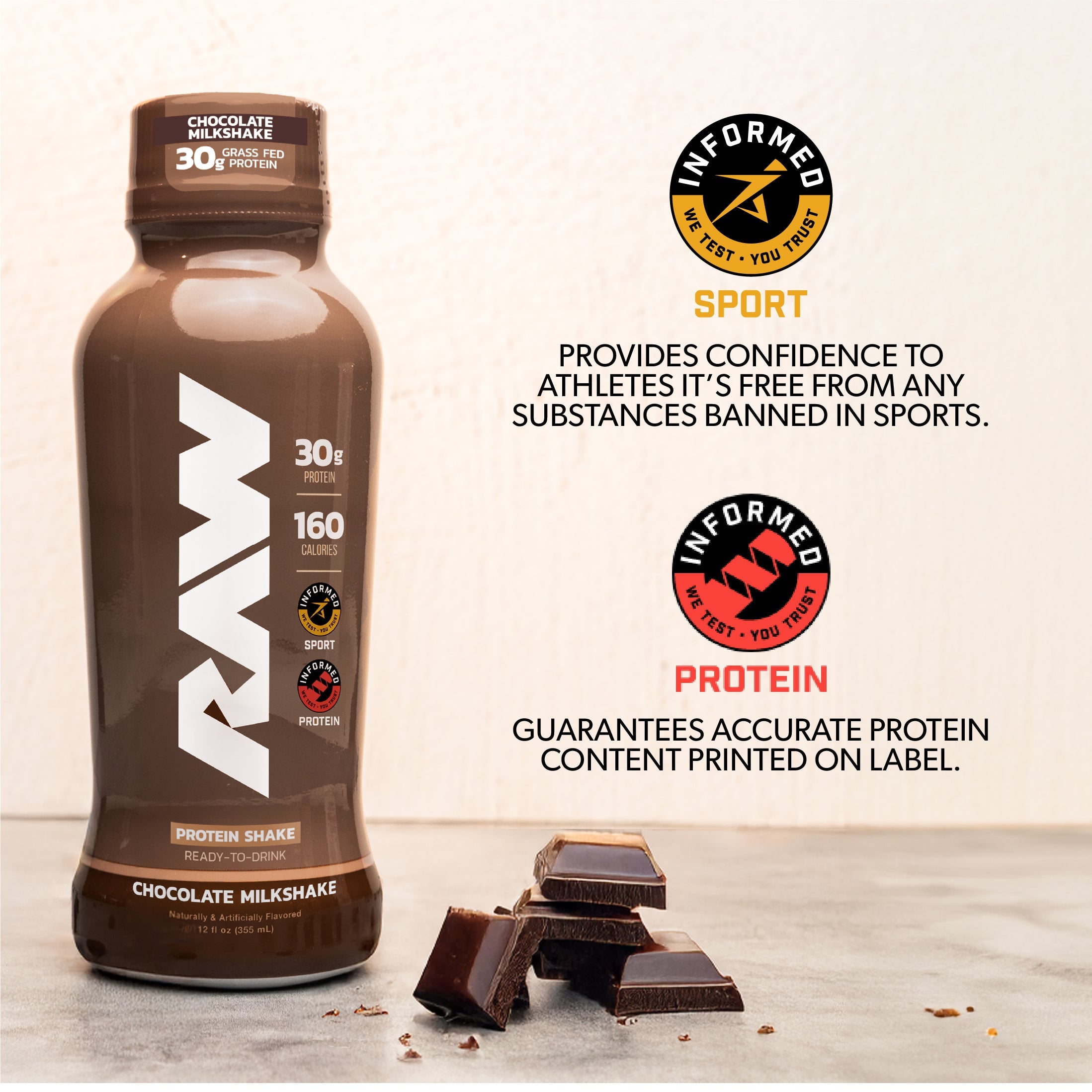
Raw Nutrition Protein RTD is both Informed Sport and Informed Protein. Will this help their case?
Iacovone's claim can be checked, too: Informed Protein, LGC's protein-content verification program, publishes its own list of certified brands, and RAW Nutrition is on it.[35] Informed Protein is different from Informed Sport, as it screens specifically for protein-shortfall, whereas Informed Sport screens for banned substances.
However, whether or not those certifications covered the specific units tested can't be determined from the complaint, because the complaint doesn't identify them! It names six flavors but discloses no lot numbers, batch codes, or purchase dates.
Certification programs certify products and production batches rather than a brand indefinitely, so without that information neither side can close the loop: RAW's public Informed Protein listing establishes that the program certifies its protein product, but the complaint supplies no lot numbers, batch codes, or test-sample purchase dates. So we can't cross reference based on what's in the public record.
EHPLabs did not respond to a request for comment. Both of its cases are closed. PEScience did not have a comment either.
Charles Weller responded to our questions, at length and on the record. Some of his responses are in sections above, and further responses follow in the next section.
A handful of smaller questions still remain open. Why did IQBAR and Naked Nutrition walk away from cases they were seemingly winning? Who actually performed the density correction applied to the RYSE and RAW test results, and to what standard? We asked Weller directly; he described the testing process as varying "depending on the product and issues involved" and declined to go further, so this one stays open.
A Response from Charles Weller
Charles, who had been in touch with us throughout the past decade or so, took the time to respond in full to many of our questions. Looking back through our archives, he had emailed us when the Bowmar case was first filed, and we agreed there were indeed issues in the functional food space (this was hot off the Lenny & Larry's protein cookie lawsuit, which we had independently tested ourselves, so we knew of the active problems in the space).
Weller kindly agreed to answer in writing and on the record:
Weller: Not Anti-Industry, But Pro-Consumer
Asked what problem he believes these cases address, he framed it as a disclosure problem: "Consumers have no practical way to independently verify what is actually in a product and therefore have to be able to rely on the label. While many companies produce accurately labeled products, our investigations have identified products where the labeling raises concerns."
On motive: "Our work isn't 'anti-industry'; it's pro-consumer. Responsible companies that invest in quality products and accurate labeling shouldn't be placed at a competitive disadvantage to companies that don't." (emphasis ours)

Charles Weller went on the record at length, explaining how his work is work isn't 'anti-industry', it's pro-consumer.
On how he got here, he said Bowmar wasn't actually the start: "I've practiced dietary supplement and food law for more than 25 years, representing clients throughout the country on regulatory and litigation matters. This litigation grew out of that longstanding experience."
On testing, he described using "reputable independent laboratories... including many of the same laboratories supplement companies use," while declining to go further: "I'm not going to publicly disclose our investigation process or attorney work product in pending cases beyond what appears in the court record." Asked directly whether he'd share the underlying EMSL reports this piece hasn't been able to find on any docket, his answer was: "Not beyond what has been disclosed or will appropriately be disclosed in the litigation."
Weller: Recent Cases are Wins for Consumers
He pointed to Scheibe as the clearest example of his approach working, calling it "a significant win for consumers." As a reminder, that was the case that had a ruling about how much testing survives a motion to dismiss (but not a ruling on whether any product was actually mislabeled).
On the pattern of cases ending in voluntary dismissal, he declined to discuss specifics: "I don't discuss confidential settlement terms or negotiations."
Commentary on RYSE, Bucked Up, and RAW? To be Addressed in Litigation
On RYSE, Bucked Up, and RAW disputing the claims against them, he was unbothered: "That's neither unusual nor unexpected. They're entitled to defend themselves, and we'll address those defenses through the litigation process."
He closed where he started: "Consumers have no way of knowing whether a company is telling them the truth about what is actually in a product. They have to be able to trust the label."
Weller’s Industry Involvement with Ground-Based Nutrition
One more thing came out of this exchange: Charles Weller's experience as a brand operator in the space.
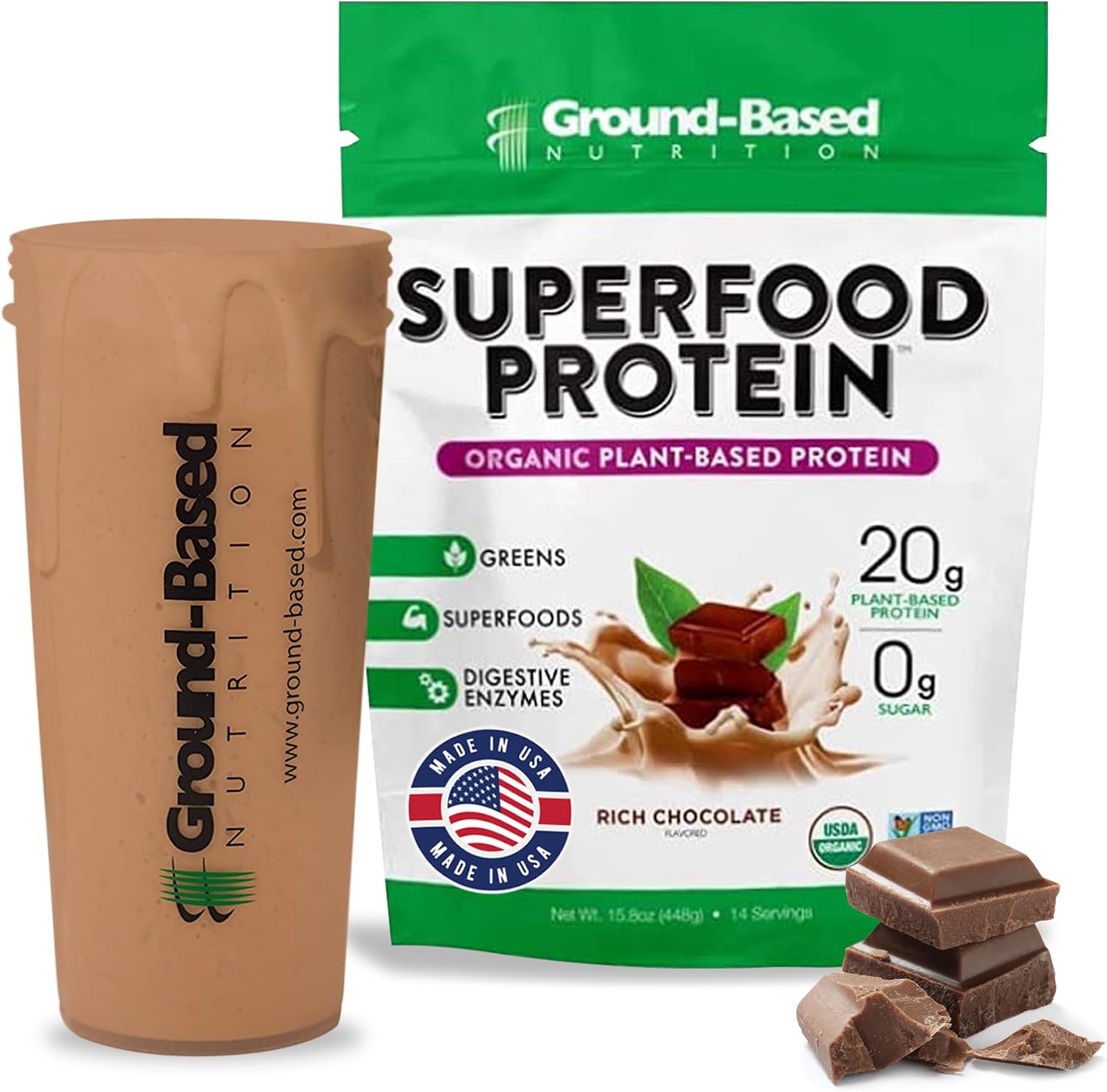
Weller once ran Ground-Based Nutrition selling plant-based protein. It is now discontinued and out of business.
Asked how his past ownership of Ground-Based Nutrition, a supplement brand selling plant-based protein powders, shapes his view of labeling and compliance, Weller said it doesn't: "Ground-Based Nutrition was a small family-owned business that has been out of business for some time. I had already been practicing dietary supplement and food law for many years before GBN existed."
PricePlow has been monitoring GBN-based supplements, and none of the stores we track have their products in stock. Its own website is closed (via Shopify password-protection). Weller confirmed that it is "100% out of business and has no current sales or operations."
Where The Litigation Goes Next
Ask industry contacts who have already been through these suits to guess where the fight is headed, and the answer isn't more of the same... it will continue to evolve.
And it's quite likely to evolve towards the growing clear protein niche.
One industry source involved in the situation predicted that the clear, beverage-style protein drinks are likely next to be legally scrutinized. The concern isn't quantity. It's what "protein" actually means when a product has been so extensively hydrolyzed that what's left behaves more like a collection of loose building blocks than intact bound protein... closer in spirit to collagen marketed as a complete protein than to the whey isolate on a typical label.
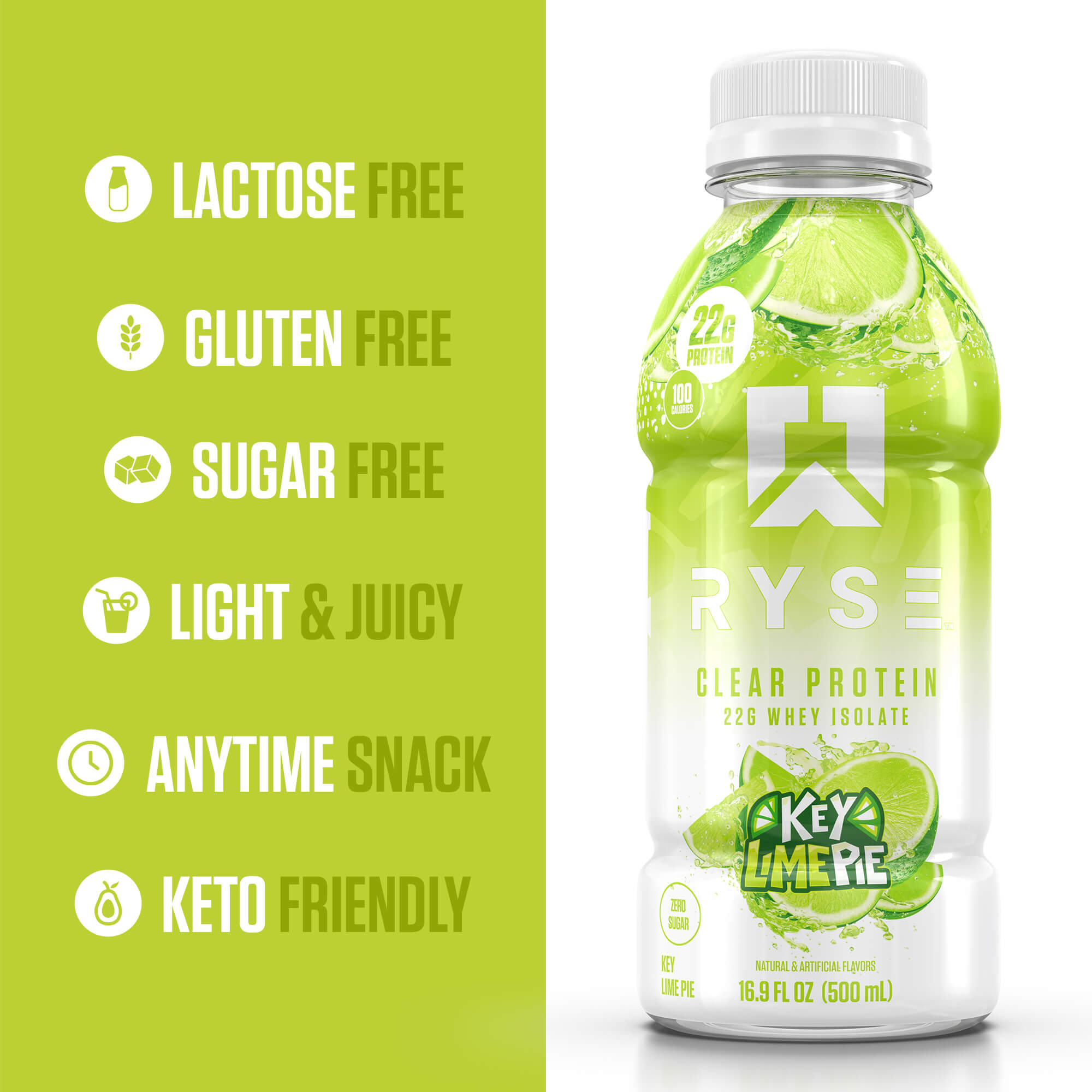
Will the next wave of lawsuits be over the composition of these Clear Protein RTDs? Two of the three ongoing lawsuits indicates they may be...
That's not a new argument, either. Clear protein drinks drew almost identical complaints in the mid-2000s. What's old is new again (only better-tasting now), as we know in this industry and its repetitive cycles.
This is probably more than a hunch, too. That path tracks the source-and-composition distinction Durnford left open in 2018. Meanwhile, Nacarino points to a different route: protein-quality disclosure through PDCAAS. A shortfall in grams is a hard case to win, since the FDCA generally preempts it. But a claim that the protein inside isn't "the kind of protein the label implies" is a different, more durable kind of argument, and it's the one this campaign has been building toward since the MusclePharm mess.
David Protein May Be a Sign of Things to Come
A useful but unrelated preview of that fight already played out this year, in a different macronutrient and a different court entirely. A group of consumers sued the maker of David Protein Bars in January 2026, alleging independent testing found the bars carried far more calories and fat than their labels claimed.
At the center of that dispute was esterified propoxylated glycerol, a synthetic fat substitute the bars use that passes through the body largely undigested, similar in principle to dietary fiber. David's public statements, reported at the time across multiple outlets, framed its labeling as following FDA rules for ingredients the body doesn't fully absorb, arguing that a straightforward lab burn test (the kind the plaintiffs relied on), overstates real-world calories for exactly that reason.
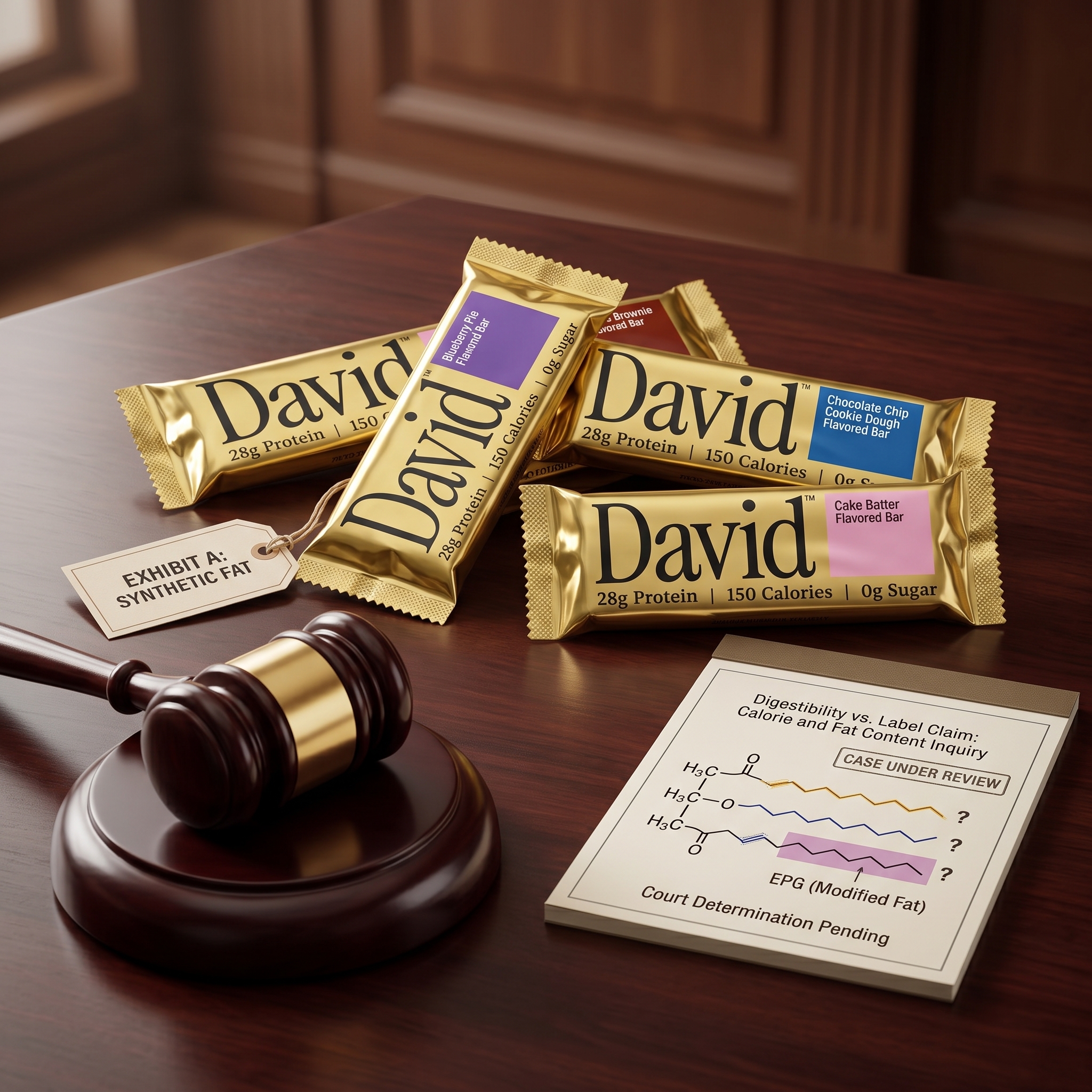
The David Protein Bar Lawsuit could be a sign of things to come. Is it about the bomb calorimeter, or how they body processes it? (AI Generated Image)
The case was voluntarily dismissed without prejudice in March 2026. Different lawyers, different macronutrient, different court, but the same underlying question the PDCAAS theory asks about protein: do you count a nutrient by raw mass, or by what the body can actually use?
Nobody has settled that question for fat any more than anyone has settled it for protein! But at least one court has now had the chance to look at it directly, which is more than can be said for any protein case in this piece.
Plaintiffs have commissioned finished-product total-protein testing, beginning at least with Bowmar. What no court has done is put both sides' testing head-to-head and actually decide who's right and whether a challenged protein label was actually false. On the PDCAAS side, Huel's declaration relied on raw-ingredient extrapolation rather than a finished-product PDCAAS test.
On one side, plaintiffs' counsel has commissioned testing before a plaintiff ever buys the product. On the other hand, a brand's strongest declaration to date measured raw ingredients, not what actually ends up in the bottle. For RAW, a third-party certification exists and is independently checkable, but whether it covers the exact product in question still needs an answer.
Two courts have dismissed two cases without ever reaching that question. The rest have either stayed pending, settled with a public notice (in one case), have been voluntarily dismissed for reasons the dockets do not disclose (potential/likely settlement), or ended through procedural or administrative routes.
What we're still missing is pretty simple: both sides' underlying lab reports, sample and lot information, the density method, defense testing, and a judge actually asked to decide who's right. We've literally never seen that play out.
So will anyone spend the time and money to take this thing all the way and get us an answer once and for all?
Back Where We Started: RYSE Supps
So why did only RYSE get thrown under the media bus this month? That's a question for others to answer. All we know is that they're merely the tip of the iceberg, and until now, that story's never been fully covered.
As for what happens next, we'll do our best to keep this article updated as RYSE's answer, Bucked Up's hearing, and whether or not Informed Protein testing works out for RAW Nutrition.
And of course, we look forward to that elusive RYSE Clear Chocolate Protein RTD.
The best way to stay in the loop on updates is to sign up for alerts on any of the brands with ongoing litigation:
Subscribe to PricePlow's Newsletter and Alerts on These Topics
RYSE, Bucked Up, RAW Nutrition, EHPLabs, PEScience, and Charles Weller were contacted for this story. Their responses, where given, are reflected above. Neither EMSL Analytical nor Amin Wasserman Gurnani had been reached as of publication but are welcome to comment anytime.
All parties involved are also welcome to represent themselveson the PricePlow Podcast.


Comments and Discussion (Powered by the PricePlow Forum)