Probiotics for endurance? TWK10® has nine published human studies behind it, and Savage Nutra is now bringing the strain to North America. In placebo-controlled trials, healthy adults lasted longer on hard treadmill tests after six weeks.
Probiotics have spent most of their supplement-aisle life in the digestive health section, but sports nutrition is starting to claim a few of them.
Your gut bacteria do more than break down dinner, after all. They make compounds your body can burn for energy, they interact with your immune system, and they may even affect how much protein you absorb.
Over the past decade, researchers have been testing whether a single, well-chosen strain can help people run longer, get stronger, and stay mobile as they age. Leave it to Joey Savage to find it -- and the data looks good.
Savage Nutra Adds TWK10®, a Clinically Studied Endurance Probiotic
One strain keeps showing up in this area of research: TWK10®, a strain of Lactiplantibacillus plantarum isolated from Taiwanese pickled cabbage. Since 2018, it's been tested in nine published human studies on endurance, strength, muscle, and healthy aging.
TWK10 belongs to Taiwan's Synbio Tech, which has now brought on Savage Nutra, the consulting and ingredient company founded by formulator Joey Savage, to distribute the strain in North America! It joins the nitric oxide-focused TENSIA® as Savage Nutra's second L. plantarum strain, and it brings a different kind of research to the table:
- Longer time to exhaustion: In placebo-controlled trials, healthy adults who took TWK10 for six weeks lasted longer on a hard treadmill test, and a higher dose beat a lower one.
- Live or heat-killed: A heat-killed (postbiotic) version also extended treadmill endurance in human trials, which opens the door to drinks, bars, and gummies.
- Strength and muscle: Trials linked TWK10 to stronger grip, more muscle thickness when paired with pea protein and lifting, and faster times on a walking-and-balance test in frail older adults.
- Patent protection: Synbio Tech holds US patents covering TWK10 for exercise performance and for walking capacity in older adults.
We've mentioned TWK10 on the blog before, but it's never had a full breakdown until now. Sign up for our TWK10 and Savage Nutra news alerts, and then let's do a deep dive:
Subscribe to PricePlow's Newsletter and Alerts on These Topics
What Is Lactiplantibacillus plantarum?
Lactiplantibacillus plantarum is one of the most common lactic acid bacteria in fermented foods. You'll find it in sauerkraut, kimchi, pickles, sourdough, and olives. It was called Lactobacillus plantarum until a 2020 reclassification broke up the old Lactobacillus genus, so you'll see both names in the TWK10 research, depending on when it was published.
Why the Strain Matters
The species name on its own doesn't tell you much, though. Probiotic effects depend on the specific strain, as the exercise research shows. When researchers in Hong Kong and Guangzhou pulled together 12 controlled exercise and recovery trials of L. plantarum in a 2026 systematic review, they found the effects were strain-specific: one strain worked mainly as a recovery aid, while TWK10 showed the most consistent evidence for aerobic endurance.[1]
So a label that only says "L. plantarum" or "probiotic blend" can't be tied to the trials below. What counts is the exact strain, its form, and a daily dose that matches the research.
The Gut-Muscle Axis
Why would a gut bacterium affect your muscles? Researchers point to the gut-muscle axis. Gut microbes ferment dietary fiber into short-chain fatty acids (SCFAs) such as acetate, propionate, and butyrate, which are energy sources for the body and help regulate metabolism, gut permeability, inflammatory responses, and immune function.[2]
Probiotics as a category have some muscle data behind them, too. A 2023 meta-analysis of randomized trials found that probiotic supplementation improved muscle mass (across 10 trials) and overall muscle strength (across six), although total lean mass didn't change (across 12).[3] Those pooled results mix several strains, including TWK10, which is why strain-specific trials carry more weight.
Meet TWK10®: From Pickled Cabbage to the Treadmill
TWK10 comes from pao-tsai, a traditional Taiwanese pickled cabbage.[4] Synbio Tech's scientists and Chi-Chang Huang's sports science group at National Taiwan Sport University have co-authored most of its research since.
It Started With Mice

The first exercise study arrived in 2016. Mice given the strain (called LP10 in that paper) for six weeks showed dose-dependent gains in grip strength and swimming endurance, plus lower lactate, ammonia, and creatine kinase after exercise.[5] At the higher dose, the number of type I (slow-twitch) fibers in the calf's gastrocnemius muscle rose 1.72-fold compared with control mice. Those are the fatigue-resistant fibers that handle endurance work.
Two US Patents
Synbio Tech holds two US patents on the strain, which is deposited as CGMCC 13008:
- Exercise performance: Granted in January 2019 and now co-owned with National Taiwan Sport University, US10188685B2 covers using the strain (named LP10 in the filing) at 10 billion CFU or more per day to improve exercise performance and reduce muscle fatigue.[6]
- Walking capacity: Granted in April 2025, US12274719B2 covers using TWK10 to improve walking capacity in older adults.[7]
Live Cultures vs. Heat-Killed Cells
TWK10 has been studied in two forms:
- Live TWK10 is a classic probiotic, dosed in colony-forming units (CFU), a count of cells that can still grow.
- Heat-killed TWK10 is a postbiotic. The culture is heated (70°C for 60 minutes in one trial) to inactivate the cells, and since nothing grows afterward, the dose is given as a cell count.[4]
Joey Savage, founder of Savage Nutra and President of Future Nutra Foundation, previews the first-ever Future Nutra Innovation Summit and introduces Tensia, a nitric oxide-producing probiotic, on Episode #233 of the PricePlow Podcast.
The heat-killed form gives formulators more room to work. Compared with live probiotics, postbiotics generally offer better stability, a longer shelf life, and a wider range of product applications, though they don't last forever, since oxidation and enzymes can still break them down.[8] Synbio Tech lists eight formats for TWK10: powders, sachets, capsules, tablets, ready-to-drink beverages, jellies, gummies, and energy bars.
TWK10® Clinical Evidence
Synbio Tech counts more than 400 participants across TWK10's human research, from young adults on a treadmill to frail older adults.
-
The Big Picture
The 2026 systematic review found that TWK10 had the most consistent evidence of any L. plantarum strain it examined. Four of the five TWK10 endurance trials found significantly longer time to exhaustion, 1.24- to 1.58-fold over placebo, and the heat-killed form kept that benefit.[1] Across all 12 trials it reviewed, the authors also noted thin reporting on allocation concealment and few trials registered in advance, two gaps future TWK10 trials can close.
Most TWK10 trials measure time to exhaustion (TTE). Participants run on a treadmill at a fixed, hard workload, usually 85% of their maximal oxygen uptake (VO2max), until they can't keep going. TTE tells you how long someone can hold a tough pace. It doesn't tell you whether they'd finish a race faster.
-
The First Human Trial (2018)
The first double-blind human trial randomized 16 adults to TWK10 or placebo for six weeks. The TWK10 group lasted significantly longer in an exhaustive treadmill test and had higher blood glucose during the test than the placebo group.[9] The published abstract doesn't state the dose, but the 2026 review lists it as 100 billion CFU per day.[1]
-
Higher Dose, Bigger Effect (2019)
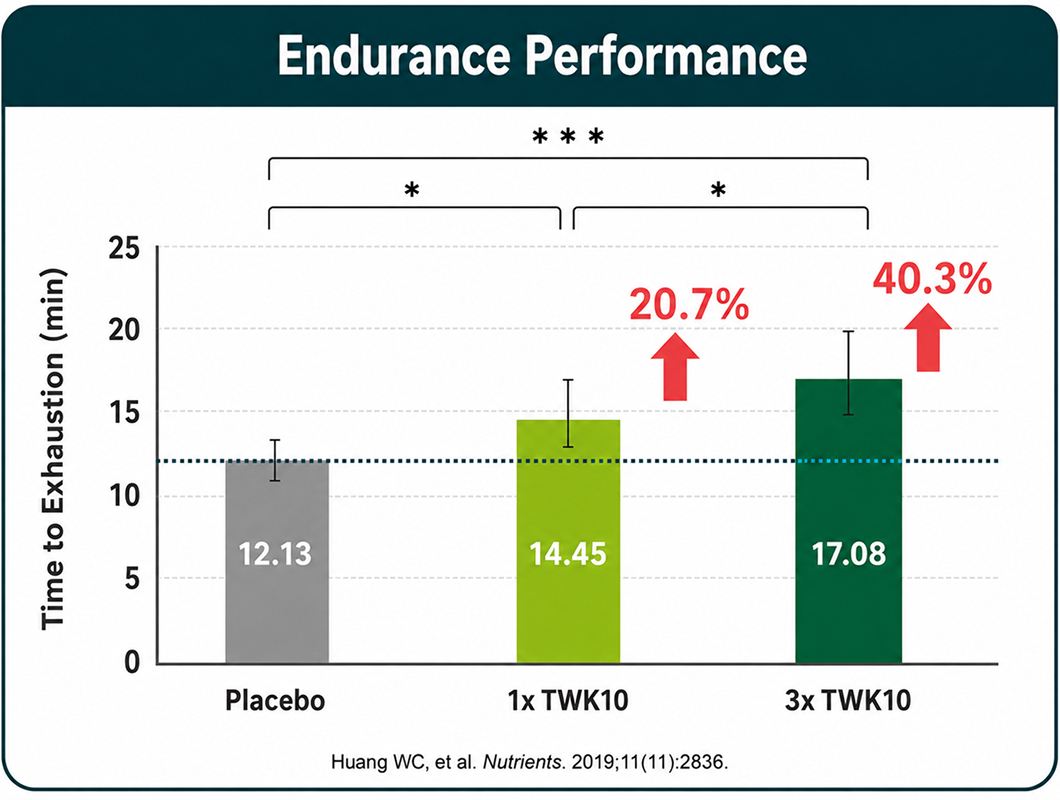
The follow-up trial was more than three times larger. Huang's team randomized 54 healthy adults aged 20 to 30 (27 men and 27 women) without professional athletic training to placebo, 30 billion CFU, or 90 billion CFU of TWK10 daily for six weeks.[10]
Both doses extended time to exhaustion compared with placebo (p = 0.0207 for the low dose and p < 0.001 for the high dose), and the high dose beat the low dose (p = 0.0336). During a separate 30-minute run at 60% of VO2max and 90 minutes of recovery, the TWK10 groups (especially the high dose) had lower ammonia and lactate, and the high-dose group kept blood glucose higher during exercise. Body fat also decreased and muscle mass increased significantly in the high-dose group over the six weeks.

Six weeks of TWK10 took healthy adults from 12.13 minutes on an exhaustive treadmill run to 14.45 at the lower dose and 17.08 at the higher one. A clean dose response in a probiotic trial.
A dose-response pattern like this strengthens the case that TWK10 itself drove the improvement, and we love seeing one in a probiotic trial.
-
Live vs. Heat-Killed, Head to Head (2022)
In 2022, researchers compared the two forms directly. They split 53 healthy adults into three groups for six weeks: placebo, 300 billion CFU of live TWK10, or 300 billion heat-killed TWK10 cells per day.[2]
Both forms extended time to exhaustion: 17.55 minutes with live TWK10 and 16.72 minutes with heat-killed TWK10, versus 12.23 minutes with placebo. Within each group, that's a 1.38-fold and 1.33-fold improvement over baseline, while the placebo group didn't change significantly. Both forms also reduced markers of exercise-induced inflammation compared with placebo, and the authors concluded that the two forms had similar effects on endurance.

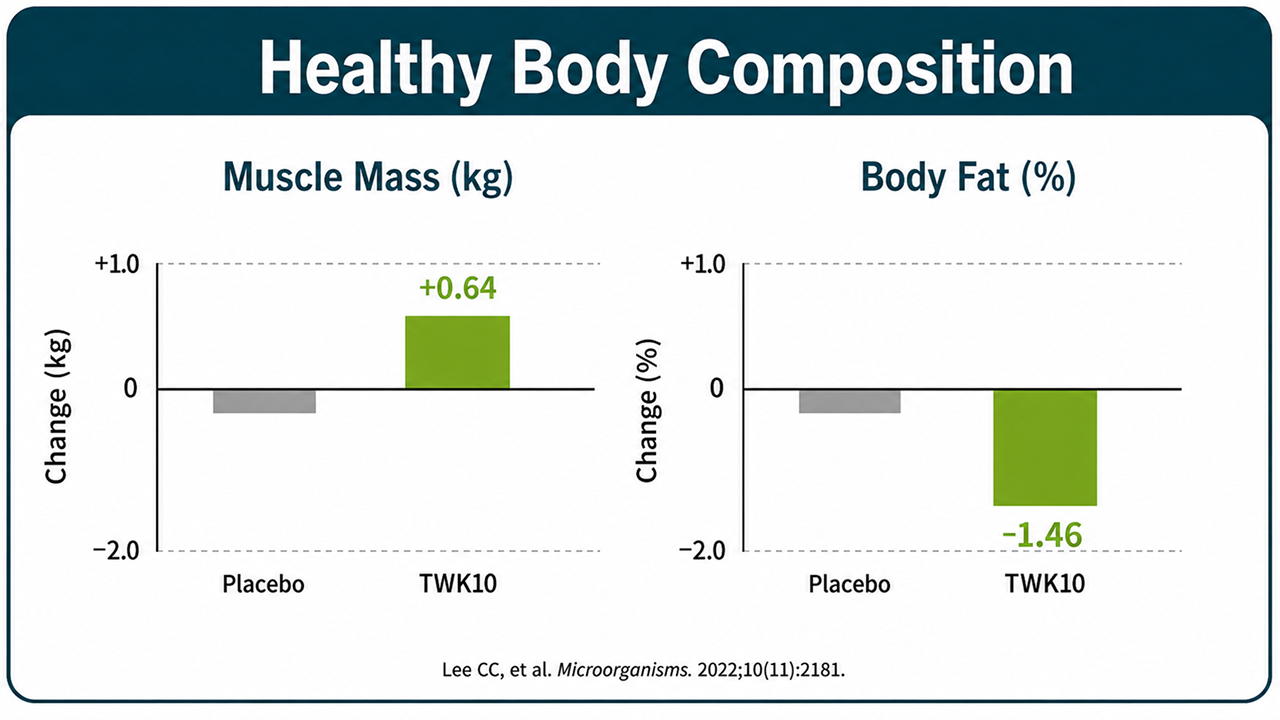
After six weeks, the TWK10 group added 0.64kg of muscle and shed 1.46 percentage points of body fat while placebo barely budged.
Body composition is where the live form pulled ahead. Measured by bioimpedance, the live TWK10 group gained 0.64kg of muscle weight and dropped 1.46 percentage points of body fat, versus a 0.15kg muscle loss and a 0.09-point fat drop with placebo. The heat-killed group's changes (0.14kg of muscle gained and 0.48 points of fat lost) didn't separate from placebo.
-
Lower Doses Still Worked (2023 and 2025)
Two later trials tested smaller daily amounts in healthy men aged 20 to 40 without professional athletic training.
In the 2023 trial, 30 men took placebo or 30 billion heat-killed TWK10 cells daily for six weeks. Time to exhaustion increased 1.24-fold compared with placebo (p = 0.0028), and grip strength rose 1.12-fold in the right hand and 1.09-fold in the left. Blood lactate and ammonia ran lower than placebo during exercise and recovery, and muscle weight increased within the TWK10 group, from 33.77kg to 34.13kg.[4]

Every pre-workout chases nitric oxide through citrulline or nitrates. TENSIA® takes a third route. It's a single probiotic strain that made NO from nitrate in lab testing, and it just landed in sports nutrition inside Alpha Lion SuperHuman Jacked.
A 2025 study tested live, mass-produced TWK10 in worms, mice, and people. In its human arm, 30 men took placebo or 10 billion CFU daily for six weeks. Time to exhaustion rose 1.24-fold over placebo, grip strength rose 1.12-fold (right hand) and 1.1-fold (left), and lactate and ammonia came in lower. In C. elegans worms, TWK10 extended lifespan by about 26%.[11]
Note that these two papers list the same ethics approval and identical baseline data for their 15 placebo participants, so they may share one control group.
-
TWK10 Plus Interval Training (2024)
The endurance boost doesn't necessarily come without training, though. Researchers assigned 47 middle-aged women with obesity to placebo, TWK10 (60 billion CFU daily), high-intensity interval training (HIIT) with placebo, or HIIT plus TWK10 for eight weeks.[12] Training improved time to exhaustion with or without TWK10, while TWK10 alone didn't, and the HIIT-plus-TWK10 group cut hip circumference more than the placebo group. The combination also avoided the waist-circumference increase seen with HIIT alone. The 2026 review suggested that body fat and sex may influence who responds to TWK10.[1]
-
Pairing TWK10 With Pea Protein (2024)
A 2024 trial asked whether TWK10 helps people get more out of plant protein. Thirty-two adults (16 men and 16 women) took 20g of pea protein daily for 28 days, either alone or with 10 billion CFU of TWK10, and everyone lifted weights three times a week.[13]
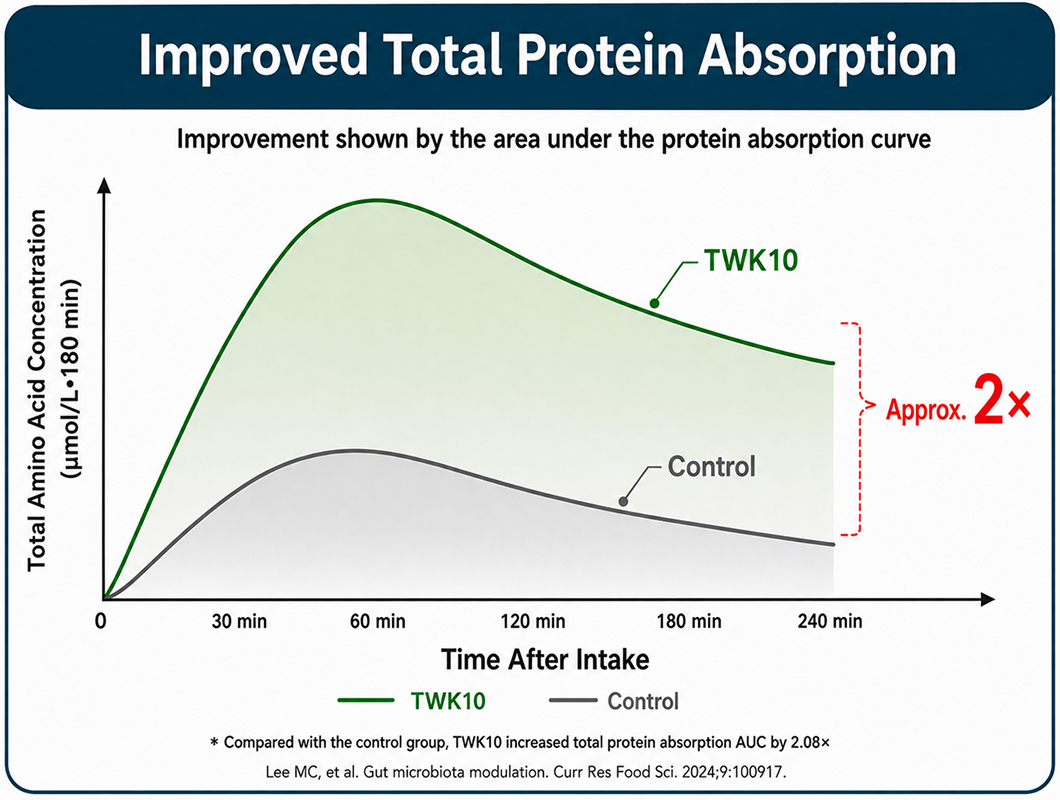
Adding TWK10 raised the peak and total blood levels of branched-chain, essential, and total amino acids after a pea protein dose.[13] The TWK10 group also gained more muscle thickness than the protein-only group at two of four ultrasound sites (right quadriceps and left biceps), and its 1-rep max bench press improved significantly more. Total lean mass measured by DXA didn't differ between the groups after four weeks.
Stacking TWK10 with 20g of pea protein roughly doubled total amino acid exposure across four hours. Same protein intake, more raw material.
It's the most direct evidence for pairing TWK10 with a protein product.
-
Older Adults: Walking, Balance, and Muscle (2021)
TWK10's longest trial ran 18 weeks in older adults with mild frailty. Fifty-five participants took placebo, 20 billion CFU, or 60 billion CFU of TWK10 daily, and 42 finished, leaving 12 to 17 people per group.[14] The main gait and balance test was the 3-meter timed up and go: stand up from a chair, walk 3 meters, turn around, and sit back down.
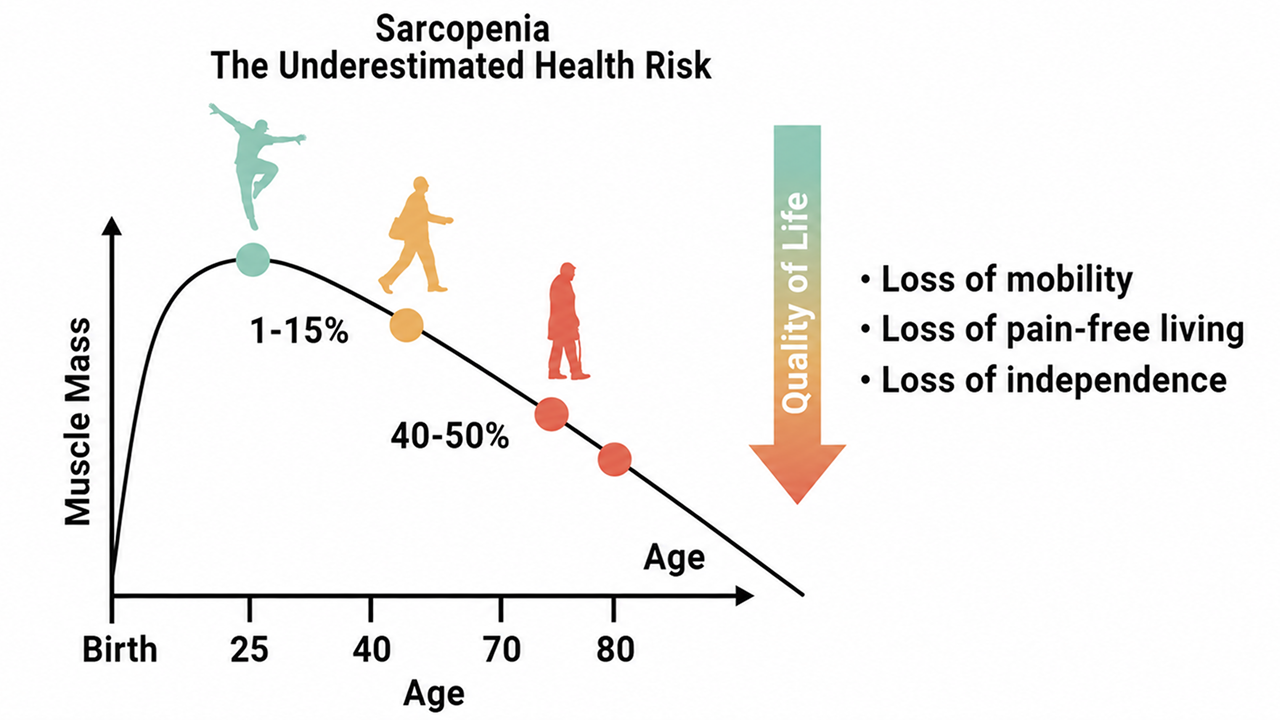
Muscle mass peaks around 25 and the slide gets steeper with every decade, taking mobility and independence with it. That's the window TWK10's 18 week trial targeted.
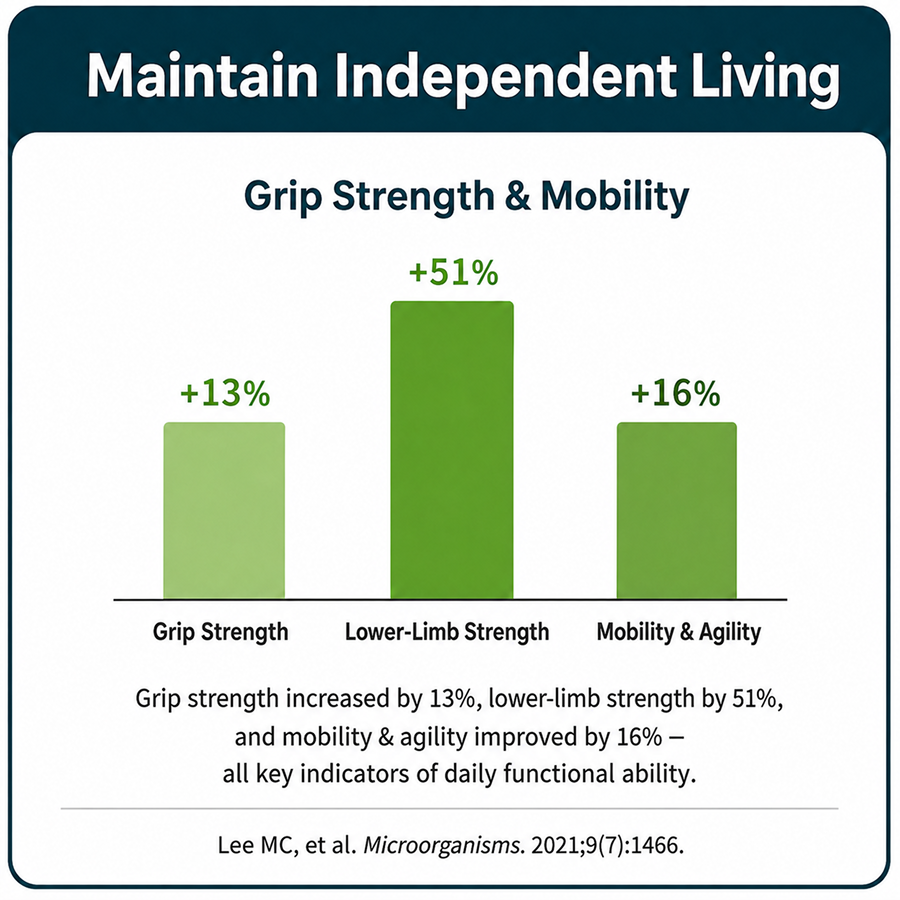
By week 18, the high-dose group finished the timed up and go in 8.0 seconds versus 11.7 seconds with placebo, 31.66% faster. The placebo group got slower over the study, from 9.4 seconds at baseline, while the high-dose group improved from 9.6 seconds.

The high dose group improved 13% on grip, 51% on the chair stand test, and 16% on timed up and go. Those three measure whether someone can still get out of a chair unassisted.
Lower-body strength moved in the same direction. In a 30-second chair stand test, both TWK10 groups improved from baseline (1.37-fold for the low dose and 1.51-fold for the high dose by week 18), while the placebo group didn't change significantly. Within the high-dose group, DXA-measured muscle mass rose from 37.1kg to 38.2kg and left-hand grip strength climbed 1.13-fold.
How TWK10® Works
Interestingly, researchers still haven't pinned down exactly how TWK10 supports endurance, but the trials point to a few connected pathways.
-
Lower Lactate and Ammonia
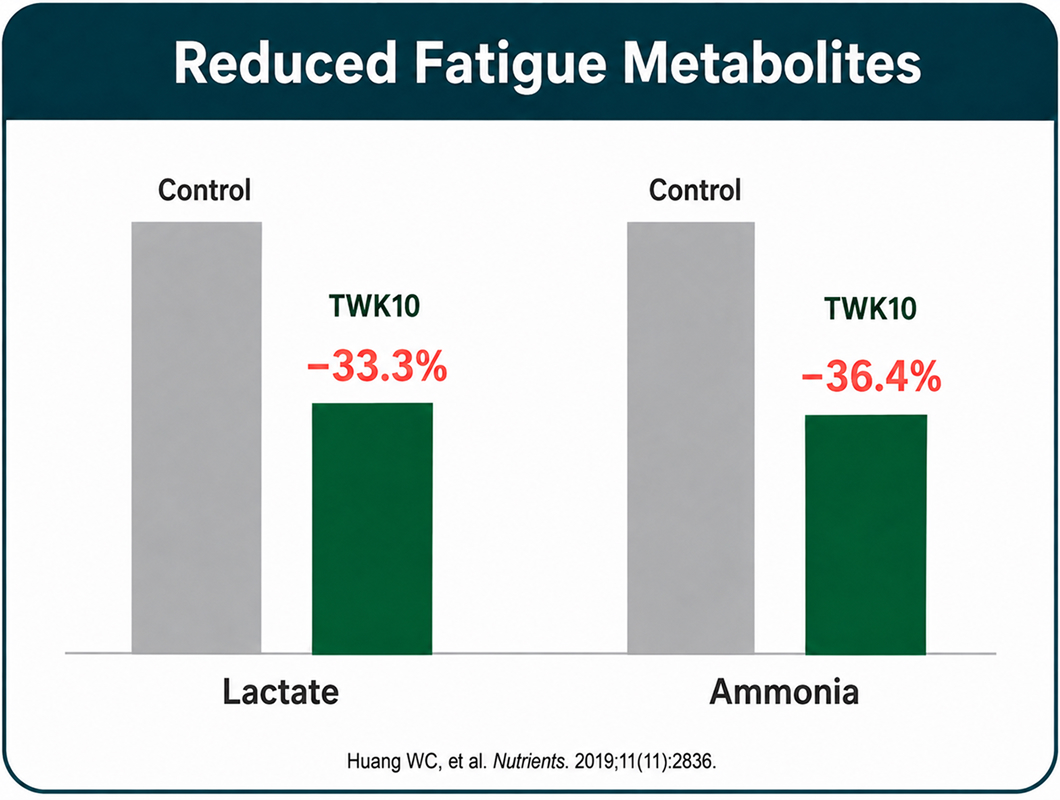
Blood lactate ran 33.3% lower and ammonia 36.4% lower than control in the same 2019 study, two markers that climb when you're running out of gas.
Hard exercise raises blood lactate and ammonia, two markers tied to fatigue. In several human trials, TWK10 groups had lower levels of both during standardized exercise or recovery.[4,10] Blood concentrations alone can't show whether TWK10 reduces how much the body makes or helps clear it faster, though.
-
Muscle Fibers and Glycogen
Animal studies add a few more clues. Beyond the slow-twitch fiber increase covered above, a 2021 study in young and aged mice found that TWK10 raised muscle glycogen (stored carbohydrate), preserved grip strength in older animals, slowed age-related declines in bone mass and in learning and memory, and increased the gut bacteria that produce SCFAs.[15] The 2025 study saw dose-dependent increases in muscle and liver glycogen in mice, although an earlier mouse study found lower resting liver glycogen and no change in muscle glycogen.[11,16] As a reminder, these are animal findings.
-
Feeding the Gut-Muscle Axis
The gut is the obvious place to look. In the 2022 human trial, both live and heat-killed TWK10 raised stool levels of acetate from baseline, and live TWK10 shifted the gut toward more Akkermansiaceae and Prevotellaceae bacteria.[2] Whether these gut changes drive the endurance gains hasn't been established. A 2026 systematic review of gut microbiota and exercise found that only seven of 18 studies directly examined links between microbial shifts and performance, and their findings were inconsistent.[17]
-
Better Amino Acid Absorption
The pea protein trial points to one more route: helping you absorb more amino acids from protein. TWK10 also increased the variety of bacterial families in those participants' guts, which the authors linked to better amino acid uptake.[13]
Safety and Tolerability
TWK10 even has its own dedicated safety study. Researchers sequenced the strain's whole genome and found no antimicrobial resistance genes, virulence factors, or genes for making biogenic amines. In lab tests, TWK10 didn't break down red blood cells and was susceptible to every antibiotic tested except kanamycin. It caused no mutations or chromosome damage in standard genetic toxicity tests, and rats given up to 2,000mg/kg of body weight daily for 28 days showed no subacute toxicity.[18]
The human trials have run from four to 18 weeks. Across the 12 L. plantarum trials in the 2026 systematic review, which used up to 300 billion CFU per day, no serious adverse events or significant intolerance were reported.[1] The heat-killed form adds one more layer of reassurance, since without live microbes, there's little chance of bacteria crossing the gut wall.[8]
As with any probiotic (or supplement for that matter), talk to your doctor before using TWK10 if you're pregnant, immunocompromised, or managing a medical condition.
TWK10® Dosing and Applications
Clinical doses: TWK10 trials have covered a wide range:
- Live TWK10: 10 billion to 300 billion CFU per day, usually for six weeks.[2,11]
- Heat-killed TWK10: 30 billion or 300 billion cells per day, for six to 12 weeks.[4,19]
- Older adults: 20 billion or 60 billion CFU per day for 18 weeks, with the clearest results at the higher dose.[14]
Endurance gains showed up at doses as low as 10 billion CFU of live TWK10 and 30 billion heat-killed cells, and in the one trial that compared doses, 90 billion CFU outperformed 30 billion. Nobody has pinned down a minimum effective dose yet.
Check the label for counts, not milligrams: To match a product to this research, you need the strain, its form (live or heat-killed), and a daily CFU or cell count. A milligram amount on its own doesn't tell you how many actual cells you're getting. A 2026 review of postbiotic research called for clearer reporting of exactly these details.[8]
Timing: No research has tested timing. Every trial used daily intake for at least four weeks, so think in weeks, not single doses.
Stacking: Pea protein is the only tested pairing, at 20g a day alongside resistance training.[13] We imagine any protein source is a solid pair, though, and would consider adding some butyrate too. TENSIA, also distributed by Savage Nutra in America, makes a logical performance stack too.
Who it fits: Most TWK10 trials enrolled healthy adults without professional athletic training, not competitive athletes. The pea protein trial adds plant-protein users, and the 18-week trial covers older adults with mild frailty. No published trial has tested TWK10 in trained athletes yet.
TWK10®: A Probiotic That Earned Its Spot in the Gym Bag

Joey Savage joins Team PricePlow for Episode 129 of the PricePlow Podcast to discuss the launch of Savage Nutra, his novel consulting company
TWK10 gives sports nutrition something it rarely gets from a probiotic: one patented strain with years of human exercise trials behind it. In several placebo-controlled trials, healthy adults who took it for six weeks lasted longer on hard treadmill tests, and the heat-killed form kept that endurance benefit. Older adults on the higher dose moved faster through a walking-and-balance test, and adding TWK10 to pea protein raised blood amino acid levels after a protein dose.
This is right up Joey Savage's alley. He's now bringing TWK10 to North American brands, giving the company two L. plantarum strains with different jobs: TENSIA on the nitric oxide side, and TWK10 for endurance and muscle. That's quite a lineup for a company Joey launched on Episode #129 of the PricePlow Podcast in 2024. Next, we're watching for the first North American products to put TWK10 on the label, plus trials testing it in trained athletes.
Sign up for our TWK10 and Savage Nutra news alerts, and we'll cover those products as they launch:


Comments and Discussion (Powered by the PricePlow Forum)